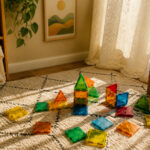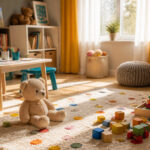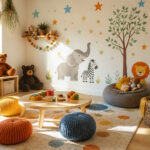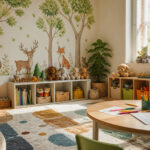
These ideas run from a $24 macrame net to a full closet conversion, and the one that fits your living room depends on whether you need mobility, visibility, or hidden storage.
A rolling toy box on casters follows the play across carpet or tile; a hanging net keeps plush collections off the floor in a corner you probably are not using anyway.
[link-whisper-related-posts]1. Baskets in Open Shelves

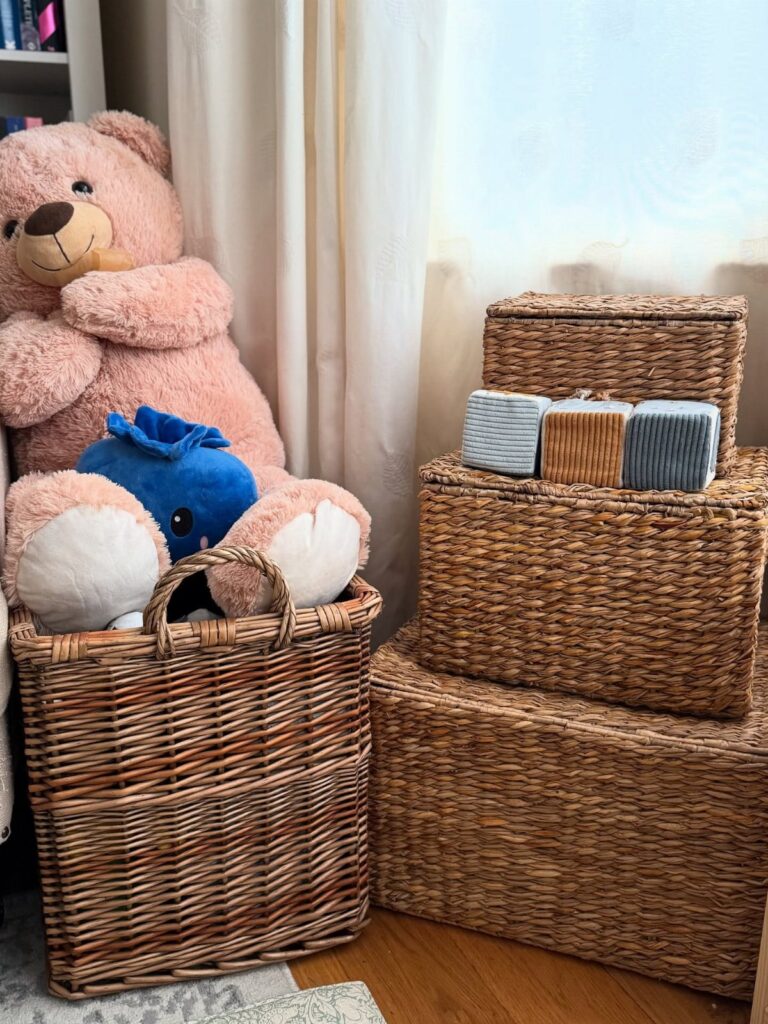
Open shelves stop looking like clutter the minute you drop a woven basket on them. We use rope and hyacinth bins in ours, and the toys inside read as texture instead of mess.
Get the basket size right and the shelf does the sorting for you. A basket too small spills over; too large wastes the shelf.
Measure your opening, then shop for something that leaves an inch of breathing room on each side. Walmart usually runs cheapest on hyacinth, though stock comes and goes.
This works best when your heaviest toys live at the bottom. Our LEGO stash sat in a basket under the side table, reachable to small hands but not screaming primary colors to every adult who walked in.
2. Rolling Toy Box

Wheels change everything. A toy box that rolls follows the play instead of anchoring it to one corner, and cleanup becomes pushing the bin back where it belongs.
Stackable plastic ones work for tight spaces; a single wooden crate on casters blends better if your living room runs more neutral. Paint it to match your media console and it disappears against the wall.
Chalkboard paint turns the lid into a label the kids can redraw themselves.
Check your floor before you buy. Thick carpet fights small wheels; hard floors or low pile need less clearance.
One of ours picked up a hairline crack after a year on tile because the plastic was too rigid for the weight we loaded in.
3. Hanging Storage Baskets

Wall-mounted baskets keep stuffed animals off the floor without demanding drawer space you probably do not have. Wicker or woven ones read as intentional decor; wire or mesh leans more utility room than living room.
Mount at kid height, not yours. Kids can fetch their own toys and put them back without asking for help.
A hook in the corner behind the door catches the overflow without becoming the room’s focal point.
These suit lightweight toys only. Board books warp the weave; wooden blocks split the hanging hardware.
We tried one with small cars and spent a month fishing them out from behind the radiator. Stuffed animals, dress-up accessories, and soft dolls are the fit here.
4. Convert Coat Closet

A coat closet two steps from the sofa is dead space until you add shelves. IKEA’s wall-mounted system runs cheap and turns that hanging rod into cubbies, drawers, and bins in an afternoon.
Patterned wallpaper on the back wall helps the open door read as intentional, not apologetic. Labeled drawer carts inside keep sets together: one for trains, one for dolls, one for the random plastic animals that multiply overnight.
This trades away guest coat storage, so check your front closet first. If winter jackets already live there, the conversion is free.
We pulled the wire shelf from ours and the living room floor has stayed visible since.
5. Craft Station Table

A craft table with built-in storage stops the art supply migration across your coffee table. The lift-top coffee table hides bins underneath; thrifted storage tables cost next to nothing if you refinish.
Size matters more than style. A surface about the size of a train table lets two kids work without elbow wars.
Underneath, cube baskets corral the bulky stuff; a center cabinet swallows board games flat.
Pegboard above catches the small disasters: scissors, glue sticks, the marker lids that otherwise walk away. We hung ours at seated eye level and stopped finding dried-out markers under the sofa cushions.
6. Use Clear Bins

Clear bins end the dump-and-hunt routine. When kids can see the cars or figurines through the side, they grab the right box the first time.
Stack three high and label the lip. Lids keep sets intact; we use them for anything with small pieces that must stay together, like K’nex or Qixels.
Open tops work better for the daily rotation of blocks and trains.
IKEA’s Smarra boxes at $20 hit a sweet spot between looking intentional and taking abuse. For heavier use, the cheaper hardware-store tubs crack at the corners after a year or two.
Check the plastic flex before you load them: if it does not give slightly under pressure, it will give suddenly under a toddler.
7. Hanging Toy Nets

A macrame net hung in a corner turns dead wall space into storage for stuffed animals and anything soft that weighs next to nothing.
We like this because it keeps the floor clear and the toys visible enough that kids actually remember they own them.
You can buy a ready-made net for about $24 or sew one from fabric with a basic kit and a few wall hooks. Either way, pick a corner where a kid can reach the bottom without climbing.
A white net against a light wall stays quiet visually, so the toys inside become the focus instead of the storage itself.
This works best for plush collections, not blocks or anything with hard corners that will distort the shape or tear the weave over time.
If your living room has no free corners, the back of a closet door takes the same hardware.
8. Labeling Storage Bins

Labels turn baskets into a system kids can actually use without asking where something goes every time.
We started with picture labels when ours were too young to read, then swapped to words once they could; either way, the bin itself does the reminding, not us.
A marker and masking tape work fine; we have also printed labels on regular paper and taped them on with clear packing tape.
Adhesive bookplates hold a printed picture or a strip of paper, and a Cricut with vinyl handles words if you already own one.
The real win is not perfect compliance. Our kids ignored labels some days and followed them others; the habit built slowly, and by elementary school they sorted without prompting.
Skip this if your children are not yet two, since too many steps frustrate more than they help.
Design for Easy Access
Open shelving at 23" to 35" keeps toys where small arms can reach them without help. We set ours at the low end for toddlers and raised it as they grew.
A lid is one more step between a kid and a clean floor. We use lidless bins and fabric baskets for anything in daily rotation.
The toys go in fast and they come out fast.
Wide, shallow drawers beat deep ones. A deep drawer turns into layers of forgotten stuff; shallow keeps the top layer visible and the sorting intact.
One category per container. Mixed bins train kids to dump everything out to find one piece.
We learned that with a "vehicles" bin that held cars, planes, and three random dinosaurs. Separated, they stay on the shelf.
Match Storage to Habits
Toys migrate. LEGO walks to the rug, books drift to the sofa, the kitchen set ends up under the dining chair.
Match the bin to where the toy actually lands. Storage that stays in one corner fights this; storage that follows play works with it.
Building toys belong on the floor that takes the most abuse, not on carpet you are trying to keep nice. A small rolling cart that follows the mess between rooms catches the overflow without building a whole second system.
Furniture with built-in storage swallows more than you would think. A coffee table with compartments or a sideboard with hidden shelves takes the hit so the rest of the room stays readable.
We put a lidded bench by the window and it became the landing spot for everything that traveled from the bedroom.
But that doesn’t mean your house has to look like FAO Schwarz, as there are a number of organized ways for toys and living rooms to coexist.
— Care.com
Decluttering Strategies
Start with storage, not the toys. Every toy needs a home the kid can actually reach; clutter piles up wherever the system quits.
We run a weekly edit: broken pieces, outgrown sets, anything untouched for a month. That plus a quick nightly sweep keeps the floor visible without losing a Saturday to it.
We did four times a year through preschool; now at elementary age, twice holds. Right before Christmas and when school lets out are our marks.
Interests shift fast and the untouched stuff piles up faster.
One rule: if it has not left the bin and it is not seasonal, it leaves the house.
Frequently Asked Questions
How to organize a living room with kids toys?
Start with storage that matches your space, then sort toys by where kids actually play. We use open shelves with woven baskets for quick cleanup and rolling bins that follow the play from corner to corner.
Keep the heaviest toys low and the daily rotation within reach, and the floor stays visible without a nightly battle.
What is the 20 toy rule for kids?
The 20 toy rule limits each child to twenty toys to cut clutter and deepen play. Fewer choices mean kids engage longer with what they have, and cleanup shrinks to minutes.
We have not used a hard number ourselves, but a weekly edit of broken, outgrown, and untouched pieces keeps our rotation lean without counting.