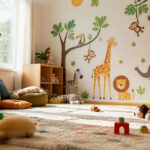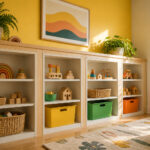
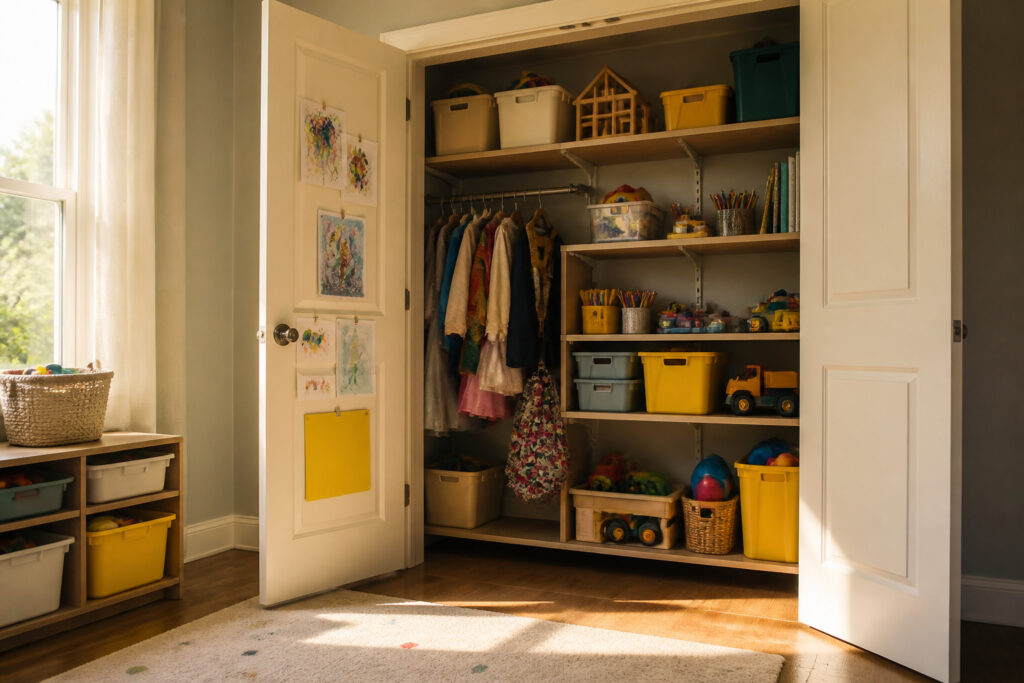
A closet organization playroom is a child’s closet converted into self-serve storage for toys, dress-up clothes, and art supplies.
It only works if the system can change as fast as the child does; fixed shelves built for toddler trucks will fail by first grade when notebooks and a keyboard need that same wall space.
The families we followed spent no extra money upfront on adjustable rods and movable shelves, and they avoided one full rebuild later because the lower bracket simply moved up as the kid grew.
[link-whisper-related-posts]Adjustable Storage Solutions
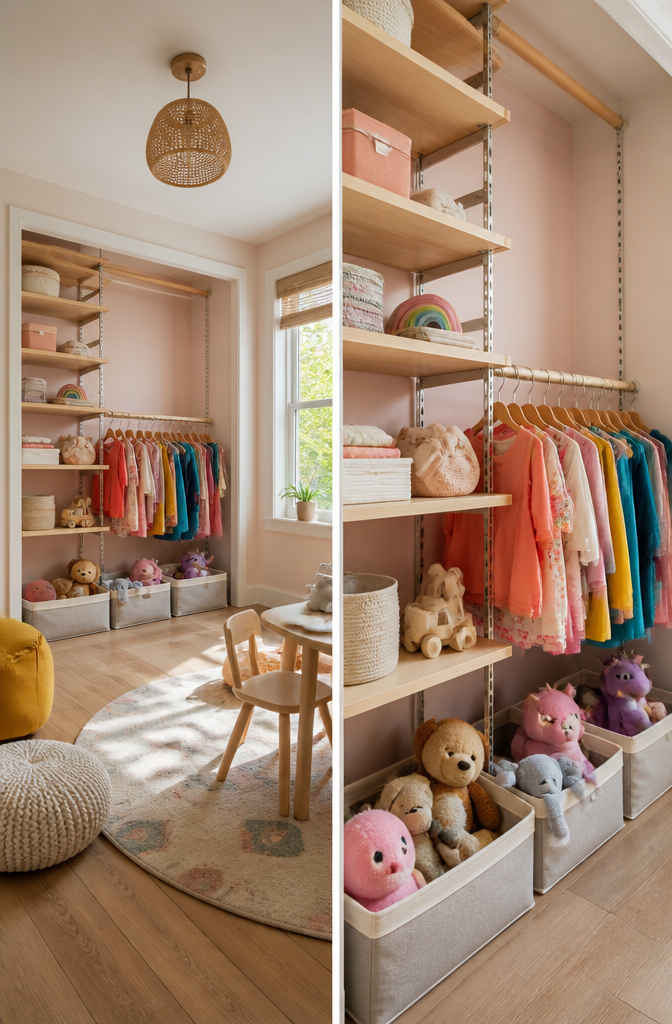
Adjustable-height closet rods and movable shelves are what let the same wall space shift from stuffed animals to board games to sports gear without tearing anything out.
We like systems that include a lower hanging rod sized for a young child’s height and a second, higher rod left empty at first.
The lower bracket moves up later, and that empty rod becomes the primary hanging space as the kid grows.
Open bins near the floor work for toddlers who sort by grabbing, while deeper drawers that once held bulky toddler items can later take clothing, electronics, or sports gear. The upfront planning matters more than the specific hardware.
A setup built for this kind of change costs no more than fixed shelving at installation, but it saves the full redesign you would face in five or six years when the fixed system no longer fits what the child actually owns.
Open Bins and Baskets

Young children sort by grabbing, not by folding, so open bins near the floor let them see what they own and actually put it back.
We learned this after watching our own kids walk past closed lids and leave toys in a pile.
Out of sight really does mean out of mind at this age; a stuffed animal in a lidded box might as well not exist.
Low, wide bins work better than tall ones or narrow cubbies, which kids skip in favor of the floor. The independence matters more than the neatness.
A three-year-old who can dump and refill a basket herself will do it; one who needs help with a latch or a stack will not.
As kids grow, these same open bins can swap for closed cabinets or drawers without changing the closet footprint. The layout stays useful even when the contents shift from blocks to board games.
Low, Wide Bins

Low, wide bins win the moment a child is crawling on carpet. They can see inside without standing, and the lip sits low enough that dropping a block in counts as putting it away.
Tall bins or narrow cubbies change that math.
A toddler has to balance on one foot to peer over the rim, or reach deep into a slot they cannot see into, so the toys end up on the floor and stay there.
The same bin works through more stages than you might expect. A crawling child uses it from the floor.
A kid at full height still finds it faster to sort through than a vertical stack, because everything spreads flat instead of burying itself.
Later, when the collection shifts to board games and art supplies, you can swap the open bin for a drawer or cabinet that fits the same footprint. The width and height stay useful even as the contents change.
DIY low shelves at the bottom of a closet work on the same principle. One parent we followed installed them in a playroom closet and found the kids could see, reach, and put away everything without help.
The setup looked messy in active use, but it functioned because independence mattered more than appearance.
Cube Storage Units

Cube storage units are the workhorse we keep coming back to when a closet playroom needs to flex.
The 11–13 inch cubbies fit most toy categories without swallowing the room, and the flat tops let you stack a second row or run a low bench along a wall.
We have used them in an L against two closet walls and as a straight room divider; both times the unit held because the weight sits straight down through the frame, not on flimsy pegs.
Open-backed cubes keep stuffed animals and dress-up gear within reach, while the same unit with a back panel stands against a closet wall without toys tumbling into the laundry. The real advantage shows up with irregular shapes.
A bin made for a shelf expects a rectangle. A cube swallows a toy guitar, a chunky ride-on, or a half-built LEGO set that you do not want to break apart just to put away.
Leave one or two cubes empty as overflow and the system stops fighting the way kids actually play.
Drawer Systems

Drawer systems earn their place once a child is old enough to read a label or remember a category, which for most kids lands somewhere around five or six.
Before that, closed drawers hide toys from a mind that searches by sight, and you end up with every bin dumped on the floor to find one red car.
We learned this with our own space: the year we switched from open bins to a three-drawer dresser in the closet, cleanup time tripled because our four-year-old could not hold the mental map of what lived behind each front.
For the small pieces that defeat open storage, drawers make sense at any age. Puzzle pieces, trading cards, figurines, and art supplies all spread across a surface the moment a bin tips.
A shallow drawer keeps them flat and findable. Match the depth to whatever goes inside.
Deep drawers swallow single-layer items; shallow ones stack vertically and waste less space.
The same dresser that held bulky toddler clothes in deep drawers later sorted art supplies and electronics once the kid grew, which is the shift the better closet systems are built for.
Closed storage also teaches a different rhythm of play. A young child needs to see the toy to want it.
An older child with a project in mind, a specific deck of cards or a half-finished drawing, already knows what to reach for. Drawers suit that intent.
They do not suit discovery. If your playroom still needs to spark play rather than manage collections, keep at least some storage open, even if that means mixing a low bin for figures with a drawer stack for the rest.
Rotating Toy Storage

Rotating toys works because most children play harder and longer when fewer choices are in front of them.
The idea is simple: keep about a third of the toys in a closet, out of sight, and swap them every few weeks.
The toys coming out feel new enough that kids will dig into them, and the ones going away get a break from being ignored.
The schedule does not need to be rigid. We have found that six to eight weeks is about right for our space, though you will notice when the room goes quiet.
That is the signal to rotate, not the calendar.
Closet storage for the off-rotation toys can be as basic as clear bins on a shelf or as simple as garbage bags in a corner if that is what you have. Keep the out-of-rotation toys completely outside the play space.
A bin left in the corner gets opened. A bin behind a closet door does not.
The real gain is not less clutter, though that happens. It is that the same building blocks or dress-up clothes get played with harder after a month away than they did when they were always available.
Kids notice details they skipped before. A toy they walked past daily becomes interesting again because they have not seen it.
Open vs. Closed Storage

Open storage invites kids to actually use it. Low, wide bins let a toddler put blocks back without help, which means the floor stays clearer than with tall cubbies they skip in favor of dropping things.
Closed drawers trade that ease for a cleaner look, and they make sense as collections shift toward games, art supplies, or electronics that don’t need constant grabbing.
The mess question is real. Open bins show clutter the moment it happens; closed systems hide it until someone opens the drawer on a stuffed, jumbled pile.
Cleaning frequency follows: open setups need a quick sort every few days, closed ones can go longer but take more time when you finally tackle them.
| Open Bins | Closed Drawers | |
|---|---|---|
| Best age range | Toddlers through early elementary | Late elementary and up |
| Independence | High: kids grab and return without help | Lower: need to open, remember contents |
| Cleaning frequency | Every 2–3 days | Weekly to monthly |
| Durability stress | Pulled, climbed, overloaded directly | Hinges and slides wear from slamming |
Durability splits the difference too. Open bins take direct abuse, but simple construction survives it.
Drawers depend on hardware; cheap slides fail faster under kid use than a basic plastic tub.
Laminate vs. Wood

Laminate and melamine finishes take the hits better than raw wood in a closet organization playroom. We’ve watched crayon scrub off the coated surface with a damp rag while the same mark on bare pine needed sanding.
The difference shows at the edges: once laminate chips at a corner, the particleboard underneath swells with any moisture. Raw wood dents instead of chipping, and you can sand it smooth again, but marker bleeds in and stays.
| Laminate/Melamine | Raw Wood | |
|---|---|---|
| Scuff resistance | Better — wipes clean | Dents, can be sanded |
| Spill resistance | Better — resists moisture | Absorbs, may stain |
| Marker/crayon | Lifts off with damp cloth | Sinks in, harder to remove |
| Edge durability | Chips expose core | Dents, remains sealed |
| Repair | Difficult; replace piece | Sandable, refinishable |
Rounded edges on either material help, and soft-close hardware keeps fingers clear. For a weekend install on a real budget, laminate wins if you expect the rough treatment kids actually deliver.
Adjustable vs. Fixed Systems
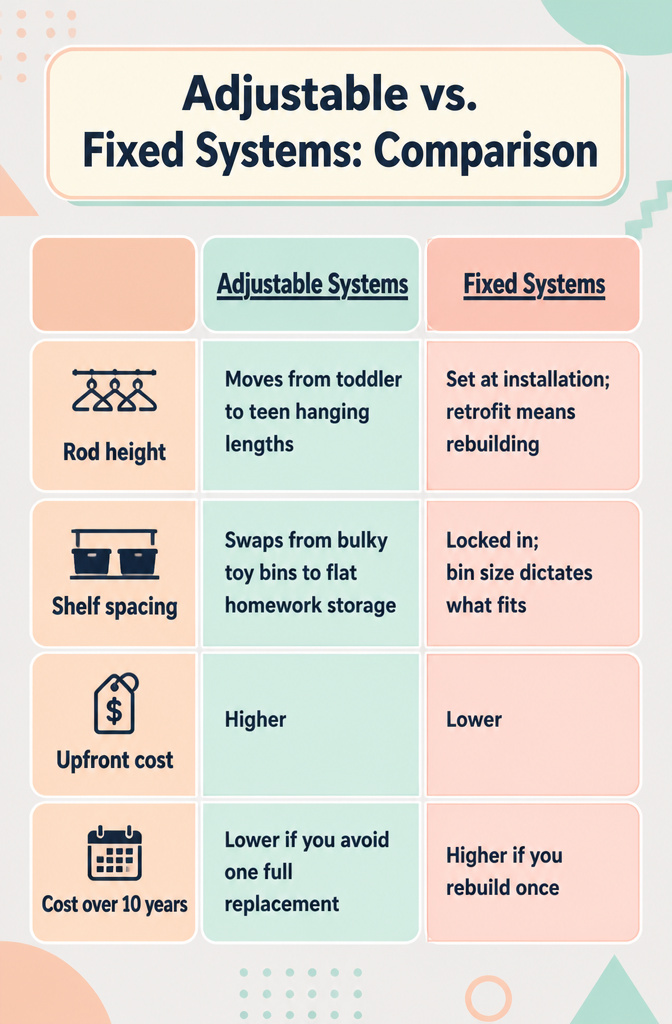
Adjustable closet systems earn their cost back if you plan to stay in the space through more than one childhood phase.
Fixed shelving makes sense only when you know the room’s purpose will not shift: a dedicated craft closet with a pegboard wall, or a narrow coat closet where rods at standard heights already fit every user.
Every other playroom storage scenario we have planned has needed change later.
| Adjustable Systems | Fixed Systems | |
|---|---|---|
| Rod height | Moves from toddler to teen hanging lengths | Set at installation; retrofit means rebuilding |
| Shelf spacing | Swaps from bulky toy bins to flat homework storage | Locked in; bin size dictates what fits |
| Upfront cost | Higher | Lower |
| Cost over 10 years | Lower if you avoid one full replacement | Higher if you rebuild once |
We learned this on a project where we installed fixed melamine shelves at 12-inch intervals for a three-year-old’s oversized trucks. By age six the bins had collapsed into the space where notebooks and a keyboard needed to live.
The wall-mounted track system we replaced it with used the same footprint but let us drop a shelf entirely and add a second rod.
The hardware cost more at the start, but one less Saturday demolition and one less trip to buy replacement material made up most of the gap.
Durable Materials for Kids’ Spaces

Laminate and melamine finishes survive the daily abuse that turns raw wood into a maintenance project. We’ve watched crayon marks wipe off melamine with a damp cloth while the same scribble on unfinished pine needed sanding and resealing.
Scuffs, juice spills, and marker lines come off these surfaces; they soak into raw grain before you notice them.
Rounded edges on laminate shelving also matter in a playroom, since sharp corners collect dings and splinters fast when bins get shoved in hard.
Soft-close hardware costs a few dollars more per hinge, but it eliminates pinched fingers and the slamming that loosens cabinet joints over time.
For a weekend install that still looks intact next year, skip the handsome oak you have to baby and pick the surface you can wipe down after a Saturday art session.
Shared Spaces and Sibling Zones

A single reach-in closet, maybe seven feet wide by two feet deep, can be split into two halves with separate rods, shelves, and bins rather than letting one side dominate.
We have seen this stop the morning arguments before they start. Each child gets a defined zone even before their needs fully diverge, which matters more than the square footage itself.
Color coding or labeling the bins and hangers lets younger children see the boundary without you enforcing it. One child gets the blue bins on the left, the other gets green on the right.
When the system is visual, you spend less time refereeing and more time stepping over the same LEGO brick everyone else does.
Sliding doors complicate this. If drawers or open shelves in the middle get blocked by the door track, plan the split so each half functions independently.
Bars on the sides with shelves above work; drawers in the center do not.
For families expecting the room to change again, say a nursery becoming a shared kids’ room, it helps to plan storage for that eventual layout from the start rather than redesigning it twice.
Rotating Toys to Keep Play Engaging

We keep roughly a third of the toys out at any one time, which for most families works out to one medium bin per category: cars, blocks, pretend play, art.
The rest live in the closet on the top shelf or in under-bed boxes if the closet is shallow.
Parents on forums mention swapping weekly or monthly, and we land somewhere in the middle: every two to three weeks, or whenever cleanup starts taking noticeably longer.
When a child asks for something in the closet, we treat it as a trade, not a denial. They pick one toy from the floor to go into storage, and the requested one comes out.
This keeps the total volume flat and avoids the buildup that makes a playroom feel cluttered.
The one-at-a-time rule some caregivers use, where kids clean up the current set before opening another, works well for maintenance but falls apart if adults do not follow through.
In one account from a childcare forum, the playroom stayed organized only when the whole household stuck to the system; otherwise the space reverted to chaos within a day.
Two to three weeks is the rotation window that actually sticks, long enough for deep play, short enough that novelty returns before boredom sets.
Frequently Asked Questions
What are some good storage solutions for a playroom?
Adjustable-height closet rods, movable shelves, open bins near the floor, and cube storage units all work well.
The best systems let the same wall space shift from stuffed animals to board games to sports gear as the child grows, without requiring a full redesign.
How can I maximize space in a small playroom?
Use vertical storage and rotate toys to keep the area functional.
Keep about a third of toys out at any time and store the rest in the closet or under-bed boxes; swap them every two to three weeks so the room stays fresh without becoming crowded.
What materials are best for kids’ storage?
Laminate and melamine finishes hold up better than raw wood against crayon marks, juice spills, and daily scuffs. They wipe clean with a damp cloth, while marker and moisture tend to sink into unfinished grain.
What is the best way to organize a playroom?
Match storage to the child’s age: open bins near the floor for toddlers who sort by sight and grabbing, then shift toward closed drawers and labeled systems as kids reach five or six and can remember what lives behind each front.
Plan for change from the start so the same footprint works through multiple phases.
How to turn a closet into a play area?
Start with adjustable rods and shelves set low enough for the child’s current height, then plan for them to move up later.
Use the floor space for low, wide bins or cube units the child can reach independently, and keep some cubes empty as overflow for half-built projects.