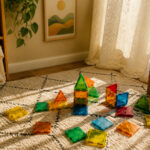
The best playroom toy for a three-year-old is a set of magnetic tiles, because the magnets do the alignment work that fingers this age cannot manage alone.
Buy Picasso Tiles if you want a 30-to-60 piece set that survives daily use without overcommitting, or skip them entirely if your child still mouths everything and you have not inspected tiles weekly for cracked corners.
[link-whisper-related-posts]1. Magnetic Tiles for Building What They Picture

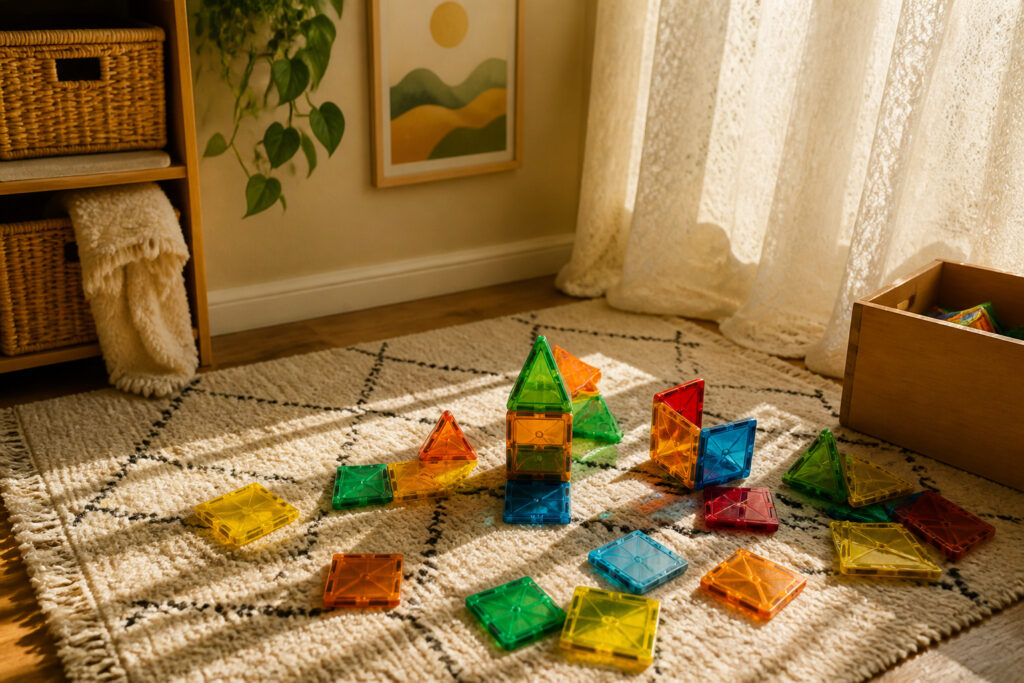
Magnetic tiles start at age three because the pieces are large enough for a preschool grip and the magnets do the alignment work fingers cannot.
A child this age will snap together flat squares to make a house for a doll or a garage for a truck they already own, not the castles and rocket ships an older child builds.
The tower will stand five or six tiles high, then lean and collapse because the magnetic bond is not strong enough to hold against a bump from the side.
We have seen that moment of frustration more than once, and it is useful: the child learns to build a wider base, which is engineering at three.
Picasso Tiles hold up well enough for daily use and the price point lets you buy the 30 to 60 piece set a preschooler actually needs without overcommitting.
Magna-Tiles cost more and the edge rivets are sturdier, though both brands need regular inspection to make sure magnets stay sealed inside the plastic. Check tiles weekly; a cracked corner is a reason to retire that piece.
For this age, skip the 100+ piece sets. Sixty pieces is enough to fill a afternoon and not so many that cleanup becomes a battle you lose.
2. Play Silks That Become Whatever They Need

A three-year-old with a play silk in hand will spend twenty minutes turning it into a cape, a river for rubber ducks, a blanket for a doll, then a hiding spot they vanish into entirely.
That fluid switching is exactly where their brains are at this age: they do not commit to one scenario yet, and a silk lets them abandon and invent without the frustration of parts that only fit one way.
We keep a basket of six to eight in the corner of our playroom. They do not fold; they wad, and that is exactly why they work.
A creased silk is still a cape. For fabric, the heavier habotai weight holds up to being stepped on and tied in knots without tearing the way the sheer ones do.
Machine wash gentle, hang dry, and they last.
What they do not do: build stable structures, teach fine motor precision, or survive as a solo toy for a child who still mouths everything.
If your three-year-old is in a stage where everything goes to the lips, or if they need visible results to stay engaged, skip these for now and come back in six months.
3. Unit Blocks That Outlast the Phase

Not every wooden block set is actually a unit block set, and the difference matters once a three-year-old starts stacking.
Unit blocks follow a proportional system: one standard unit measures a half-inch by one inch by two inches, and every other piece in the set is a fraction or multiple of that ratio.
A square block is half the length, a double block is twice the length, and so on.
That mathematical relationship is what lets a child build a wall at three that actually stands, then later build a bridge that spans and holds weight.
A useful starter set runs 50 to 80 pieces for basic shapes, which is enough for towers and simple enclosures at age three.
By five, the same child will be building taller structures and needing more pieces; 80 to 120 covers intermediate play with arches and ramps. The blocks that last are the ones that were dense hardwood to begin with.
Soft pine dents and splinters within a year of real use. Maple or birch holds up to being thrown, stepped on, and built into increasingly complex cities through age six and beyond.
Storage is simpler than the toy industry wants you to believe. Open shelving or a basic bin keeps blocks visible and within reach, which is what gets them used.
A 50-piece set fits in a single under-bed box. A grown collection of 120-plus still only needs a shelf or two, and nothing needs to be "organized" beyond dumping them back in.
4. Play Kitchen for the Pretend Years

A three-year-old at a play kitchen does the same three tasks on repeat: fill a pot, stir nothing, and hand you a plastic spoon.
We watched a Melissa & Doug set occupy our showroom floor for months, and the kids never touched the ice-cube dispenser or the phone.
They wanted the knobs that clicked and the oven they could shove pans into while copying whatever their parent had cooked that morning.
These units eat more space than a toddler armchair, so measure your wall before you order. Assembly runs two to three hours, and the screws strip easy if you rush.
The bells and whistles that sell the box are usually the parts that break first: electronic burners, running water, anything that needs batteries. The basic wooden frame with a few doors and a sink gets more hours of use.
Skip the category entirely if you rent a small apartment or if your budget is tight enough that one big toy crowds out everything else.
A mixing bowl and a wooden spoon from your own kitchen gives most of the same pretend play for almost no money and zero assembly.
5. Dolls and Figurines They Talk Through

Three-year-olds do not play house the way two-year-olds do. At two, ours mostly tucked dolls under blankets and abandoned them.
By three, they are narrating. The doll becomes a passenger in the dump truck, a customer at the play kitchen, or a bear who forgot his lunch.
The toy is a mouthpiece, not a baby.
This shift changes what survives. The soft-bodied dolls that worked at two get chewed on, dragged through kinetic sand, and left in the bath.
We have found plastic animal figurines and simple people figures hold up better. They are stepped on, wedged under couch cushions, and still come back for the next scene.
A collection of 20 to 30 mixed figures gives them enough cast members without overwhelming the bin.
We keep ours in a low open bin, nothing lidded, because a lid means the figures stay on the floor. Rotating the set every few weeks keeps the stories from going stale.
The difference between a doll and a figurine in actual play is simple: dolls get named and assigned feelings, figurines get assigned jobs. Three-year-olds need both, but they will lose the shoes, the bottles, and the tiny plastic forks.
Buy the figures that do not come with accessories.
6. Puzzles at the Right Frustration Level

A three-year-old with a 100-piece puzzle in front of them is a three-year-old who will wander off in under five minutes. We have watched it happen.
The piece count that actually holds their attention at this age stops around 12 to 24 pieces, and even that upper number works only when the picture is something they already recognize, a fire truck or a cat they can name out loud.
Start with peg puzzles, the kind where a knob gives their still-clumsy fingers something to grip. Wood holds up better than cardboard when they force a piece backward or stand on the board to reach something across the room.
Melissa & Doug makes the ones we see passed down from one kid to the next, and that matters because these puzzles do not stay in rotation long.
The move to simple jigsaws, maybe eight pieces with a frame that shows the outline, comes after they stop treating every piece like a hammer.
When they outgrow one, it goes to a younger sibling or to the closet shelf where you will find it two years later and wonder why you kept it. That is the lifespan.
A puzzle is a closed-ended toy with a single correct outcome, not an open-ended one they return to differently each time.
It still earns its place because finishing one teaches something useful about sticking with a task until the last piece clicks. Just do not expect that lesson to last past the next growth spurt.
7. Art Supplies That Wash Out

Washable markers and crayons are the supplies a three-year-old can actually use alone. We keep them in a lidded bin on a low shelf so the child can reach them and, just as importantly, put them back.
The washable claim holds up on skin and most clothing if you catch it the same day, but it does not survive a week in the hamper or a hot dryer.
Test it on your couch fabric before you find out the hard way.
What gets made at this age is scribbles, not scenes. The value is in the motion, not the result.
Skip watercolor sets entirely: the brushes need too much control, the water tips, and the paper turns to pulp before anything recognizable appears.
Glue sticks work better than liquid glue for the same reason; liquid glue is for supervised time at the kitchen table, not the playroom corner.
An easel sounds nice, but a flat table keeps the mess in one plane and the paper from sliding. Rotate the paper stock every few weeks, not the supplies themselves.
The bin stays the same; what changes is whether the paper is blank, lined, or a leftover mail envelope they can cover end to end.
8. Play Couch for Climbing and Crashing

Three-year-olds need to push against something with their whole body, and a play couch meets that need without the hard edges of furniture.
We have watched them turn the same foam pieces into a fort wall one morning, a tunnel to crawl through after lunch, and a nap spot by mid-afternoon.
The covers need to be machine-washable, because they will collect crumbs and footprints faster than you expect.
Keep the couch away from hard furniture edges and walls when it is set up for climbing or jumping, since the foam gives but the wall does not.
The pieces stack flat when you need floor space back, though they still take up the footprint of a full couch.
Most hold enough weight that an older sibling can climb on too, which changes the game from solo crashing to joint construction.
Skip this if your playroom is already tight on open floor, or if you have a full-size couch in the same space that the kids are allowed to climb.
Two soft landing zones in one room is one more than most layouts can absorb.
9. Kinetic Sand for Hands That Need to Fidget

Kinetic sand feels nothing like the sandbox stuff. It is 98 percent regular sand bound with 2 percent polydimethylsiloxane, the same silicone oil used in Silly Putty.
That binding is what lets a three-year-old squeeze a lump into a rope and slice it clean with a plastic knife without water, without grit under the nails, and without a trail of loose grains across the floor.
We have tested the "mess-free" claim in our own carpeted playroom. It is not mess-free; it is contained-mess.
The sand sticks to itself with enough force that dropped bits roll into a ball you can press back together, but a dropped handful on a rug still needs picking out fiber by fiber.
What they actually build at three is mounds, not castles.
The texture holds a shape well enough for a wall but not the overhang of a turret, and a three-year-old’s grip strength is not up to packing a mold tight enough to release cleanly.
Our kids press cars through it, bury small dinosaurs, and write letters with a finger.
The play runs about twenty to thirty minutes in a single stretch, longer if you add tools, shorter if you walk away and leave them without a prompt.
We keep ours in a 28-quart under-bed tote with a lid that latches. The sand stays inside if the kid stays inside.
When someone wanders off trailing a fistful, we have a no-shoes rule for the playroom and a handheld vacuum parked nearby.
For carpet, press a blob of fresh kinetic sand onto the stuck grains and lift; the binding pulls the stray grains into the new lump better than scraping or rubbing.
On hard floors, a damp paper towel picks it up in one pass.
The sensory difference matters at this age. Regular sand is loose, unpredictable, hard to control.
Kinetic sand gives predictable resistance, which is why a child who needs to fidget will reach for it repeatedly. It is calming in the way kneading dough calms, but without the yeast and the waiting.
10. Climbing Structures for Indoor Energy

A Pikler triangle folds flat enough to slide behind a door, which matters more than the footprint it takes open.
Most three-year-olds top out the intended weight range by five, so the resale window is narrow but real: list it in January, when parents are resolving to get their kids moving indoors.
We have seen them move in parent groups within a week at about half the purchase price.
Ceiling height is the dealbreaker. A child standing on the top rung of a standard triangle clears six feet, and enthusiastic climbers launch upward.
Skip it if your light fixture hangs low or your ceilings sit under eight feet. Carpet or a rug underneath helps, but a concrete slab basement floor with no padding turns a normal tumble into an urgent care visit.
Wall-mounted climbing holds need studs you can locate and permission you probably do not have as a renter; the triangle needs neither, which is why we point renters toward it first.
Open-Ended Toys Versus One-Job Toys

Open-ended toys give a three-year-old room to decide what happens next. A unit block can be a bridge today, a city at six, and something more complex years later because the child supplies the story, not the manufacturer.
One-job toys do the reverse: they perform one trick, usually with a button, and the child watches. Both have a place, but the ratio matters more than people expect.
Of the ten picks in this list, the unit blocks, magnetic tiles, play silks, and play couch sit firmly on the open side. They adapt to whatever stage the child is in and tend to stay in rotation.
The single-purpose items, like a puzzle with one correct outcome or a toy built around a recorded phrase, narrow the possibilities but can build a specific skill or give a parent a needed ten minutes.
Where we have seen playrooms go flat is when one-job toys crowd out the open ones. The child pushes through every preset interaction in a few sessions, then the floor stays clean because nothing pulls them back in.
A mix weighted toward open-ended pieces keeps the room alive longer without constant restocking.
We aim for enough blocks and tiles visible on open shelving that the child reaches for them first, with a few closed toys for the moments when directed play is actually what everyone needs.
Rotating Toys Without the Pinterest Setup

Owners on Reddit mention cutting their toy collection down to about ten items out at a time on open shelving, which sounds drastic until you see how differently a three-year-old plays when they can actually see their options.
We keep the rest in opaque bins on a closet shelf, no labels, no color-coding. The system only works because it takes under two minutes to swap a bin.
Keep the favorite out. That is the mistake we made early, rotating a beloved truck set off the shelf because it had been there three weeks.
The child notices. We learned to treat the constant, the same cars and trucks one parent joked they would sleep-smother to keep, as fixtures and rotate around them.
How often depends on what you observe. When play goes flat and the blocks become stepstools instead of castles, that is the signal.
For most families that lands between ten days and three weeks. What they do not notice is the bin itself, or whether the replacement toys arrived Tuesday or Saturday.
They notice that something new is available, not the logistics behind it. We suggest keeping a single bin per shelf rotation and a loose calendar reminder you will ignore until the play tells you it is time.
Safety at Three: Choking Hazards and What Slips Through

Three is the age where the age label on the box is not the same as safe to use.
Most of us have handed a younger sibling’s toy to a three-year-old because it fit in their hands, only to realize the pieces were smaller than we thought.
A three-year-old can pass the physical choke test, chewing and moving food well, but they still explore with their mouths when a toy frustrates them.
We look for the small parts warning even on toys marked 3+, especially puzzles with thin pieces or building sets where connectors snap off.
The ASTM and CPSIA certifications tell us the manufacturer did the testing, not that the toy matches your particular child.
Off-gassing is harder to spot. New plastic toys, play couches, and fabric items release VOCs for weeks.
We open packaging early and let pieces air out in a garage or porch when we can, particularly in winter when a closed house traps everything inside.
Wooden toys with non-toxic finishes are our fallback when a child has respiratory sensitivities.
Hand-me-downs need a harder look than new purchases.
We check magnetic tiles monthly for loose magnets that have pulled free from their plastic housings, inspect painted wood for chips that could flake off, and wash fabric toys on a regular schedule even if they look clean.
Our rule: any crack, peeling finish, or broken part goes straight to the trash, not the repair pile.
What Three-Year-Olds Develop Through Play

At three, fine motor skills look like a child figuring out how to turn a small dial or thread a bead without flipping the whole toy in frustration.
An activity cube with a bead maze, spinning gears, and a tracking maze gives them repeated chances to practice that thumb and forefinger pinch.
The gears will jam, and they will learn to back up and try a different angle, which is problem-solving at this age, not a design flaw.
Magnetic tiles add spatial reasoning. A three-year-old snaps two squares together, sees the connection hold, and starts predicting what angle a third needs.
The magnets do the holding, so the child can focus on geometry instead of fighting gravity. Start with 30 to 60 large pieces; smaller sets run out too fast and end the game before the idea forms.
Wooden blocks and animal figurines work social skills through pretend play. A child lines up blocks for a road, sets a wooden animal beside it, and narrates aloud.
That monologue is practice for later cooperation, even when no one else is in the room. Kitchen sets extend it to role-play scenarios with siblings or parents.
Puzzles work best when they take three to five minutes of struggle, not instant success or abandonment. The piece that almost fits teaches more than the piece that drops right in.
Sensory play at this age means kinetic sand or textured surfaces that keep hands busy while the mind works elsewhere; a child sorting play food by smooth versus bumpy is doing both sensory and early math work at once.
Frequently Asked Questions
What are the best playroom toys for 3 year old?
The best playroom toys for 3-year-olds are magnetic tiles, play silks, unit blocks, a play kitchen, dolls and figurines, puzzles with 12 to 24 pieces, washable art supplies, a play couch, kinetic sand, and a climbing structure like a Pikler triangle.
These toys match where a three-year-old is developmentally: they need open-ended materials they can adapt, enough structure to build real skills, and outlets for full-body energy.
How do I choose toys for my toddler?
Pick toys that fit your child’s current grip strength and attention span, not the age label alone.
Ask whether the toy will still interest them next month, whether it fits your actual space, and whether they can use it in more than one way.
A toy that does one trick with a button usually lands in the donation bin faster than one they can turn into something new each day.
Why are open-ended toys important?
Open-ended toys let the child supply the story instead of the manufacturer, so they stay in rotation as skills grow. A three-year-old with unit blocks builds a tower; at six, the same blocks become a city.
Toys with one preset interaction run out of novelty in a few sessions, while open-ended ones build patience, problem-solving, and independent play because the child has to do something active to make them work.
What are some ideas for a playroom for a 3-year-old?
Set up open shelving with a small selection of toys visible at once, keep the rest in opaque bins for rotation every ten days to three weeks, and leave open floor space for crashing and climbing.
Zone the room by activity type: a low table for art, a soft area with the play couch, and open carpet for blocks and tiles. Store supplies in lidded bins the child can reach and return themselves.
What toys will keep a 3 year old busy?
Kinetic sand holds attention for 20 to 30 minutes, longer with tools; play silks absorb a full afternoon of shifting scenarios; and magnetic tiles fill an afternoon until cleanup.
Keep the set size manageable: 30 to 60 tiles, six to eight silks, or a single under-bed box of sand. Too many pieces, and the child spends more time overwhelmed than playing.
What is the hottest toy for a 3 year old?
No single toy dominates because three-year-olds vary widely in what pulls them back repeatedly.
In our observation, the toys that get the most hours are the ones already in the room: magnetic tiles for kids who like building, play kitchens for kids deep in pretend cooking, and kinetic sand for kids who need sensory input to settle.
The common thread is that the child controls the play, not the toy.