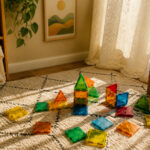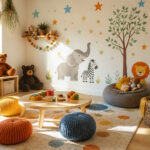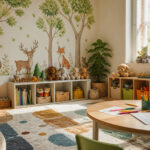

A kids room rainbow theme works best when only one or two elements carry full color, not every surface at once.
The mistake most parents make is painting all four walls or matching curtains to bedding, which turns the space into something that hums instead of inviting.
A single three-foot arch behind the bed, or one bold duvet against flat white walls, anchors the room without overwhelming it.
The Benjamin Moore Tropicana Cabana aqua we saw in one build paired cleanly with warmer stripes above; when the phase passes, that arch covers in one coat.
[link-whisper-related-posts]Rainbow Wall Murals and Arches

A painted rainbow arch on the main wall gives you the biggest visual impact for the least paint and time.
We have seen rooms where a single arch about three feet wide, placed behind the bed or the reading chair, anchors the whole space without turning the walls into a circus.
The Benjamin Moore Tropicana Cabana paint used in one build we tracked reads as a clean aqua that pairs well with warmer rainbow tones above it; if you are renting or just cautious, that same three-color arch is easy to paint over later when tastes change.
Full wall murals demand more wall and more nerve. One option that skips the primer entirely is Wallcandy Rainbows Temporary Wallpaper, which goes up with water and peels off when the phase passes.
For either type, we would stop at one wall, maybe two if the room is generous. Covering every surface in rainbow stripes tends to swallow the furniture and the kid along with it.
Keep the big pieces white, almost like clouds, and let the wall do the talking.
Rainbow Bedding and Textiles

Bedding carries most of the color in a kids room rainbow scheme, and that is where we usually start.
A full set of rainbow sheets against white walls gives you the theme without committing paint or wallpaper you might need to undo later.
We have watched renters build entire rooms around one strong textile and keep the rest neutral so the security deposit stays safe.
The Organic Rainbow Sheet Set works best if you want the color there but soft, not saturated. The stripes run watercolor-muted, which means you can layer in brighter toys or books without the bed fighting everything else.
For something that holds its own against plain drywall, the Rainbow Charm Duvet Cover runs bolder, more saturated blocks.
We have seen it paired with unfinished wood floors and a single low pile rug, and the room still reads complete because the bed itself does the work.
Balance matters more than matching. If the bedding is loud, keep the walls flat white or a very pale gray.
If you want color on the walls too, scale the bedding back to just the sheets and use a solid duvet, or the room tips into carnival territory fast.
The same rule applies to curtains: one rainbow element at full strength is usually enough. Two starts to feel like the decor is shouting at you.
Rainbow Rugs

A rug with bold rainbow stripes does more to separate a shared kids room into zones than paint on the walls ever will.
We have watched parents lay a rainbow stripe rug under the bed and instantly create a sleep zone that the eye reads as distinct from the play area across the room, even when the floor is the same carpet throughout.
The Rainbow Stripe Rug and the Oh Joy. for Lorena Canals rainbow rug both handle this job, but they scale differently. The Rainbow Stripe Rug runs wider and flatter, which suits open floor plans where the play zone sprawls.
The Lorena Canals piece is washable and slightly smaller in standard sizing, so it fits tighter rooms where the sleep zone bumps close to the wall.
For a room under ten feet wide, skip the oversized statement and let the rug edge sit two feet from the wall on each side; otherwise the stripes fight the walls and the room feels stuffed.
In larger rooms, two smaller rugs beat one giant one every time. A rainbow rug at the bed and a solid or low-contrast runner near the toy shelf keeps the color from swallowing the space.
Rainbow Wall Art and Decals

Not every rainbow room needs a painted wall. Removable wall art lets you test the idea without committing a weekend to tape and drop cloths.
We have peeled a lot of decals off in our years at the shop, and the ones that survive are the thick vinyl sets with a low-tack adhesive that releases clean within about two years.
Go thinner and you risk paint coming with it.
You have two workable layouts. One large decal, maybe a single arch across the crib or bed, anchors the room and reads as intentional.
A cluster of smaller prints and decals, hung salon-style, builds the same color story but lets you pull pieces out as the child shifts from bright primaries to something calmer.
That second route is the one we steer renters toward; it fills a wall without a single hole if you use the right strips.
A rainbow-themed kid room is always fun.
— PopSugar
What that means in practice: you can start with just a few colors and add more later.
Start with three colors in a single arch or a small print set, then layer in the rest as you find pieces that actually fit the room rather than forcing a complete set that fights the light.
Rainbow Storage Bins and Organizers

Bright storage bins can pull a rainbow room together or turn it into a jumble, and the difference is usually the edges.
We have watched cube organizers in saturated red, yellow, and blue sit next to each other and read as clutter instead of color because the bins were each a different finish, some glossy and some matte.
Match the sheen, not just the hue, and the wall of toys suddenly looks intentional. The same rule holds for open bins versus lidded ones: mixing both breaks the rhythm.
Pick one style and repeat it.
For daily use, soft fabric cubes hold up better than the rigid plastic ones that crack when a kid stands on them. We have replaced enough cracked lids to know.
If your main rainbow runs warm, lean the storage toward coral and amber rather than squeezing in a cool purple just because it is in the spectrum.
The purple can live in the bedding or the rug where it shows in smaller doses.
Rainbow Lighting

The Sunnylife Neon Rainbow Lamp throws more light than you would expect from something that looks like wall art.
We hung one in a six-year-old’s room and ended up swapping the bulb for a lower wattage because bedtime became a negotiation.
For sleep, look for a dimmer switch or a lamp with a warm secondary setting; pure rainbow LEDs read as playtime even at midnight.
Rainbow nightlights solve this by design. The soft silicone ones that change color on tap are bright enough for bathroom trips but dim enough that kids settle back down.
Cord safety is the real concern under age five. Battery-operated options win here, though we have seen parents run the cord through a wall-mounted channel or simply place any plug-in model on a high shelf the child cannot reach.
Neon signs look grown-up cool but weigh more than plastic alternatives. Check the mounting hardware against your wall type; drywall anchors that hold a paper print will not handle a glass tube.
Renters should lean toward battery LED strips shaped into arcs, which peel off when the lease ends.
Rainbow Furniture Accents

A single bold piece of furniture in full rainbow does more for the room than a rainbow everything. We learned this after bringing in the Rainbow Tie-Dye Bean Bag Chair and watching it become the spot kids actually fight over.
One chair, loud and clear, gives the eye somewhere to land. Paint the dresser in stripes and the chair becomes an accent; paint the bed, the shelves, the desk in competing colors and nothing reads as intentional.
Chairs and dressers carry the theme longer than bedding or wall decals that peel inside a year. A solid wood dresser with painted drawers in ROYGBIV order survives two redecorations before anyone tires of it.
Bean bag filling goes flat eventually, but the cover outlasts three comforters. If you are renting, furniture moves with you; the mural stays behind.
Spend the money on the piece that takes weight and touch. Let the cheap stuff, the posters and the throw pillows, do the quiet work.
Choosing a Cohesive Color Palette

A rainbow room falls apart when the colors fight instead of talk.
We learned this the hard way on a bedding swap last year: saturated red, blue, and yellow all at full strength turned the wall into three separate rooms shouting over each other.
The fix was pulling every color back to the same intensity, either all bright or all muted. Pastel, muted, bright, dark, or saturated, any palette works if you stick to it throughout.
Neutrals are the breathing room that keeps the eye from tiring. Plain white furniture against rainbow walls lets the colors do the work without adding another voice to the chorus.
We now treat white, natural wood, or soft gray as part of the palette, not an afterthought.
Three to five distinct colors is the ceiling before chaos sets in. Below that, you have a theme; above it, you have a toy aisle.
If you want the full spectrum, run it in a single controlled stripe or arch, then let the rest of the room rest. No single color should overtake the power, or the room ends up looking out of place.
Keeping the Room From Overwhelming

A rainbow room can go from cheerful to chaotic fast if every surface competes for attention.
We learned this running the store floor when parents would walk in, freeze in front of a wall of saturated color, and mutter that it was "too much." The same thing happens at home.
Leave the ceiling and the largest wall plain, usually in a warm white or soft gray, and let the rainbow live on one accent wall, the bedding, or a single rug. That quiet zone gives the eye somewhere to land.
The 60-30-10 rule still works here, just with the colors split across that 60 percent neutral base.
The 30 percent becomes your main rainbow piece, maybe the mural or the quilt, and the 10 percent carries the bright accents: a lamp base, drawer knobs, a small shelf.
Spread the rainbow across too many large items and the room starts to hum. Keep it to one or two and the kid gets the joy without the parent getting a headache.
We also stopped carrying rainbow-patterned curtains after too many returns. They fight the wall, they fight the bedding, and morning light turns them into stained glass that wakes the room up too hard.
Solid curtains in a color pulled from the palette, not the whole arc, solve that without looking like a retreat.
DIY Rainbow Projects That Hold Up

Painting a rainbow arch with clean edges looks simple until the paint bleeds under your tape and leaves a ragged line.
In one video walkthrough, the crew ran a thin bead of caulk along the tape edge before spraying color; that seal is what separates a crisp arch from a wobbly one.
They used a level to mark vertical guides, then labeled each section so the right color landed in the right stripe.
Even with that prep, thinning the paint with water became necessary when the sprayer started skipping at full pressure, a fix that cost nothing but an extra ten minutes.
We have learned the hard way that letting the tape sit overnight matters as much as the caulk line. Rushing that step turns a Saturday project into a Sunday redo.
For wall art, a framed print or a neon rainbow sign skips the mess entirely. Hand-painted blocks, purchased prints, and a neon light can all share the same wall if the colors line up.
Ready-made pieces ran from about twenty dollars for small prints up to rug and furniture prices.
Painting your own arch, by contrast, needs only a quart each of three colors and a roll of painter’s tape, maybe sixty dollars total if you already own basic brushes.
You choose between saving time or getting exactly the colors you want.
A bought sign gives you the shape in ten minutes; the arch takes a full day with drying time, but you pick the exact curve and the exact colors.
One source painted their arch small and organic, not wall-filling stripes, which kept the work manageable and the repaint easy when tastes change. That scale, about three colors in a modest curve, is where DIY wins.
Wide vertical stripes across a whole wall, as the video crew attempted, multiply the taping and the chances for bleed-through. For that much coverage, a peel-and-stick mural or a large framed textile starts to look like the smarter weekend spend.
Adding Learning to the Decor

Rainbow alphabet prints hang at the right height and suddenly the wall is doing two jobs at once.
We learned that eye level for a two-year-old is roughly three feet off the floor, so anything meant for early learning belongs down there, not centered at adult height where it becomes wallpaper.
Lower placement means the child actually traces letters with a finger instead of just sleeping near pretty colors.
The same print that teaches a preschooler her ABCs still works at age six if you shift it up and pair it with a simple word list taped beside it.
By second grade, the rainbow colors keep it from feeling babyish while the content steps forward into spelling helpers or a multiplication ring. We have watched rooms evolve this way without swapping out every decorative element.
Skip anything too cute to outlast the diaper years. A rainbow number line from 1 to 20 reads as decor now and still holds up when homework starts.
The educational pieces that last are the ones with clean lines and real information, not cartoon characters holding flashcards.
Frequently Asked Questions
How can I decorate a rainbow-themed kids’ room?
Start with one strong element and keep the rest neutral. A painted arch, bold bedding, or a striped rug anchors the room while white furniture and plain walls prevent overload.
Add removable pieces like decals or temporary wallpaper if you want flexibility as tastes change.
What colors should I use for a rainbow room?
Pick one intensity level and stay there: all bright, all muted, or all pastel. Three to five distinct colors is the practical limit before the space tips into chaos.
Balance saturated colors with white, natural wood, or soft gray so the eye has somewhere to rest.
What are some fun rainbow decor ideas?
A neon rainbow lamp doubles as nightlight and wall art, a tie-dye bean bag becomes the room’s focal point, and alphabet prints hung at toddler height turn decoration into early learning.
Let one piece carry full rainbow strength rather than spreading it thin across every surface.