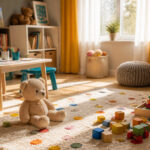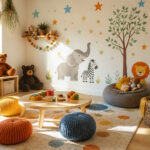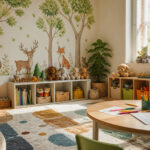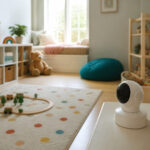
The best kids room playroom is the one you repaint least. Gray walls with yellow, teal, or pink accents survive from nursery to preteen without a brushstroke, while peel-and-stick murals and framed slogans handle the phases that pass in months.
The real test is not the toddler years; it is whether the same space still works when a fourth-grader needs a homework desk where the LEGO table stood.
[link-whisper-related-posts]1. Incorporate a Mural or Colorful Art

A mural or a few large pieces of colorful art can shift the whole feel of a kids room playroom without touching the furniture or the floor plan.
We have seen rooms go from nursery-soft to eight-year-old-energy just by swapping out the wall piece, and the paint underneath stays the same.
Paint a slogan straight onto the wall if you want something that feels built-in; hang a framed print or a canvas if you want to change it out in twenty minutes when the phase passes.
"Playrooms need a giant dose of fun… Clasen recommends adding a mural, colorful art and kids’ furniture, or a giant slogan painted across a wall."
That dose of fun is the part that dates fastest, so keep the art separate from the architecture.
A decal peels, a framed poster moves to the hallway, a painted slogan gets covered with primer when they hit middle school and want the room to feel older.
The wall itself never has to apologize for what was there before.
2. Use Multifunctional Furniture

In a kids room playroom, furniture that pulls double duty buys you years before the next redesign.
A storage ottoman we picked up for our own floor space hides a full bin of dress-up clothes and still serves as seating when the neighbor kids pile in.
Fold-out tables let the same square footage switch from LEGO construction site to homework desk without a second trip to the store. Beds with drawers underneath replace the toy box that always seemed to block the door.
The real return comes later, when the same piece of furniture still works as your child grows. That craft table your toddler used for finger paint becomes the spot where a fourth-grader builds science-fair displays.
The window seat that held picture books now stacks manga and hosts sleepovers.
Maggie Griffin, a designer in Gainesville, Georgia, built exactly this kind of room for three boys ages 3 to 12: one wall with durable, wipe-clean surfaces, a sectional for the oldest, and a single table that works for both coloring and complex brick builds.
Keeping storage at the perimeter, as several designers favor, leaves the center open for whatever stage comes next. Shallow bins slide beneath couches.
Individual bins in cubbies let a preschooler sort by color and a preteen hide charging cables. The room adapts because the furniture never committed to just one age.
3. Create Designated Play Zones

A kids room playroom stops working when every toy lands in the same pile. We split our floor into zones, and cleanup finally started happening without us nagging.
A low shelf for art supplies and shallow bins under a small couch keep board games and puzzles sorted without eating floor space. The center stays open for building blocks and the kind of messy play that needs floor space.
Keeping storage on the perimeter leaves the middle free for actual play. That perimeter rule changed how we thought about the room.
We used to line every wall with furniture, which left kids circling the edges like a waiting room. Pulling storage to one long wall, even using basic cubbies we already owned, opened the rest for distinct activity areas.
The zones do not need to be permanent. Our art corner became a homework spot when our oldest turned nine, and the couch that once held us while toddlers stacked blocks now works for reading time.
Zones let the room shift without a full redesign.
4. Maximize Storage With Cabinets or Lockers

Wall-mounted storage cabinets or a full run of school lockers along one wall keep the floor open for play zones while corralling the chaos.
We like lockers because assigning each kid a number turns cleanup into a system they can actually remember; one holds sports gear, another dolls, a third board games, and suddenly putting things away has rules a five-year-old can follow.
Wayfair, IKEA, and Target all stock individual metal lockers if built-ins are not an option, and shallow under-bed bins slide beneath a couch for the toys that rotate in and out.
Open cubbies with individual sliding bins work too, but only if you want the toys visible; we have learned that closed fronts survive a real weekend better, because out of sight means you will not spend Sunday restyling a shelf that already looked fine on Saturday morning.
5. Design a Cozy Reading Nook

A reading corner only works if the seating is soft enough that kids actually stay put.
We have watched our own children walk past a perfectly good chair and sprawl on the floor instead, because the chair felt like a timeout.
Thick, plush rugs and ultra-comfy chairs soften the whole space and make it somewhere they want to be.
If the room is tight, bean bag chairs or oversized pillows arranged in a corner do the same job without the footprint of a couch.
Layer in multiple textures through fabrics and pillows so the nook feels like a retreat, not a holding area. The same corner can serve for reading, drawing, or quiet time after a loud play session.
A toy room works better when it handles both energy and winding down, and the soft materials are what signal the shift between the two.
6. Prioritize Natural Light

Window placement in a kids room playroom matters more than most parents realize until they watch their child squinting at a puzzle on a cloudy afternoon.
Light coming from two sides, or at least from the side rather than directly behind the activity, cuts the glare that tires young eyes during reading or craft time.
If your room has only one window, position the table or desk so the child faces it or sits with it to one side, never with their back to it.
Pale walls and ceilings bounce that light deeper into the space, which is why we always reach for soft whites or very light grays in rooms that feel boxed in.
A matte finish hides the scuffs better than eggshell, and it does not throw glare back at eye level. Repainting the whole room is overkill; one light-colored accent wall opposite the window can shift how the light moves.
Sheer curtains filter harsh midday sun without blocking the view, and they cost less than blackout systems that make more sense in a bedroom.
For east-facing windows that dump too much morning light, a simple tension rod with a lightweight panel takes ten minutes to install and leaves when you do.
Work with what the house gave you instead of opening walls or chasing a picture-window budget that belongs in a different project entirely.
7. Use Whimsical Wall Coverings

Peel-and-stick wall coverings let you commit to a theme without committing to a contractor. We have watched enough kids cycle through dinosaurs, space, and whatever the latest streaming show is to know that tastes change before the glue even cures.
Removable wallpaper and decals solve that.
Brands like West Elm and Tempaper & Co. make options that go up without paste and come down without drywall damage, which matters when you are renting or just do not want to repaint before resale.
Stripes and graphic patterns give the same punch as a full mural but cost less and install in an afternoon. Designer Raili Clasen uses them for vintage sports-team energy, paired with an old-school pendant to finish the look.
The real win is that when your kid decides they are done with primary colors, you peel the covering off and the wall underneath is untouched.
No skim-coating, no primer, no weekend lost to fixing a decision from two years back.
8. Include a Craft or Art Area

A craft table gives you a dedicated surface for the messy stuff, and that matters more than the size of the room.
We like a spot with a laminate or sealed top that wipes down after marker bleed-through or glue drips.
Storage underneath or on a rolling cart keeps paper, paints, and LEGO bricks within reach but off the floor when the project is done.
Place this zone near a hard floor, not over carpet, because you will be sweeping up glitter and dried clay for years.
If your layout puts the craft table between the reading nook and the active play area, it becomes a natural buffer: quiet enough for coloring, close enough that a younger sibling can wander over with a puzzle while an older kid builds.
That is the arrangement that has worked in our space, and it keeps the room from feeling like separate territories instead of one room the whole family actually uses together.
9. Implement a Magnetic Wall for Creativity

Sheet metal from a fabrication shop turns an ordinary wall into a magnetic surface for less than most store-bought boards, and you can size it to fill a third of the wall instead of settling for the small rectangles sold online.
We like this route for a kids room playroom because the large surface lets a toddler post art with magnets and an older kid build with magnetic tiles on the same wall.
Secure it with construction adhesive and screws into studs; the sheet is thin enough to sit nearly flush, but you will still see the edge, so plan a frame or paint the perimeter to match the wall.
The fabrication shop cut ours to size, which saved us from wrestling a 4×8 sheet through a table saw. If you are renting, skip the adhesive and use heavy-duty mounting brackets so the whole panel comes down without tearing drywall.
One warning: test your magnets first. Not all refrigerator magnets grip sheet metal well; ceramic magnets or stronger neodymium ones hold better, and that is a $5 experiment before you commit to the full install.
10. Choose a Cohesive Color Scheme

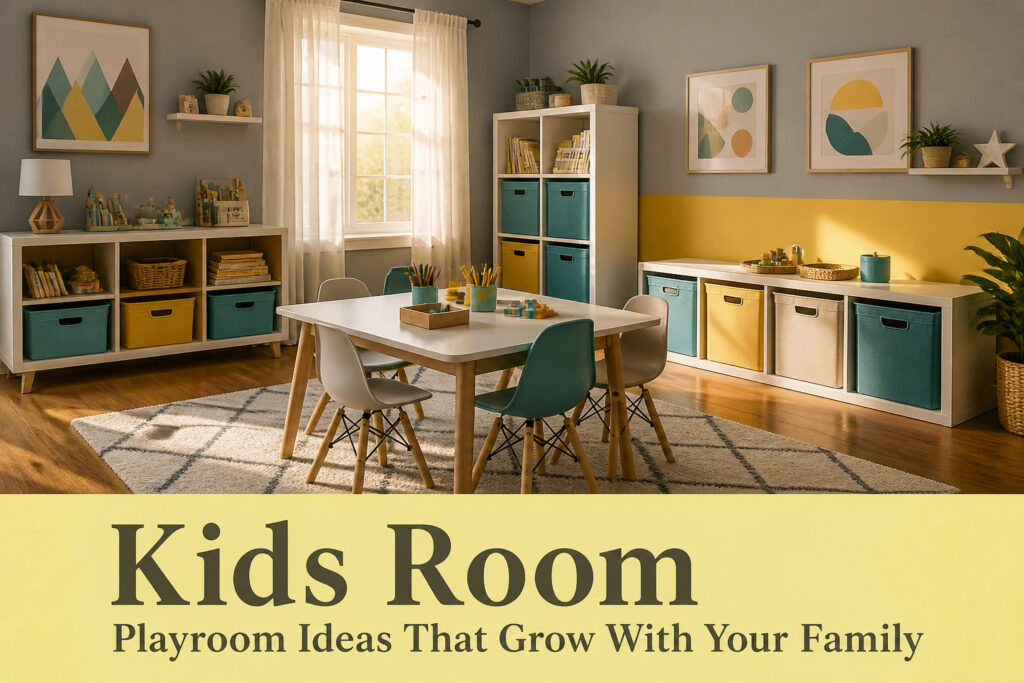
Gray walls give you a base that survives every phase from nursery to pre-teen without a repaint. We learned this after watching a friend repaint twice in three years while her gray-walled neighbor just swapped the curtains.
Keep the trim and ceiling in warm white so the room does not go cold.
Yellow, teal, and pink are the accent colors that read playful now and intentional later.
A yellow lamp or teal storage bin looks cheerful against gray at age four; the same gray with blush bedding and a desk lamp passes for a tween space with no structural change.
We would skip the saturated primaries unless you want to repaint when the Lego phase ends.
The question of best colors came up repeatedly in the research for this piece, and the consensus ran toward this neutral-plus-accent approach. Our own call: pick two accents max per room.
Three competing bright colors against gray starts looking like a daycare rather than a home.
11. Consider a Playroom on the First Floor

A first-floor playroom off the kitchen or mudroom lets you supervise without hovering.
You can hear what is happening while you finish a task, and the noise stays where you already are instead of traveling through floor joists to a home office or bedroom above.
That matters if you rent, because soundproofing an upper floor usually means opening walls or adding mass to the structure, work most leases do not allow and most budgets do not cover.
Keep the space near where you already spend time so a toddler can check in with a drawing without trekking stairs, and so the room still works when your child is older.
Designer Amy Storm notes that a bright first-floor space with good storage can shift later into a study area or teen lounge.
The same square footage does double duty, which is useful when you cannot build an addition or finish a basement.
12. Include Open-Ended Toys for Creativity

Open-ended toys earn their floor space differently than the single-use gadgets that pile up in closets.
A set of wooden blocks or a basket of loose parts does not come with a prescribed ending, so children cycle back to them across years rather than weeks.
The same pile of natural-finish blocks becomes a road at three, a castle at five, and a math manipulative at seven. That longevity matters when you are fitting a room to grow.
We stock the Hammond Toy Store shelves with this in mind.
Unfinished wood, beeswax, and wool hold up to the kind of rough use that happens in a shared kids room playroom, and they do not carry a branded storyline that tells a child what to build.
The absence of a fixed outcome is the feature, not a gap.
The research on play backs this up. Children stay with loose-part materials longer than with toys designed for one correct result, and they build more complex structures on repeat visits.
A 2017 study in the journal Child Development found that kids given ambiguous building materials produced more varied and elaborate constructions over time than those given single-outcome sets.
Earlier work from the National Association for the Education of Young Children makes the same point: open materials adapt to the child’s stage rather than dictating it.
For a room that needs to serve a two-year-old and a seven-year-old at once, that adaptability is practical budget sense. One bin of blocks replaces three rounds of outgrown specialty toys.
Design for Growth

The best playrooms start life looking like living rooms. We learned this after watching too many families replace every stick of furniture once their kids hit middle school.
Design the room like a living room first, then layer in the play zones. That means tailored upholstery, real-wood tables, and architectural lighting that sets a mood even when LEGOs cover the floor.
Maggie Griffin built her three sons’ playroom this way, with a sectional that already seats a tween for lounging and a window seat ready for sleepovers.
Her craft table works for a toddler’s coloring and a nine-year-old’s builds without changing height or hardware. The grasscloth above board-and-batten wainscoting gives texture now, but the lower half wipes clean after ten years of scuffs.
Pre-planning the infrastructure matters more than choosing the right beanbag. Run power and data to where a desk will eventually sit, and think through seating arrangements that flip from imaginative play to homework to teen hangout without a full redesign.
The TV, if you add one, should pair with gaming consoles for older kids and carry parental controls tight enough for a three-year-old. Everything else, toys and books especially, sheds naturally as interests shift.
The furniture stays.
Budget-Friendly Storage That Works

We looked at the indoor hanging cocoon chair at $475 and the rock climbing wall panel starting from $420 and decided neither belonged in a storage section.
They are activity pieces, and calling them storage just to bulk up a list would waste your money and your wall space.
What we actually bought were clear shoe boxes, about a dollar each when you catch the back-to-school sales, and a secondhand bookcase we sanded and painted.
The shoe boxes fit board-game pieces, train sets, and the random plastic animals that migrate between rooms.
The bookcase we set on its side, so the cubbies sit low enough for a three-year-old to reach and high enough that the same kid, now eight, still uses them for comic books.
For labeling, we skipped the custom neon sign at $520. It looks sharp in photos, but a label maker tape or a strip of masking tape and a Sharpie tells a child where the LEGOs go just as fast.
Spend under $40 on bins and a used shelf, and you have storage that works through every phase your family actually lives through, not the one you staged for a weekend photo.
What to Avoid in Small Spaces

Small playrooms collapse under their own weight when you try to make them do everything at once.
We learned this setting up a corner for our own kids: one weekend, a few hundred dollars, and the mistake of buying bins before we knew what the space was actually for.
The bins sat half-empty while the floor became the art station.
Narrow the use first. For a dedicated art spot, hang canvases on the wall and place a small table and chairs in the center.
Chalkboard paint turns the wall into a scribble-safe surface without losing floor space.
If the room becomes a gaming zone instead, skip the table and bins entirely; move toy storage to the kids’ bedrooms and use only a loveseat and screen.
Multifunctional furniture only helps when the functions are ones you will actually use. A pullout loveseat for sleepovers is worth the floor it takes if sleepovers happen monthly.
If they happen twice a year, the floor is better left open. Gray with yellow, teal, or pink accents makes a flexible backdrop that survives changing interests without repainting.
The best location is the one that fits your home’s flow, not the one that looks right in a photo. Set the play nook near where you already spend time.
Kids need unstructured time more than they need all the things.
Weekend Timeline and Supply List

Most weekend playroom projects fall apart when you skip the measuring step. We have made that mistake twice, and both times the storage unit sat in the hallway for a week.
Measure the wall, the doorway, and the path between them. A unit that clears the wall but not the stair landing is a unit you will return.
Here is the order we work in now:
- Measure twice, buy once. Record wall height, width, and any baseboard or outlet that blocks a flat fit.
- Buy paint or peel-and-stick paper last, after furniture is in place. The color reads different under real light and against real toys.
- Move existing furniture to the center of the room. You need the full wall clear to test placement.
- Install storage first, then seating, then play surfaces. Rugs go dead last; they mark fast during heavy lifting.
- Stop at four hours of active work. The second half of a long day is when we cut corners and mis-drill.
For supplies, start with a stud finder, a four-foot level, and a pack of adjustable wall anchors. The anchors cost under ten dollars and save you from hitting studs you guessed wrong on.
Frequently Asked Questions
What should a playroom include?
A kids room playroom needs a space where children can play while an adult supervises from a comfortable spot, plus designated zones for different activities and practical storage that does not require a specialty-store budget.
The design should also grow with your child, since the creative space will likely become an art or homework area later. Terrific playrooms keep storage on the perimeter so the center stays open for actual play.
How do you make a cozy playroom?
Add soft seating thick enough that kids want to stay put, such as a simple couch, bean bag chairs, or oversized pillows arranged in a corner.
Layer multiple textures through fabrics and pillows so the nook feels like a retreat rather than a timeout. Thick, plush rugs help soften the whole space and signal when it is time to wind down after active play.
What is the best color for a kids playroom?
Gray walls make the best base for a kids room playroom because they survive every phase from nursery to pre-teen without a repaint.
Add yellow, teal, or pink as accent colors through lamps, storage bins, or bedding; these read playful now and intentional later.
Keep trim and ceiling in warm white so the room does not turn cold, and limit yourself to two accent colors to avoid a daycare look.