Small bedroom organization is the practice of fitting everything you need into a space that usually holds less than you own.
The mistake most people make is buying bins before they know what stays; we learned that in a dozen resets, and the $64 drawer organizer kit only works after the unloved clothes are gone.
Start by pulling everything out and sorting, because the calm comes from absence, not new storage.
[link-whisper-related-posts]Declutter Before You Store

We learned this the hard way in a dozen bedroom resets: do not buy a single bin until you have pulled everything out and sorted it. The calm you feel afterward is not from new storage.
It is from the absence of things you did not love or use.
Start with what is actually in the room, not what you wish were in it. Pick up each item and ask whether you love it or reach for it regularly.
If the answer is no, it goes. This step feels slower than shopping for drawer dividers, but it is the only way to learn what storage you actually need.
A closet you never open, a dresser full of clothes you forgot you owned, those tell you where the real problem lives.
Once the unloved pieces are gone, the room itself shows you the gaps. Maybe you need under-bed height for two bins, not six.
Maybe the nightstand is fine and the wall wants hooks instead. You cannot see that while clutter is still talking.
Under-Bed Storage

The space under your bed is dead real estate until you give it a job. We have watched people try half a dozen systems before one sticks, and the pattern is always the same: visibility matters more than capacity.
The Water Hyacinth under bed basket at $50 wins if your bed frame leaves the edge exposed. It stores extra blankets or folded clothes and does not look like a dorm room fix.
For beds with a skirt or a low frame that hides everything, the Clearview under bed storage bin at $25 is the smarter buy.
You see what is inside without pulling it out, which means you actually use what you stored instead of forgetting it for two seasons.
Under bed drawers at $30 work best for shoes or anything you grab often. They slide out like a shallow dresser you do not have room for.
Plastic storage totes fill the same role for less money and stack when you are not using them, though they read as temporary to anyone who opens the bedroom door.
We have not found reliable height or width measurements for any of these, so check your frame clearance with a tape measure before you order. A bin that wedges in place is a bin you stop opening.
Drawer Organizers

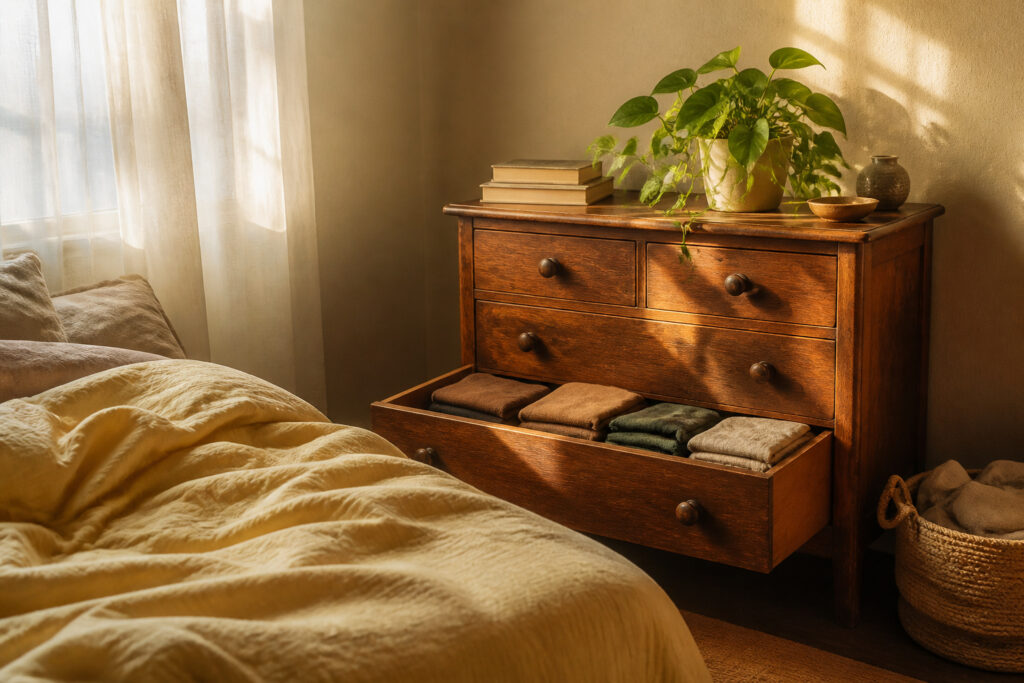
Drawer dividers and small boxes turn a single junk drawer into four or five purposeful zones.
We have watched too many bedrooms where the socks and the charging cables and the lip balm all share one shallow grave, and nothing stays found for more than a morning.
A basic drawer organizer starter kit runs about $64, which gets you enough pieces to split two to three standard drawers into real compartments.
The units with adjustable widths hold up better than the fixed kind, because drawer sizes vary even inside the same dresser.
Fabric boxes work for soft goods; rigid plastic or bamboo holds shape for heavier items like batteries or a hair tool collection. Skip the ones with lids inside drawers, since lifting a lid to grab a pen defeats the point.
Stacking organizers in drawers fails the moment the drawer opens with any force; the top layer always slides. Stick to single-height layouts unless your drawer is deep enough that nothing reaches the top rail.
Multi-Functional Furniture

A storage bench at the foot of your bed gives you a place to sit while you put on shoes and swallows the clutter that otherwise ends up on the floor.
We looked at a $799 storage bench that does exactly this: hinged lid, interior compartment deep enough for spare bedding or off-season clothes, and a finished surface you actually want to look at.
That price is real money for a weekend-project budget, and we would not have considered it except that we had already tried the cheaper route.
We once used a cedar chest there, then a plain bench with baskets shoved underneath. The baskets slid around, collected dust, and never quite fit.
The felt pads on the legs helped us roll that first bench to the living room when company came, but the storage was always makeshift.
A built-in compartment changes the equation because the lid contains what the open bench merely hides.
Ottomans with storage work the same trick anywhere you need a surface.
We have seen them used as nightstands, at the end of a narrow bed where a full bench will not clear the doorway, and even as a coffee table in studio apartments where the bedroom is the living room.
The rule is the same: if the piece does only one job in a small room, it is taking space it does not earn.
Color Coding
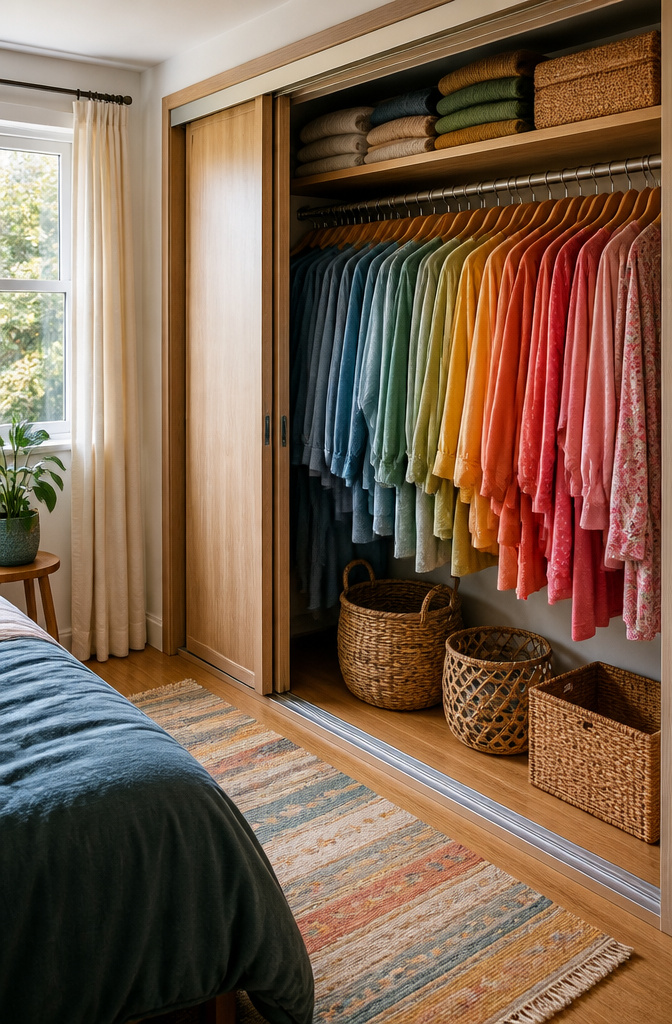
Arranging clothing by color in a closet turns a jumbled rack into something you can read at a glance.
Color coding works the same at home as it did in our stockroom, where customers used to lose ten minutes hunting for a specific shirt.
Blues hang with blues, warm tones drift together, and suddenly the whole wall looks like you planned it that way.
Stick to a single sequence, light to dark or the reverse, so your eye travels in one direction instead of bouncing around.
This costs nothing but the time to sort, maybe half an hour if you pull everything out first. Morning after morning, you spot what you need without touching half the rack.
We have seen renters hesitate, worried it looks too staged for a rental, but landlords do not mind hangers and the system moves with you intact. The only catch is maintenance; one lazy laundry day and the gradient breaks.
We find it easier to keep up than to restart from chaos, so the half hour pays out over months.
Personal Zones in Shared Bedrooms

Shared bedrooms fall apart when every item has to be negotiated. We split the room into three kinds of territory: his space, hers, and common space.
The common areas stay neat because they affect both of you; personal areas stay private, which means one of you can ball up clothes in a drawer and the other does not have to care.
Side tables anchor each zone. One person keeps books and oils; the other stacks magazines and loose change.
A tray on top corrals the clutter so it reads as intentional, not messy. Keep personal items out of the open floor and off shared surfaces.
If it belongs to one person, it lives in that person’s zone or it does not live in the room.
What Multi-Functional Furniture Actually Costs

A storage bench at the foot of the bed runs $799 if you want the built-in look, or $150 at Target for something that still holds blankets and spare pillows.
We have seen both in small bedrooms, and the difference is not always in how much they store. The higher price buys joinery that survives being sat on daily and wood that does not split when the seasons change.
If the bench is mostly a landing pad for folded laundry, the cheaper one holds up fine.
Under-bed drawers cost $30, and that is where most of the money in this category actually goes. A $25 Clearview bin or a $50 water hyacinth basket does the same job of swallowing off-season clothes.
The bench looks intentional; the drawer hides. For a room where every inch counts, the drawer usually wins because it does not eat the two feet at the foot of the bed you need to walk around.
The $998 trunk is the outlier, pretty enough that you forgive it for taking up space a small room does not have.
We would skip it unless the room is large enough that the trunk is solving a seating problem, not creating one.
Weekend Timeline for a Small Bedroom Reset

- Saturday morning: pull everything out. We open the closet and drag every basket, shoe, and extra blanket into the hall. If you do not love it or use it weekly, it leaves the room now. Do not buy a single bin until you see what is actually staying.
- Saturday afternoon: measure the gaps. Measure under the bed, the closet floor, and any shelf that is only half full. Write the dimensions down. A Water Hyacinth under-bed basket runs about $50 and needs at least 6 inches of clearance; a Clearview bin is $25 and works when the bed skirt hides it.
- Saturday evening: order or shop. We keep the running total under $200 for a first pass. Drawer organizer starter kits are $64 if your dresser is the problem; expanding dividers cost less if the drawers are shallow.
- Sunday morning: install what you have. Under-bed storage goes in first, then drawer inserts. If you bought a lidded basket at $88 for the closet shelf, set it where you can reach it without a step stool.
- Sunday afternoon: arrange what remains. Put daily items back in the easiest spot, not the most hidden. Everything else lives in the new containers or leaves the room.
- Sunday evening: live with it for a week. If a basket stays empty, return it. If the winter blankets still sit on the chair, you missed a bin. Adjust, then stop.
What We Skip and Why

Some organization ideas look smart on the shelf and fall apart once you live with them.
- Over-the-door shoe racks add inches to a door’s swing arc. In a tight bedroom, that means the door hits the bed frame or you stop using the door entirely. We tried one on a hollow-core interior door and the hooks rattled against the panel every time it moved.
- Hanging fabric shelves sag under any weight past t-shirts. The cardboard inserts warp in humid months, and the whole unit tilts so clothes slide to one corner. Ours went to the closet for linens, then to the donation pile.
- Wall-mounted systems, pegboards, and floating shelves are off the table in a rental. Patchwork and paint matching eat your weekend; some leases bill for holes outright. We learned to look for tension rods, freestanding units, and anything that leaves the drywall alone.
- Clear drawer bins without lids stack poorly and collect dust. The ones we bought for socks and underwear turned into a sliding mess every time the dresser opened. Lidded boxes or built-in dividers held up better.
What survived: anything that uses existing structure without altering it, and anything that carries its own weight.
Pinterest Versus the Real Room

A Pinterest board for a small bedroom shows floating shelves with no brackets, beds draped in linen that never wrinkles, and walls painted colors your landlord would charge you to fix. We have tried to copy that look.
The shelves needed anchors we could not use in plaster. The linen looked like linen does by Tuesday.
The color you can change back is the color worth using.
We now sort saved pins by what the photo hides. A basket wall looks light and airy because the photographer removed the contents.
In a real room, those same baskets hold three pounds of hair ties and charger cables before they sag.
We skip anything that needs a drill unless the deposit is already gone, and we measure the gap under a bed frame before we buy a single bin.
The ideas that survive a weekend are the ones that move with you. Tension rods, over-door hooks, and shoe organizers that hang rather than mount have worked in every rental we have had.
The pegboard that looked charming in a styled corner required finding studs we did not own. We left it for the next tenant and bought a leaning mirror instead.
Frequently Asked Questions
What are the best under-bed storage solutions?
The Water Hyacinth basket at $50 works well when the bed frame leaves the edge exposed, while the $25 Clearview bin is better for beds with a skirt or low frame because you can see inside without pulling it out.
Under-bed drawers at $30 suit shoes or items you grab often, since they slide out like a shallow dresser. Always measure your frame clearance with a tape measure before ordering.
How can I declutter my bedroom effectively?
Pull everything out and sort before buying a single bin. Pick up each item and ask whether you love it or reach for it regularly; if the answer is no, let it go.
The room itself will show you what storage you actually need once the unloved pieces are gone.
What furniture can help with bedroom organization?
A storage bench at the foot of the bed gives you seating and swallows clutter like spare bedding or off-season clothes. Ottomans with storage work as nightstands or surfaces in narrow spaces where a full bench will not fit.
The rule is simple: if a piece does only one job in a small room, it is taking space it has not earned.
How to organize a bedroom in a small space?
Start with decluttering, then add under-bed storage for items you rarely use, drawer organizers to split junk drawers into zones, and multi-functional furniture so every piece earns its footprint.
Color coding your closet costs nothing and turns a jumbled rack into something you can read at a glance.
What are the 7 golden rules for bedroom design?
The seventh principle woven throughout is to measure before you buy so nothing wedges in place.
What are some trendy ideas for small bedrooms in 2026?
It focuses on proven methods that survive real weekends: tension rods and freestanding units that move with you, under-bed storage that fits your actual frame clearance, and systems that use existing structure without altering walls or risking your deposit.
What to put in a small empty space in a bedroom?
The space under your bed is the most common dead zone to fill, with baskets, bins, or drawers for off-season clothes, extra blankets, or shoes.
At the foot of the bed, a storage bench or ottoman adds seating while hiding clutter. Wall space can take hooks or tension rods if you cannot drill into drywall.