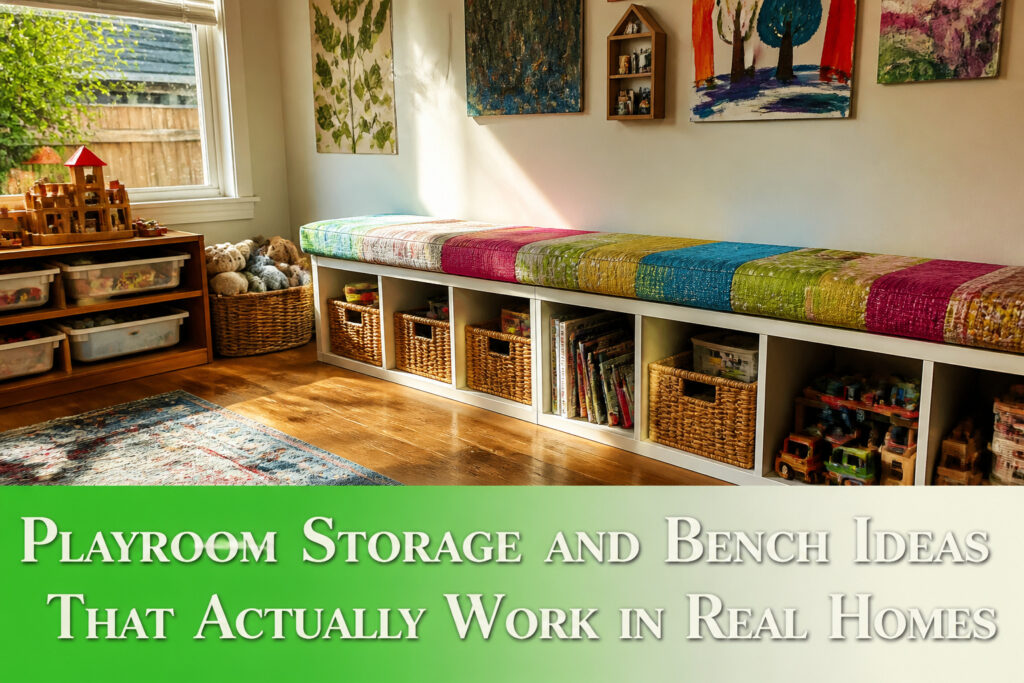
A playroom storage and bench is seating built on top of toy storage, but it only works if the cushion is thick enough to sit on for more than a few minutes.
The setups that fail in real homes look fine in photos yet end up as surfaces for clutter because nobody wants to stay seated on bare shelving with a throw pillow.
The builds that last use a cut foam mattress pad on top of stacked IKEA Kallax units, held together with 3M velcro so kids can climb without the pieces sliding apart.
[link-whisper-related-posts]IKEA Kallax Shelves Converted into a Bench

Standard Kallax shelving units become bench seating with storage cubbies below when you lay them on their backs and stack two of them.
The 3M velcro between the units keeps them from sliding apart when kids climb on, which matters more than you’d think.
We cut a foam mattress pad to size for the cushion; it sits right on top without slipping, and you can pull it off to clean or swap out later.
This setup solved a real problem in a playroom with two walls of windows and almost no wall space left for furniture. The bench runs under the windows instead of against them, and every cubby below holds a bin.
You get seating plus storage without buying separate pieces.
For renters and first-home owners, the whole build happens in a weekend. No drilling into walls, no permanent changes.
If you move, the velcro strips peel off clean and you stack the shelves upright in a closet or new room.
The cost stays under what you’d pay for a single purpose-built storage bench, and you keep the modular part: add another unit later, or split them into separate toy stations if the layout changes.
The foam mattress pad is the detail that makes it comfortable enough to actually sit on; bare Kallax with a throw pillow looks cute in photos but nobody stays there long.
Toy Storage Benches with Cushions

A toy storage bench with a cushion top turns the box into a seat adults actually use.
We have watched playrooms where the bench sat empty until the foam went on; after that, parents stayed on the floor longer because sitting down no longer meant sitting hard.
The cushion itself does not need to be elaborate. One approach we have seen work is a foam mattress pad cut to fit the bench top, which keeps the seat comfortable over years of use.
The fabric you wrap it in matters more than the thickness, but that is a separate decision. What counts here is the combination: storage below, softness above.
Without the cushion, the bench becomes another surface to clutter. With it, the same piece becomes where you sit to build blocks or read aloud.
For renters, this is especially useful. A storage bench with a cushion top is one piece of furniture, not two, which matters when the playroom is also the guest corner or the hallway outside the bedrooms.
The cushion makes it read as seating to anyone walking past, so the storage does not announce itself.
Stackable Storage Solutions
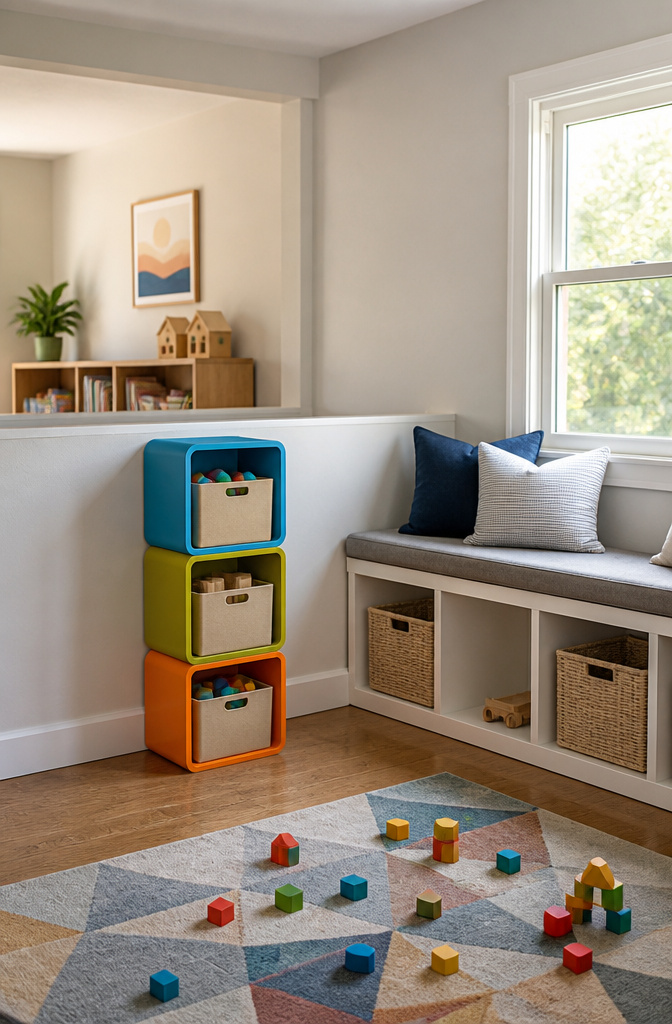
Stackable units let you build upward instead of outward, which matters when a playroom doubles as a guest room or hallway corner.
We started with two cubes and added a third when the train set outgrew the first shelf; a year later we peeled it back to two after the dinosaur phase ended.
That elasticity is what separates stacking systems from built-ins, which look finished but lock you into one footprint.
The real advantage shows in tight floor plans. A vertical stack against the short wall of a rectangular room eats maybe sixteen inches of depth while the same toys in low, sprawled bins would swallow half the carpet.
You do sacrifice some top-shelf accessibility for preschoolers, so we kept the daily-use items on the second level and rotated seasonal stuff upward.
When the kids were small we turned the bottom cube backward so the open side faced the wall, creating a solid base they could sit on without pulling anything down.
It was not elegant, but it worked until they were tall enough to reach the third row.
Bins for Toy Organization

Bins turn bench cubbies from empty boxes into working storage.
Without them, small toys sink to the back and disappear; with them, each bin holds one category and nothing else, which is what lets a four-year-old put things away without help.
We have watched families skip labels to keep the look clean, and the bins become catch-alls within a month. A label on the front, not the top, means a child squatting at the cubbie can read it.
Pictures beat words for pre-readers; both together cover mixed ages in the same room.
Standalone bins on open shelving work the same way, though they cost floor space a bench cubbie does not. The trade is flexibility: you move a heavy bin of blocks where the building happens, then slide it back.
Fabric bins dent and collapse after a year of hard use. Plastic cracks but holds shape longer; rope handles tear first, so we avoid them for anything a child drags daily.
The bench seat stays useful only if the bins beneath it are easy to pull. A bin that jams on the cubbie lip stops the whole system.
We leave a finger-width gap at the top of each cubbie, which matters more than the bin material.
Durable Fabric Options for Benches

Fabric choice on a playroom bench is where a lot of first projects go soft.
The original build we followed used a standard home-decor weight, and within six months the seat looked like a map of every juice box and marker cap that ever rolled under the table.
Wipeable or machine-washable upholstery is the upgrade that actually buys you time, not just the illusion of it.
Outdoor canvas and Crypton-type performance fabrics clean with soap and water instead of absorbing immediately. We have also seen vinyl hold up structurally, though it cracks eventually and feels sticky in summer.
The mattress-topper cushion method still works; it keeps the seat comfortable long-term, so you are not sacrificing that to get the durability.
If you are re-covering an existing bench, pull the old fabric tight enough that a toddler cannot bunch it into a grip, or you will be tucking it back in weekly.
Art Carts for Playroom Organization

A rolling art cart fills the gaps that fixed bench storage leaves behind. You wheel it to the table when the kids want markers and glue, then roll it away when they switch to blocks or dress-up clothes.
The top holds the project in progress, the drawers or tiers keep loose beads and crayons from scattering, and the whole thing tucks beside a bench or against a wall when floor space matters more.
We like pairing this setup with a stationary bench because the bench stays put for seating and bulk storage while the cart handles the supplies that change by the hour.
One family we followed kept their IKEA Kallax shelves stacked and static for Lego bins and board games, but used an art cart for the craft supplies that migrated between the building table and the easel.
Nothing new bought, just the cart already on hand re-positioned to match how the kids actually played that year.
The real win is reconfiguring without rebuilding. When interests shift from big stuffed animals to tiny collectible parts, you roll the cart closer or farther, add a drawer divider, or swap marker cups for a flat paper tray.
The bench stays; the cart adapts.
Drawer Systems for Additional Storage

Drawer units that slide under a bench keep the floor clear and hide the plastic chaos that open bins leave on display.
We have seen these under-bench trays work best when they ride on full-extension slides, because a child can reach the back corner without climbing inside the unit. A lidless bin is faster for a kid; they can toss and run.
A drawer adds the step of pulling, filling, and closing.
In a busy afternoon that friction matters, so we tend to reserve drawers for smaller categories like art supplies or dress-up accessories, not the daily dump of mixed blocks and cars.
Integrated bench drawers, built into the frame itself, look cleaner than add-on boxes but cut the seating depth by about three to four inches once you account for the front panel and slide hardware.
That is fine for a six-year-old, tight for an adult who actually wants to sit. Maintenance is the part nobody shows in the photos.
Drawer slides collect hair and glitter and dried Play-Doh crumbs, and the low clearance under a bench means you are working on your back with a vacuum crevice tool.
We clean ours twice a year, whether they need it or not, because once the slides gum up the drawer starts to jam and kids abandon it for the floor.
Lego Storage Solutions

Lego bricks are where generic playroom storage and bench setups usually fall apart first.
A deep bin looks tidy for about a day, then every color mixes into one layer and the kid stops building because finding a single red 2×4 means dumping the whole thing.
Bench seating with divided compartments fixes this if the dividers go all the way to the top. Shallow drawers work better than deep ones; a drawer you can see across in one glance keeps the sort intact.
Pull-out trays underneath an open bench seat are the compromise we keep coming back to: the tray slides out at floor level for spreading bricks, slides back under for cleanup, and the bench top stays clear for the actual build.
Color sorting sounds obsessive until you watch a six-year-old hunt for twenty minutes. The real test is whether a child can put a handful of mixed bricks away in under a minute without help.
If the system needs an adult to restore order every evening, it will not last.
The surface above the storage matters too. A bench top at standard seat height is awkward for floor building but right for a raised platform.
We have seen families add a second pull-out surface at lap level, like a keyboard tray, for Lego. It costs more space and more money, and for kids under eight it is usually not worth the complexity.
For older builders, though, that extra surface is what keeps the bench in daily use instead of becoming another place to pile backpacks.
Upholstered Benches for Comfort

Fully upholstered benches with storage beneath hinged or lift-top seats are a different animal than cubby units with a cushion tossed on top. Here the upholstery is the structure itself, not an afterthought, and that changes who actually sits down.
A parent can settle in for the long haul through a board game or a chapter book without feeling the frame beneath them.
The hinge mechanism matters more than the fabric; a lift-top with pneumatic stays stays open on its own while you dig out the bin beneath, and a cheap hinge will slam shut on small fingers or force you to hold it with one hand while you fish around.
We have watched this shift the room’s center of gravity. When the seating is genuinely comfortable, adults stop perching on the edge and start staying.
The playroom becomes a place to read alongside a kid rather than hover over them. The trade is that fully upholstered pieces take a beating from markers, juice, and the occasional pet.
Fabric choice is your call, but a dark weave with some texture hides the life it will actually see.
Expect to pay more than a bare cubby bench and to replace or re-cover sooner; budget for that in year three or four if the room sees daily use.
Multi-Functional Furniture

Every piece in a playroom has to earn its floor space twice over, because the room is rarely large enough for single-purpose furniture.
The bench we keep coming back to is not really a bench; it is seating that swallows toys.
A Kallax shelf turned on its side becomes a place to sit and a place to stash bins, which matters when you have no wall space left for a bookcase and no budget left for a separate storage unit.
The cushion on top is not decoration. It is what lets you sit on the thing long enough to build Legos without regretting the project.
The same logic holds for any surface the kids actually use. A low shelf with a flat top is a play table that keeps supplies visible and reachable.
A bin system with a lid strong enough to stand on is a step stool that hides the mess.
The best playroom storage and bench setups are the ones where the kids cannot tell where sitting ends and cleaning up begins. That is not clever design for its own sake.
It is what happens when square footage is tight and you are sick of sitting on the floor.
What a Storage Bench Actually Does in a Playroom

A storage bench in a playroom does one job that two separate pieces of furniture simply cannot: it claims the same square footage twice.
The seat holds a parent during story time or a kid pulling on shoes; the cavity underneath swallows the toys that would otherwise drift across the floor by Wednesday afternoon.
We have seen the math fail in rooms where a standalone bench plus a bin rack leaves no walking path.
The bench only earns its keep if the storage is deep enough for the largest toy category you own, not the ones you wish your children preferred.
That usually means a minimum interior height of twelve inches, though measurements vary too much from house to house for a universal rule.
The real test is whether the lid stays open without a hand on it while a six-year-old fishes out a stuffed animal. If it slams, the storage becomes parent-dependent, and parent-dependent systems accumulate clutter faster than they relieve it.
Materials That Survive Real Children

Solid wood framing holds up to years of climbing and sitting, and a wipeable surface beats "easy-clean" fabric every time.
We have watched a painted plywood bench seat survive marker, glue, and a juice box puncture that would have ruined upholstery in a week.
If you want cushioning, a mattress topper inside a vinyl or leather-look cover gives you the comfort without the stain risk. The fabric that looks soft in the store is the one you will be scrubbing on Saturday night.
Skip anything that needs special treatment or spot-cleaning only.
A frame built from two-by material with corner braces will outlast the toys it holds, and the extra cost of real wood over particleboard pays back the first time a kid stands on it to reach a shelf.
How Kids Actually Put Toys Away

Kids do not file. They dump, they pile, and they move on.
Matching bins in a row sound tidy, but kids will dump everything into the closest one, so plan for that.
Labels only work if the child can read them, and even then, a picture of a car beats the word "vehicles" every time.
The IKEA Kallax system we turned on its side let us pull the bins out so the kids could carry the whole container to the rug, play, and carry it back.
That motion, bin out and bin in, is the habit that actually sticks. If a toy has to be sorted into a drawer with a divider, it will live on the floor.
We stopped fighting this and started buying bins that fit what they already did.
When the Lego phase hit, the same bench held a drawer system next to the shelves because the creations were too big for bins and too fragile to stack.
The art cart stayed because paper and markers do not belong in any bin at all.
Reconfiguring what we had cost nothing and took an afternoon, which is about how long any organization system survives before the kids change what they play with anyway.
Sizing for Your Space and Your Budget

A 13-foot wall with a 41-inch bookcase leaves you deciding between one long run with a gap at the end, or two units with a bench bridging the middle.
Owners on Reddit who have built these setups warn that the gap is where toys migrate, so plan the bench width to match your largest storage unit and let the smaller piece stand alone.
Leave 30 inches of clear floor in front of any bench with a lid, because a kid kneeling to dig through a bin needs the same space as a drawer pulled open.
We have seen Kallax benches pushed flat against walls with no clearance, and the lids become shelves for more clutter instead of usable storage.
For renters, keep each piece under 60 inches wide and freestanding. Two 2×2 Kallax units with a plank seat between them move through doorways intact and leave no bracket holes to patch.
If you own and want a longer bench, three 2×2 units in a row hit just under 12 feet, fitting that 13-foot wall with room for baseboard trim.
The organized mama who converted Kallax shelves into her 2015 bench started with the same math: she needed seating without adding furniture to a small room, so she built the seat into the storage she already planned to buy.
Frequently Asked Questions
What materials should I use for a toy storage bench?
Solid wood framing with corner braces outlasts particleboard, and a wipeable surface beats easy-clean fabric every time. A foam mattress pad inside a vinyl or leather-look cover gives you cushioning without the stain risk.
Skip anything that needs special treatment or spot-cleaning only.
How can I organize toys in a storage bench?
Bins turn cubbies into working storage, with one category per bin so a four-year-old can put things away alone. Labels on the front, not the top, let a squatting child read them; pictures work for pre-readers, words for older kids.
Leave a finger-width gap at the top of each cubbie so bins slide out without jamming.
What are the benefits of a toy storage bench?
A storage bench claims the same square footage twice: seating above, toy storage below. It solves the problem of a small playroom where a separate bench plus bin rack would leave no walking path.
The bench earns its keep only if the storage is deep enough for your largest toy category and the lid stays open hands-free while a child digs inside.