
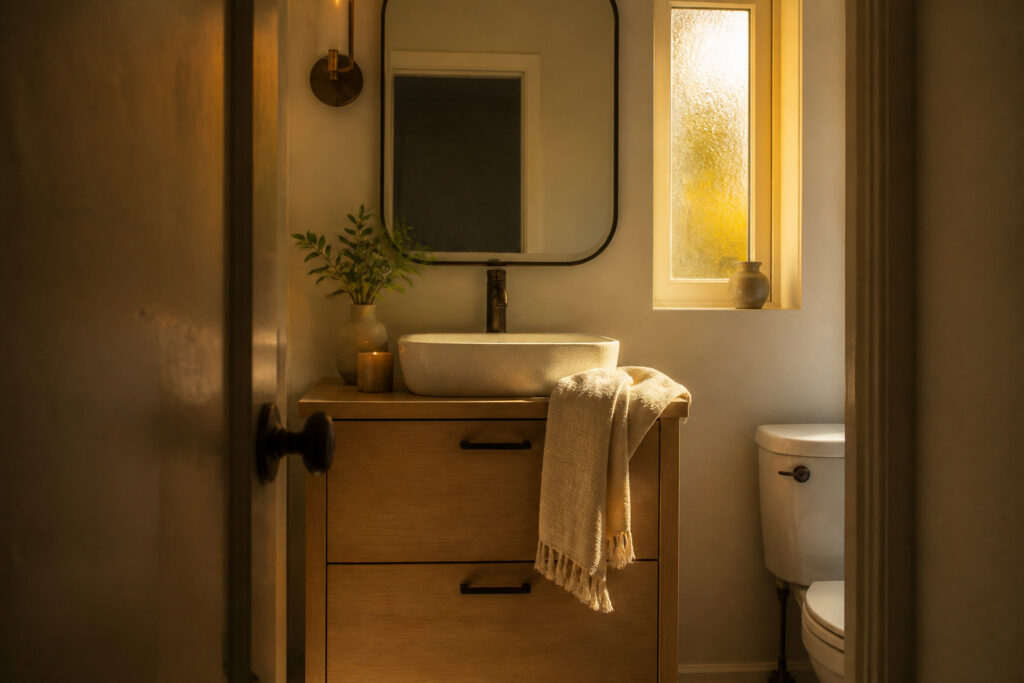
A furniture vanity powder room is a sink cabinet sized specifically for a half bath, usually 12 to 36 inches wide and built to hold only the essentials guests actually need.
Most buyers shop for the style first and measure second, which is how you end up with a 24-inch cabinet that blocks the door from closing past 90 degrees.
Stock sizes run 18 to 24 inches for a reason: powder rooms are typically carved from leftover spaces like under stairs or off hallways, and custom widths cost more than the room justifies.
[link-whisper-related-posts]Powder Room Vanity Styles

Powder rooms are where most of us finally take a risk. The space is small, guests see it, and you can get away with a vanity that would feel loud in a master bath.
The four styles you’ll actually find in stock break down like this.
Modern vanities run clean: flat panels, minimal hardware, often a floating install that shows floor underneath. They suit interiors already leaning that direction, but we have seen them work as the single contemporary note in an otherwise traditional house.
The contrast reads intentional, not confused.
Transitional splits the difference. Shaker-style doors, maybe a furniture foot, but no carving.
This is the safe bet if your house is a mix you have not sorted out yet, or if you might sell in five years. It offends nobody and impresses nobody, which is sometimes the point.
Traditional brings in the baroque or Victorian notes you see in the showpiece powder rooms online. Ornate legs, heavy moulding, maybe a marble top with an ogee edge.
We would warn that this is where budget shows fastest. A cheap traditional vanity looks like a stage prop.
If you are going this route, spend the money on the material, not the scrollwork.
Contemporary is the wildcard. Concrete, live-edge wood, powder-coated steel in a colour.
These are the vanities with unique materials and trendy finishes that guests actually photograph. The risk is dating fast.
What reads bold in 2024 can read desperate by 2028. We would keep the investment proportionate: a few hundred, not a few thousand, unless you genuinely love the piece as furniture.
Powder Room Vanity Sizes

Powder room vanities run from 12 inches up to 36 inches in width, with most landing between 18 and 24 inches. The smaller sizes dominate because powder rooms are typically tucked into leftover spaces: under stairs, off hallways, carved from closets.
A full bath vanity at 30 or 36 inches would swallow those rooms whole.
Measure your space before you fall for a style. We mark the wall width, then subtract door swing clearance and any trim that protrudes.
One of us once ordered a 24-inch cabinet that technically fit between the studs but blocked the door from closing past 90 degrees. The return cost a Saturday.
Standard sizes keep costs down because they ship from stock. Custom sizing is available if your wall space falls between those increments, though you will pay more for it.
For a room guests use twice a month, we generally buy the closest stock size and shim the gap. The money saved covers a better faucet or a decent mirror.
Storage Options

Storage in a powder room vanity runs the full range from nothing at all to drawers and shelves that hold a few guest essentials.
We have seen homeowners deliberately strip out every cabinet to get a cleaner line, and we have seen others fight to squeeze a 12" drawer into an 18" wide unit because guests need a place to find hand towels.
The honest tradeoff is this: powder room vanities usually favor looks over function because guests do not haul in shampoo bottles and hair dryers. They wash their hands, maybe fix their lipstick, and leave.
A floating shelf with a spare roll of paper and a soap dispenser is often enough. If you are the type who wants a drawer for backup supplies, plan for it early.
Retrofitting a drawer into a wall-mounted vanity built for zero storage means tearing the thing off the bracket and starting over.
The narrowest powder room vanities, down at that 12" width, sometimes skip storage entirely and use the wall cavity for a recessed niche instead. That keeps the floor clear and the sightline simple.
Wider units, up in the 30" to 36" range, can afford a shallow drawer or two without looking bulky. Our take: if the room is under five feet across, skip the drawer and spend the budget on a better countertop.
Storage you can add later with a basket on a shelf. A vanity that fights the room’s proportions is harder to fix.
Sink Styles

Integrated sinks and vessel sinks each solve a different problem for a powder room vanity.
An integrated sink, molded as one piece with the countertop, leaves no seam where grime collects; you wipe straight from counter to basin in one pass.
A surface with no lip or seam matters more than it sounds in a half-bath guests use quickly and leave wet.
Vessel sinks sit entirely above the counter, the bowl itself becoming the visual focus.
We like them for the drama they add to a small space without touching the walls, but the height costs you: the rim sits several inches above a standard counter, so you need a lower vanity or a wall-mounted faucet, and the ledge between bowl and wall traps splatter that needs its own cleaning routine.
In tight powder rooms, the integrated sink usually wins. The counter extends to the edge without the bowl’s footprint eating usable surface, and you keep the storage depth a furniture vanity powder room needs.
Vessel sinks work best when the vanity is wide enough that the bowl’s presence feels deliberate, not crowded.
Installation Types

Freestanding vanities sit on the floor like any piece of furniture, which means you bolt them to the wall for stability and hook up supply lines and a drain.
The job is straightforward enough that most homeowners with a wrench and a Saturday morning can finish it.
Because powder room vanities are smaller and usually single-sink, the plumbing stays simple: one faucet, one drain, no juggling two water supplies at once.
We have installed both types, and the freestanding ones always go faster because the cabinet carries its own weight.
Wall-mounted vanities hang from brackets anchored to studs or blocking behind the drywall. They free the floor underneath, which matters in a tight powder room where every visible inch of open tile makes the space feel less boxed in.
The catch is the wall itself. Drywall alone will not hold a vanity loaded with a fire clay sink and stored bottles of cleaner; you need solid blocking or you risk a cabinet that sags or, worse, pulls free.
The Glassman 18-inch wall-mounted unit we looked at weighs only 23 pounds empty, but water and daily use add up. Plan the blocking during a remodel, or expect to open the wall and add it.
If your powder room is a retrofit with standard 2×4 studs on 16-inch centers, a freestanding vanity is usually the safer bet unless you already know the wall structure.
Wall-mounted wins when you are gutting the room anyway or when the floor space saved is space you actually walk through.
Powder Room vs. Bathroom Vanities

A powder room vanity is built for a different job than the one you brush your teeth at every morning.
Powder rooms hold only a sink and a toilet, no shower or tub, so the vanity stays dry and sees lighter use, mostly from guests passing through. That changes what you need from it.
Bathroom vanities take the daily hit of steam, splatter, and the weight of a family’s worth of bottles and towels. They run larger because they have to.
Powder room vanities are sized specifically for the narrower dimensions of half baths, fitting comfortably where a standard vanity cannot.
Storage can be lighter too; a guest needs a place to set a purse and maybe a spare roll of paper, not the full pharmacy most of us keep within arm’s reach of the shower.
The intended use, audience, and size set them apart, even though both serve the same fundamental purpose. If you are shopping for a furniture vanity powder room, do not let a bathroom showroom upsell you into daily-grade bulk.
Buy for the room you have, not the one down the hall.
Materials That Last

Solid wood and manufactured wood are the two builds you will actually find on the floor.
We have opened enough boxes to know that high-quality wood selected for strength and stability is what separates a vanity that survives a decade of guest traffic from one that starts sagging at the joints after two years of slammed doors and leaning elbows.
Powder rooms catch less steam and standing water than a full bathroom, so the material stakes drop slightly. You can run a solid wood door or drawer front without the same warping panic you would have around a daily shower.
That said, the space is still a bathroom. A guest who leaves the sink running or a slow drip from the supply line will find the weak spot in particleboard faster than you want to learn about it.
We would not put a manufactured wood carcass in a powder room unless the finish is sealed like a boat, and even then we would rather spend the difference on the real thing and sleep through the night.
The aesthetic side matters here too. Powder rooms are where people make their bolder calls, and wood grain reads as intentional where flat laminate reads as placeholder.
If you are already choosing a 18"–24" vanity to squeeze into a tight guest bath, the material is one of the few places left to say something.
Frequently Asked Questions
What is a powder room vanity?
A powder room vanity is a smaller vanity built for guest use in a half-bath that contains only a sink and a toilet.
It stays drier and sees lighter use than a full bathroom vanity, so it can run narrower and carry lighter storage. The intended audience and size set it apart, even though the fundamental purpose is the same.
What sizes are available for powder room vanities?
Powder room vanities range from 12 inches up to 36 inches in width, with most falling between 18 and 24 inches. The smaller sizes dominate because powder rooms are typically tucked into leftover spaces like under stairs or off hallways.
Stock sizes keep costs down, while custom sizing costs more.
What styles are popular for powder room vanities?
The four styles you will actually find in stock are modern, transitional, traditional, and contemporary.
Modern runs clean with flat panels and floating installs; transitional splits the difference with Shaker doors and furniture feet; traditional brings in ornate legs and heavy moulding; contemporary uses bold materials like concrete or live-edge wood.
Powder rooms are where most homeowners finally take a risk because guests see the space and the small footprint limits the cost of being wrong.
How are powder room vanities installed?
Powder room vanities install either freestanding or wall-mounted. Freestanding units sit on the floor like furniture, bolt to the wall for stability, and hook up with straightforward plumbing that most homeowners can handle.
Wall-mounted vanities hang from brackets anchored to studs or blocking, freeing floor space but requiring solid wall structure to handle the load over time.
What is the best vanity for a powder room?
The best vanity fits your wall space without blocking door swing, matches a style direction you can commit to, and uses solid material where it counts.
In tight rooms under five feet across, skip storage drawers and spend on a better countertop; in wider spaces, a shallow drawer for guest towels works.
Buy for the room you have, not for daily-grade bulk meant for a full bathroom.
What kind of bathroom vanity looks like furniture?
Freestanding powder room vanities sit on the floor like any piece of furniture, often with legs or a plinth base that reads as intentional design rather than built-in cabinetry.
Traditional styles with ornate legs and transitional styles with furniture feet lean hardest into this look. The material matters too: solid wood grain reads as furniture where flat laminate reads as placeholder.