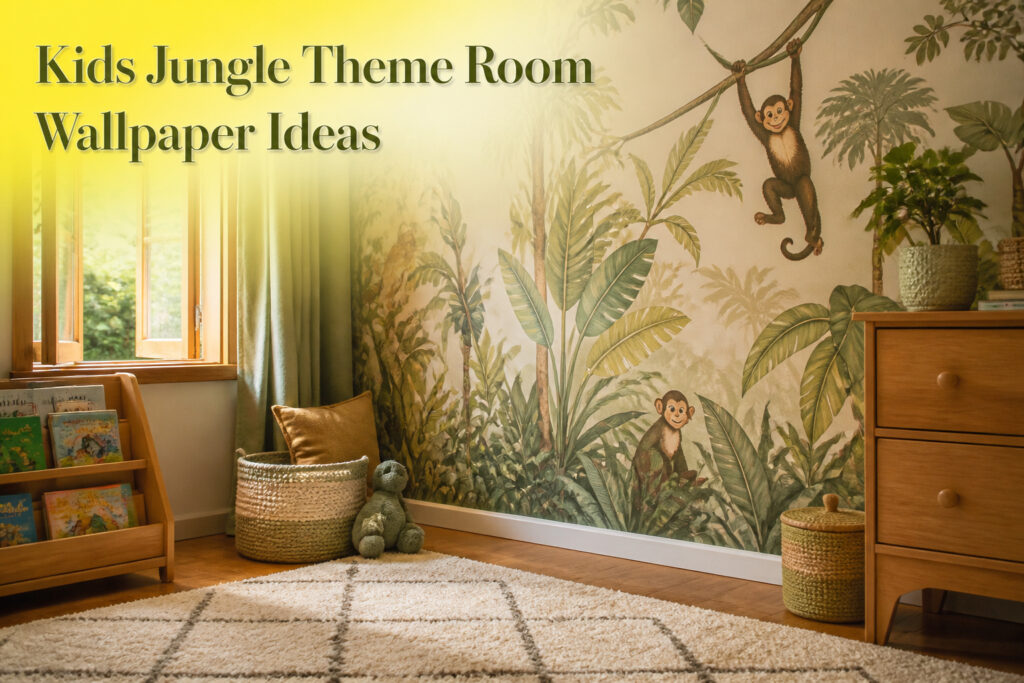
Kids room jungle theme wallpaper is peel-and-stick or paste-applied wall covering printed with jungle animals, tropical plants, or forest scenes designed for children’s bedrooms.
The real choice is between formats: peel and stick lifts off clean when your child outgrows monkeys at nine, while traditional paste survives years of bunk-bed scrapes but needs a steamer to remove.
A custom-sized tropical safari mural runs $5.57 per square foot, about $1.67 more than a standard repeating forest pattern, because someone scales the giraffe to your exact wall so its head does not land in the closet.
[link-whisper-related-posts]Kids Forest Animals in the Jungle Wallpaper Mural

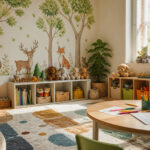
A watercolor mural with deer, foxes, rabbits, and lemurs set among tall pines gives you the storybook jungle feel without the saturated greens and roaring animals that overwhelm a small room. $3.90 per square foot, or about $42 per square meter, sits well below what most printed murals run, and the soft sage and warm neutral palette keeps the space calm enough for a nursery but still interesting enough to grow with a toddler.
We like that this style reads as "forest" rather than "jungle" in the strict sense, which matters if your kid’s room opens onto a hallway where you already have enough visual noise.
The misty mountain backdrop adds depth without demanding attention the way a photorealistic tropical print would. For parents who want the theme without the volume, this is the quieter option worth ordering a sample of first.
Tropical Nursery Safari Jungle Wallpaper

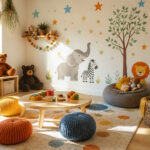
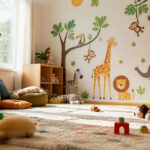
Watercolor elephants, giraffes, monkeys, and parrots drift across this mural in soft beige, green, and blush pink.
The hand-painted look keeps the layout airy, which makes the room feel larger than busier patterns allow. $5.57 per square foot puts it at the higher end of what we typically see for kids’ jungle wallpaper, though the minimum order structure means you are buying only what your wall needs.
The forest animals style that shows up in so many nurseries leans on deer, foxes, and owls in deeper greens and browns. That palette reads cozy but can turn heavy in a small room with limited light.
The tropical safari approach swaps in parrots and palm leaves, and the blush undertone warms the space without closing it in.
We have seen both work, but for a north-facing nursery or a room where you want the walls to recede, the lighter color intensity here wins.
Natural wood furniture and light textiles pair cleanly with it; the wallpaper does the visual work so you can skip hunting down matching accessories.
Peel and Stick Jungle Wallpaper

Over seventy jungle designs come in peel and stick format, and the $6 custom color sample lets you tape a real swatch to the wall before you commit. That matters more than it sounds.
We have watched too many parents eye a pattern online, order four rolls, and realize the green reads olive in their north-facing room. Six dollars ends that risk.
The backing strips away clean, which matters most for renters. When your lease ends, or when your eight-year-old decides jungles are "for babies," you lift a corner and pull slowly.
The adhesive stays on the paper, not the drywall. No steamers, no scoring, no spackle weekend.
Install timing is real. A standard accent wall runs about three hours if you work alone, two if someone holds the level.
The paper is repositionable for roughly the first ten minutes, so a crooked seam is fixable without waste.
We would still start behind the door, where mistakes hide, and save the focal wall for last, when your hands have the rhythm.
Feature Wall and Color Palette Options

A feature wall keeps the jungle pattern where it gets seen without swallowing the whole room.
We have found that dense, intricate designs work best this way; the eye gets the impact at the bed or reading corner, and the remaining walls stay in a solid color that you can match to existing paint without calling in a designer.
Pull one tone straight from the wallpaper itself, a green, a beige, or a blush if the print includes it, and take that chip to the paint counter.
The match does not need to be exact, just close enough that the wall reads as intentional background rather than leftover white.
Full-room coverage changes the feel entirely. The same watercolor elephants and parrots that look playful on one wall can turn busy when they wrap every surface, especially in a small Salt Lake City bedroom where square footage is tight.
If you go that route, look for airy layouts with open space between the motifs so the pattern can breathe. Soft palettes, the muted greens and blush pinks, keep a full room calmer than saturated jungle tones would.
The hand-painted look helps here too; the looser the illustration, the less the repeat grates on you by week three.
Two ways to play this: one bold wall and three pulled colors, or all four walls in something gentle and sparse.
The first wins if the room already has furniture in wood tones you cannot change; the second only works when the wallpaper itself is the quiet partner, not the main event.
Customizable Wallpaper Sizes

A standard wallpaper roll assumes your wall is a blank rectangle, which is almost never true in a real kids’ room.
We have cut around windows, door frames, and the odd angled corner where the closet juts out, and every time the math on the package left us short or with a seam in the worst possible spot.
Custom sizing fixes this by printing the mural to your exact wall dimensions, not the other way around.
Measure the full width and height of the wall surface you want to cover, ignoring any slopes, doors, or windows for now. The printer sends you a complete rectangle, and you trim the obstacle away during hanging.
For a sloped ceiling or a pitched wall, you still measure only the longest width and the longest height; the cutaway happens at installation, not in the factory. Add two to four inches to both dimensions when you order.
That buffer is not padding for the printer’s error, it is wiggle room for your own uneven corners and the moment you realize the baseboard was not quite level after all.
Sources pitch this as a practical fix, not an upgrade. You are not paying a premium for bespoke luxury; you are avoiding the waste of buying three standard rolls to patch around one window.
If you are wrapping the paper around multiple walls, add the widths together and order it as one continuous piece. The result is a single jungle scene that flows past the door frame instead of restarting with a mismatched seam.
Peel and Stick Against Traditional Paste

We have hung both kinds, and the difference is real once you are standing in the room with a wrinkle or a crooked seam.
Peel and stick goes up dry: pull the backing, smooth it on, and if the parrot’s head lands behind the dresser you lift and try again.
It comes back off without taking paint with it, which matters in a rental or when you are guessing whether the five-year-old will still want monkeys at nine.
The trade is everyday durability, not hard-wearing, and the finish stays matte and smooth.
Traditional paste, whether non-woven or the textured grades, needs paste on the wall and a wet strip to position.
You get one shot to align the tiger stripe before the adhesive grabs, and removal means peeling dry, though the sources say it leaves no residue.
The upside is a harder-wearing surface and, with the premium textured line, a canvas-like finish that reads more like a mural than a sticker.
| Peel and Stick | Traditional Paste (Non-Woven) | |
|---|---|---|
| Best for | Rentals, quick refreshes | Feature walls, whole rooms |
| Application | Dry, no paste | Paste the wall |
| Repositionable | Yes, during install | No |
| Removal | Damage-free | Peels off dry, no residue |
| Durability | Everyday | Hard-wearing |
| Finish | Matte, smooth | Matte, smooth |
If you are renting or might swap the theme before middle school, peel and stick wins.
If you own the wall and want the print to survive years of being brushed by bunk-bed corners, paste the wall and call it done.
What Eco-Friendly Inks and Materials Mean

PVC-free wallpaper and eco-friendly inks show up on a lot of jungle theme labels now, and we have started checking for them when we stock kids’ room options.
The material matters because standard vinyl wallpaper can off-gas in a warm bedroom, and children spend more hours breathing that air than adults do.
We are not making medical claims the manufacturers do not make; we are noting that PVC-free backing is the easier thing to hang without a respirator and a window fan, and that counts for a weekend project in a child’s room.
The eco-friendly ink side is even less defined on most product pages. We have seen "water-based" and "non-toxic" used interchangeably, with no standard attached.
Our read: if a roll costs the same and the print quality looks identical, the cleaner ink is worth specifying. If it adds twenty percent to the price, the benefit is harder to justify unless your child has known sensitivities.
Happywall’s matte finish is printed in Sweden and ships to the US in 2–10 business days, which gives you a timeline if you are ordering for a birthday or a move.
Their peel-and-stick uses the same ink set as their traditional paper, so the choice between formats does not change the chemistry question.
Grandeco’s Boutique Tropical Palm Leaf lists PVC-free explicitly at £28 per roll, which is mid-range for a specialty print.
That is the level of detail we would look for on any jungle theme you are considering: not a green badge, but the actual material and ink named on the spec sheet.
Price Ranges Across Jungle Wallpaper Types

Wallpaper for a jungle theme runs $3.32 to $5.57 per square foot, and the gap comes down to what you’re actually printing. A repeating pattern with forest animals lands near the bottom at $3.90.
Step up to a full-wall tropical safari mural and you’re at $5.57. Custom samples run about $6 each, which is worth it if you’re gambling on color match.
| Wallpaper type | Price per sq ft | What you’re paying for |
|---|---|---|
| Forest animals pattern | $3.90 | Repeat print, standard roll |
| Tropical safari mural | $5.57 | Custom crop to your wall |
| Custom sample | $6 | Color proof before full order |
The mural pricing includes the crop work. You’re not paying for better vinyl, you’re paying for someone to scale the image to your exact wall dimensions so the giraffe’s head doesn’t end up in the closet.
For a one-wall weekend project, that extra $1.67 per foot is usually worth skipping the headache of pattern matching across a corner.
What Customers Say After Installing

Peel and stick jungle wallpaper earns its keep in the feedback we see most often.
A perfectionist installer put in seven hours on a peacock print, which is not the quick afternoon most renters hope for, but the result still won the household over completely. That tradeoff matters for your weekend timeline.
The easier wins come from the no-paste, no-prep, no-mess promise that shows up in the satisfaction notes. Clean the wall, stick it down, and the job is done.
Removal is the same in reverse: lifts off without taking paint or drywall with it.
For a kids room jungle theme wallpaper that might need to change as the child ages out of it, that clean exit is worth weighing against traditional paste.
People mention how the design looks finished once it is up. Depth and pattern that would take a skilled hand to paint arrive as a finished surface, no talent required.
A jungle mural turns a wall into scenery without the cost of a commission.
Frequently Asked Questions
What types of jungle wallpaper are available?
The main styles are forest animals murals with deer, foxes, and rabbits in soft sage and neutrals; tropical safari prints with elephants, giraffes, monkeys, and parrots in beige, green, and blush; and peel-and-stick options in over seventy designs.
Forest patterns run quieter for small rooms, while tropical styles open up north-facing nurseries with lighter color intensity.
How do I install peel and stick wallpaper?
Clean the wall, peel off the backing, and smooth the paper into place. A standard accent wall takes about three hours solo or two with a helper holding the level.
The paper stays repositionable for roughly ten minutes, so crooked seams can be fixed without waste. Start behind the door where mistakes hide, and finish on the focal wall once your hands have the rhythm.
Can I customize the size of the wallpaper?
Yes. Custom sizing prints the mural to your exact wall dimensions rather than forcing you to patch standard rolls around windows and doors.
Measure the full width and height, ignoring obstacles for now, and add two to four inches to both dimensions for wiggle room at uneven corners.
For multiple walls, add the widths together and order as one continuous piece so the jungle scene flows past door frames without a mismatched restart.
How to style a room with jungle wallpaper?
Use a feature wall for dense, intricate designs so the pattern stays where it gets seen without swallowing the whole room.
Pull one tone straight from the wallpaper, a green, beige, or blush, and match remaining walls to that chip at the paint counter.
Natural wood furniture and light textiles pair cleanly with tropical safari prints; the wallpaper does the visual work so you can skip hunting down matching accessories.
What is a good wallpaper for a kids’ room?
Peel-and-stick jungle wallpaper works well because it lifts off clean when tastes change, no steamers or spackle needed. For a nursery, look for soft palettes like sage greens and warm neutrals or blush undertones that keep small spaces calm.
PVC-free backing and water-based inks add safety for rooms where children spend long hours.
What is the most popular kids wallpaper theme?
Jungle and safari themes rank high, with forest animals and tropical prints both common choices. Forest styles lean on deer, foxes, and owls in deeper greens and browns, while tropical approaches use parrots and palm leaves in lighter, airier layouts.
The tropical safari style has gained ground for nurseries because its softer color intensity keeps walls from closing in a small room.