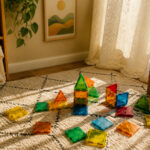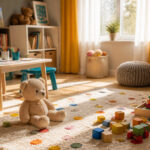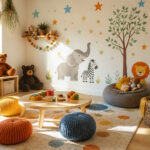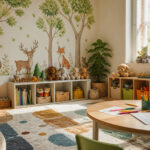
These seven playroom wall paint ideas run from a Saturday afternoon with peel-and-stick vinyl to a full mural that takes a week and a local artist’s fee.
For the shortest commitment, look for decals that say removable and repositionable on the package; for the longest, chalkboard paint survives years of doodles and wipes clean with just a damp cloth.
[link-whisper-related-posts]1. Color Blocking

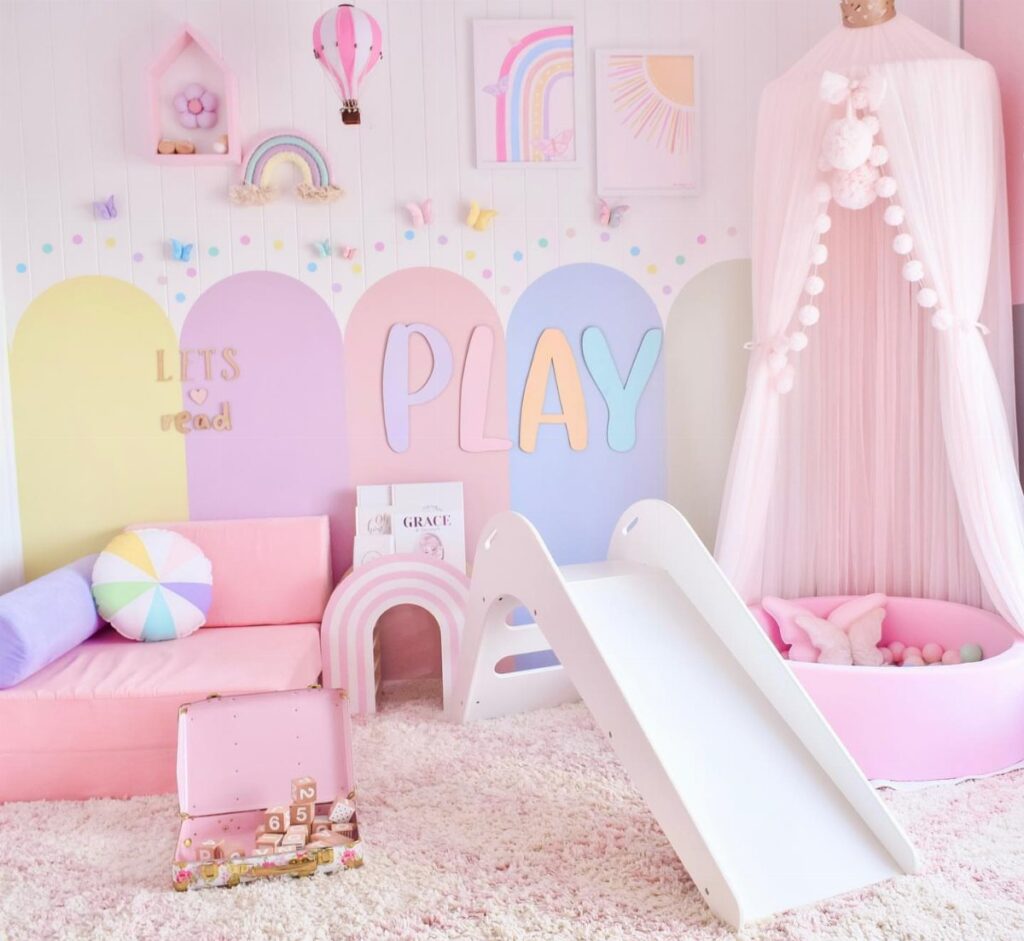
Color blocking turns one wall into several without a single piece of trim. Pick three or four hues that sit well together, then paint the lower third in one color, the middle in another, and the top in a third.
Arches and circles work too if straight lines feel too orderly. The effect is lively but controlled, which matters when the rest of the room already holds a slide and a ball pit.
Cool tones in particular help kids settle in for reading or puzzles. We like this for renters who can paint but cannot remodel; it reads as intentional design, not a half-finished project.
2. Chalkboard Paint

Chalkboard paint gives kids the wall they already wanted. Paint an entire wall or keep the chaos inside a single arch or rectangle.
The surface takes regular chalk, wipes clean with a damp cloth, and holds up to years of doodles.
We have seen this save actual drywall in houses with toddlers who will find a crayon no matter where you hide it.
A contained section near the floor works best for the under-five set; older kids can handle a full wall without grinding dust into every surface in the room.
3. Pastel Colors

Pale pinks, blues, yellows, and greens settle a room down without going dull. These are the colors that let toys and posters do the shouting instead of competing with them.
Paint one wall or all four; either reads as intentional rather than leftover. We like mint or pale blue for rooms that double as nap spaces, since those hues actually seem to lower the volume of the afternoon.
The paint grows with the child better than character wallpaper does. Pick the shade together; a kid who chose the color will let it stay up longer.
4. DIY Art Installations

DIY art installations let you frame the kids’ own work as the room’s main event. Paint simple black outlines directly on the wall, then swap the drawings inside whenever the mood strikes.
Paper flowers, fabric banners, or yarn-wrapped letters fill the same role if you want texture.
A good rule is to let the art fill about two-thirds of the open wall, leaving clear space around furniture and any trim. Measure height and width, then multiply each by 0.6 and 0.75 to get your range.
The materials run cheap enough that you can knock this out in a couple of days, and the kids can help make the pieces themselves.
5. Murals

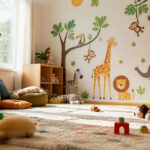
A mural turns a wall into whatever your child is currently obsessed with. Trees, rainbows, space scenes, or a fairy with a wand and a field of flowers; the subject is whatever holds their attention this year.
Hand-paint it if you have the nerve and a projector to trace from. Stencils cut the skill level way down.
Hiring a local artist costs more but buys you someone who will finish before the interest passes. Either way, paint the background color first and let it cure fully before you start the detail work.
6. Gallery Wall

A gallery wall of framed crayon drawings tells a kid their work matters enough to hang. Use matching frames or mix them; the consistency of the art underneath ties it together either way.
Swap pieces out as new favorites appear, or keep the originals and scan them so nothing gets lost. This suits kids old enough to produce recognizable subjects but young enough to still care that you noticed.
The confidence boost is real, and the cost is mostly in frame hooks and patience.
7. Whimsical Wall Decals
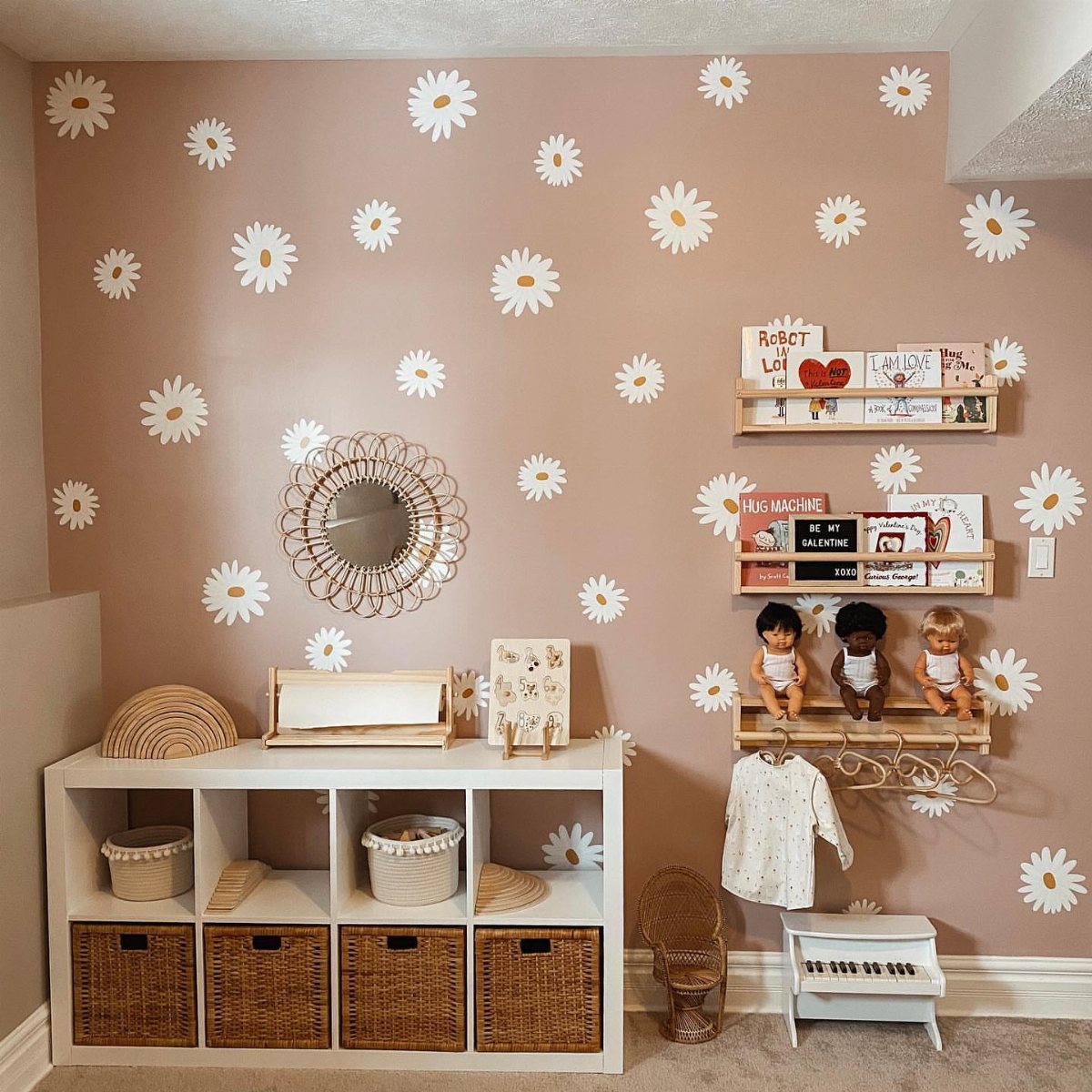
Whimsical wall decals let you change the whole mood of a playroom in an afternoon without touching a brush.
White daisies on a dusty rose ground are one way to go, but the same approach works with animals, story figures, or whatever your kid is into right now.
Peel-and-stick vinyl is the type to look for. Check that the package says removable and repositionable before you buy; cheaper permanent stickers will tear the paint when your child outgrows them.
One or two sets cover a focal wall, and the sheets are cheap enough that you can swap them out when interests change.
This suits renters or anyone who wants the look without the commitment of paint. Decals do not hide wall damage, and very textured surfaces make them bubble.
If your walls are rough, a smooth panel mounted first gives them something to grip.
Choosing the Right Colors
Start with how you want the room to feel, not which characters your kid likes this month. Calm but not boring.
Energized but not chaotic. That balance keeps the space livable for you too.
Sticking with a quieter wall color lets the toys, books, and whatever they make this month carry the visual weight. For a bolder route, pair Honeybee with Teacup Rose, or Serenata with Morning Walk.
These combinations wake up the room without overwhelming it.
Durability Considerations
Playrooms take hits that living rooms never see. The finish matters as much as the color.
Limewash paint hides minor scuffs inside its texture, so small marks do not scream for touch-ups the way flat paint does.
A metallic finish catches the light and keeps the room moving without leaning on bright color to do all the work.
Micrometal finishes work when the playroom doubles as family space; they read grown-up enough for adults while still handling kid-level wear.
You can paint right over any of them later, no stripping or priming first. That matters when the room needs to shift from toddler territory to homework zone in a few years.
Involving Children in Design
Let kids choose, but give them boundaries that keep the room usable. Two or three pre-selected swatches beats an open paint deck every time.
Ask how they want the space to feel rather than which color they saw on a screen. That question usually gets you closer to something you can both live with.
For bolder personalities, pair their pick with a balancing neutral. Gray plays with nearly any accent color and shifts easily as phases change.
Layer blues, greens, or corals on top; the backdrop stays steady while the room grows.
A. The best colors for kids’ rooms are the hues that make them feel confident and comforted. With 3,500+ hues to choose from, Benjamin Moore has paint colors for every kid and every personality.
Versatility for Growth
The room will outlast the dinosaur phase. Plan for it.
Cool neutrals like gray make the easiest backdrops. They pair with whatever accent color matches the current obsession, then shift again when that passes.
No stripping, no priming, no starting over.
Toys, posters, and books bring the theme; the walls just need to not fight them.
Bold pairings like Honeybee and Teacup Rose or Hint of Violet and Fernwood Green hold energy now without locking you into a look that feels young too fast.
We like finishes that paint over clean when the room needs to become a homework zone or hangout space.