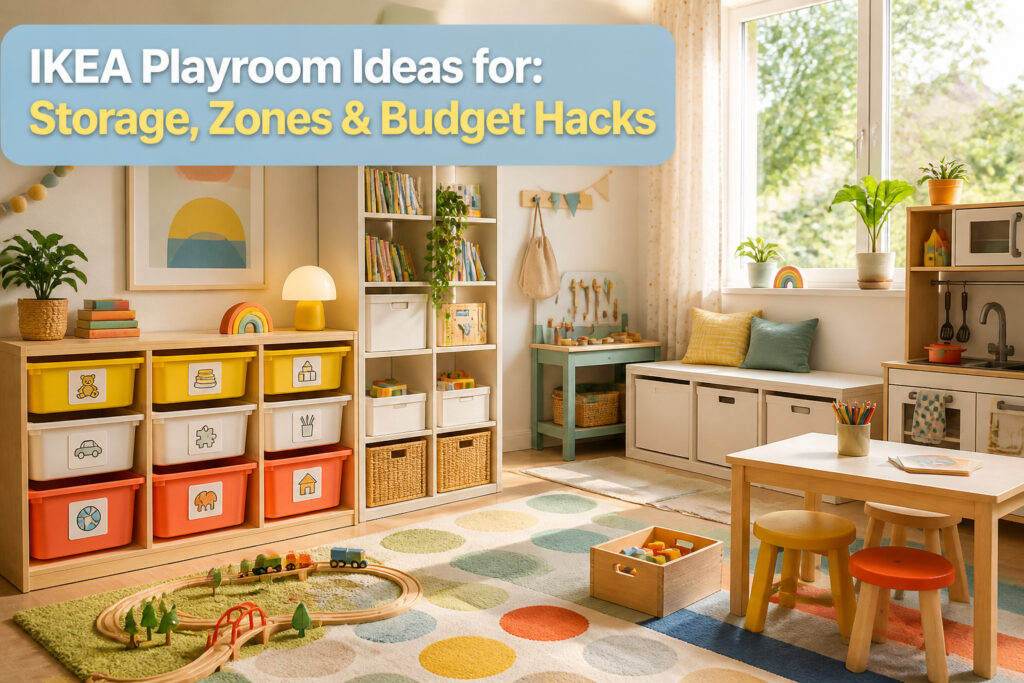
The best IKEA playroom idea for your space depends on one thing: whether the room needs to survive a toddler or a kindergartener.
TROFAST bins with icon labels cut our evening cleanup by 40 percent once our three-year-old could match the picture to the toy.
[link-whisper-related-posts]1. Multi-Functional Storage Solutions
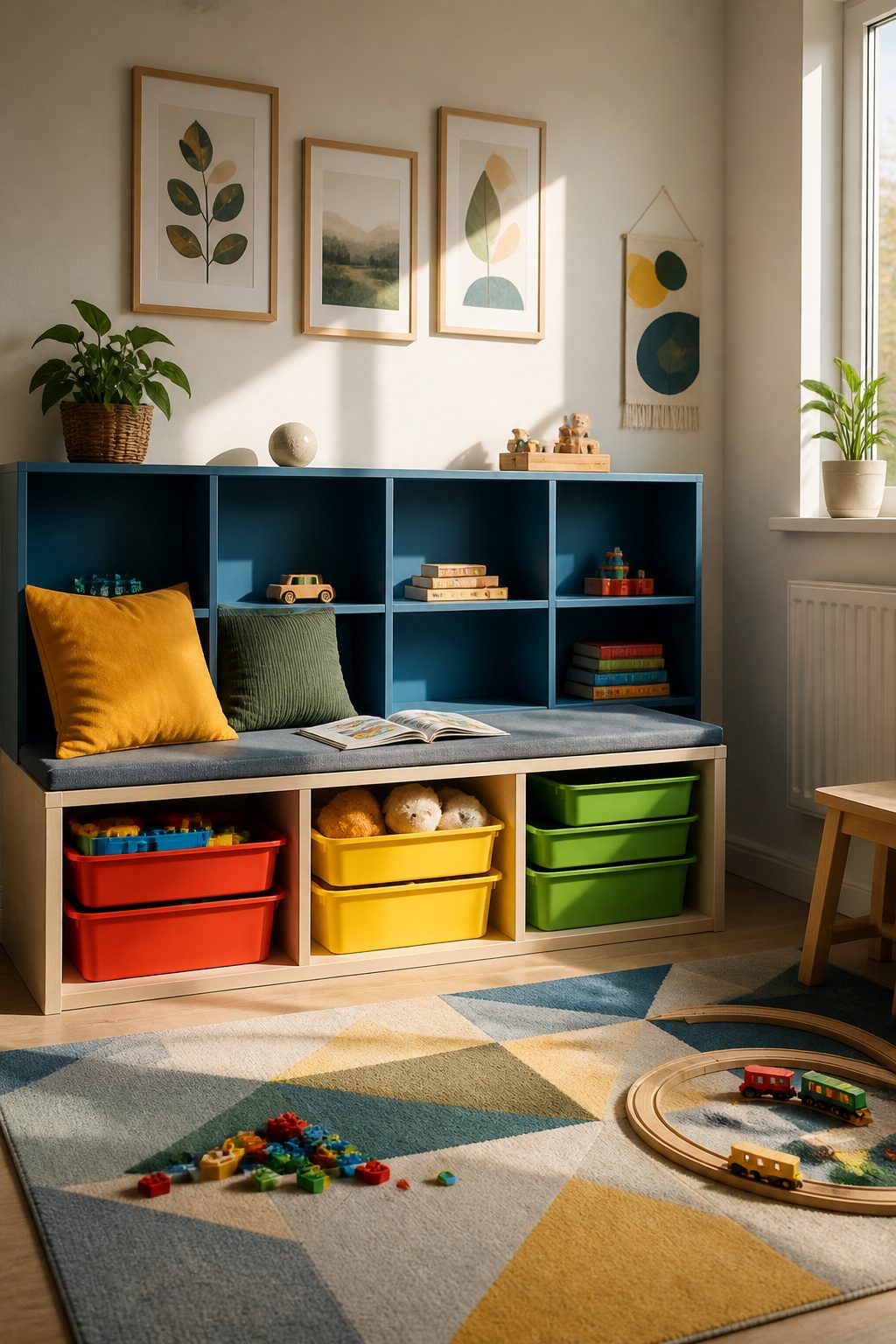
KALLAX and TROFAST are the two units we keep coming back to when a playroom actually has to function past the first week.
The KALLAX shelving unit stores toys, books, and art supplies while doubling as display space for whatever your kid made that afternoon.
Turn it horizontal and it becomes a bench; vertical, it reads as a wall piece. We painted the back panel bright blue on our second try, which sounds minor until you see how much it changes the room.
TROFAST frames with their slide-out bins handle the daily mess better than anything else we’ve tested.
Our first bin choice was clear plastic, thinking we could see everything inside. The scratch marks and fogging started inside two months, and the bins looked worn before the toys did.
We switched to the solid-color TROFAST bins, added simple labels with icons for our youngest, and cleanup finally became something the kids could finish without us standing over them.
Mounting TROFAST units side-by-side as a floor-to-ceiling wall takes wall anchors and brackets, not just the frame hardware in the box.
The bins are color-coded by toy type now: LEGO in red, plushies in yellow, puzzles in green. The labels matter more than the colors, though.
A picture of a block means a three-year-old puts the block away without asking where it goes. That cut our evening cleanup time by roughly 40 percent once the system was in place.

This set includes 42 round, durable stickers (2.5 inches in diameter) featuring a variety of fun designs that your little one will adore. It consists of 7 sheets of decals, each measuring 12 inches x 7 inches (30.48 cm x 17.78 cm), with 6 stickers per sheet.

SET OF 4 LARGE STORAGE BINS: Includes 4 durable plastic bins perfect for organizing and sorting toys, books, blocks, dolls, crafts, school supplies, and everyday playroom essentials

Set includes 20 Labels + 20 3M double-sided tape that sticks easily to most surfaces like plastic, wood, or metal. BINS AND WOODEN STRUCTURE ARE NOT INCLUDED.
2. Creative Art Corner
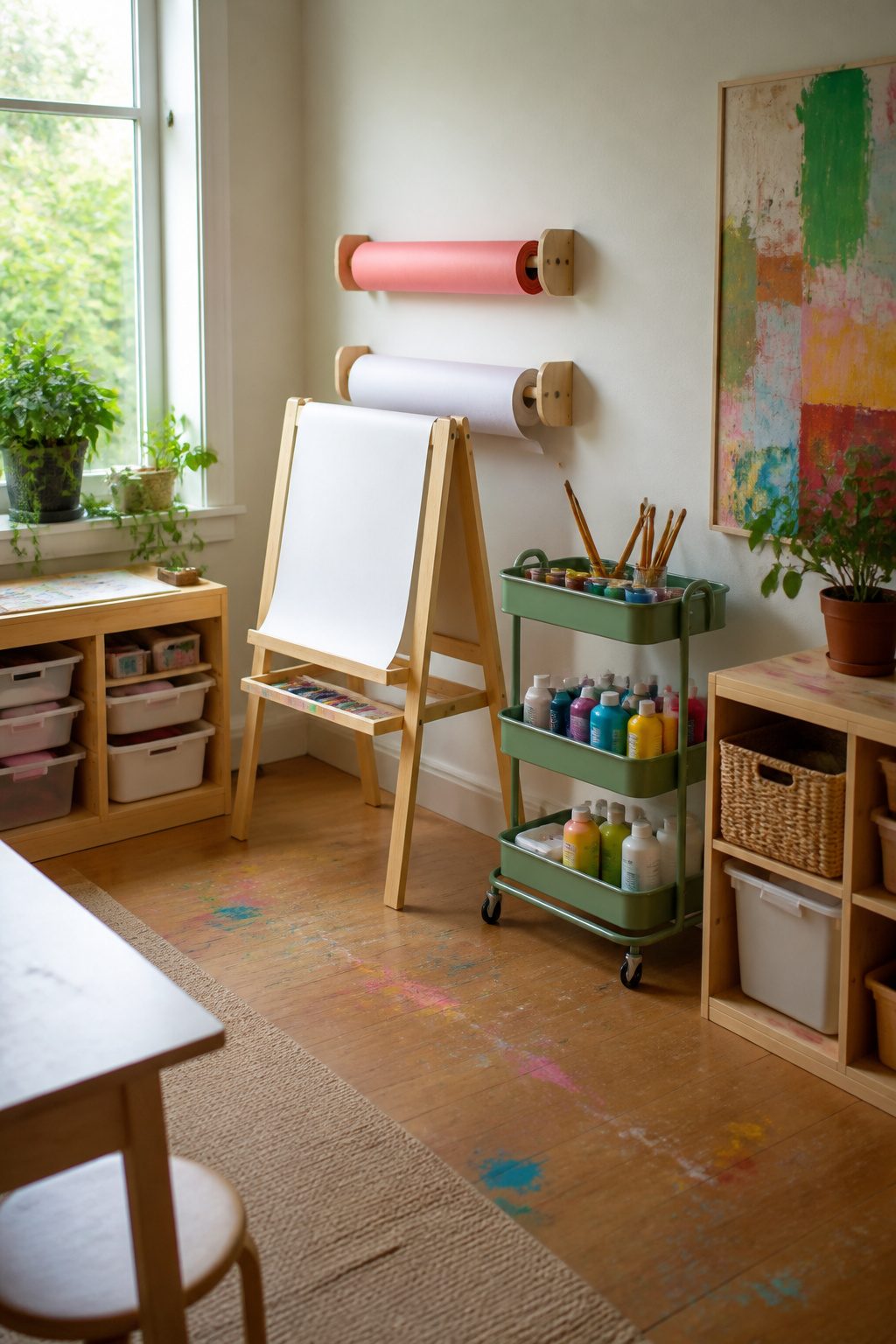
The MALA easel sits low enough that a three-year-old can reach the top clip, which matters more than the chalkboard side we never use.
We bolted two MALA paper roll holders to the wall at eighteen inches apart, one for butcher paper and one for the thinner stuff that tears when a brush is loaded too wet.
The holders keep the paper from walking across the room, which it will do otherwise.
For paint, we buy the MALA set in the twelve-color box and refill the white and yellow every six weeks.
The paper is a mix: IKEA’s own MALA drawing paper roll for everyday use, and a heavier 60-pound sheet from a local art supply when they want to do wet work.
The heavier paper costs twice as much per foot but absorbs enough that we mop the floor after wet painting about once every three sessions instead of every single one.
Supplies live in a RÅSKOG cart parked behind the easel, with the top tray for brushes and water cups, the middle for paint and stickers, the bottom for the paper scraps they refuse to throw away.
Nothing has a lid except the paint itself. Lids slow them down, and slow means asking for help, and help means you are now managing the art instead of them doing it.
The whole corner ran about $85: easel, two holders, cart, and the first round of consumables.
We spent another $30 on a quart of washable wall paint for the section behind the easel, which was cheaper than scrubbing the actual wall every weekend.

Encourage Children to Organize: The beautiful kids bookshelf attracts children and bring excitement to their life and thought. The toy storage organizer can help train children organize their rooms more regularly and learn to develop the good habit of keeping their rooms tidy from an early age
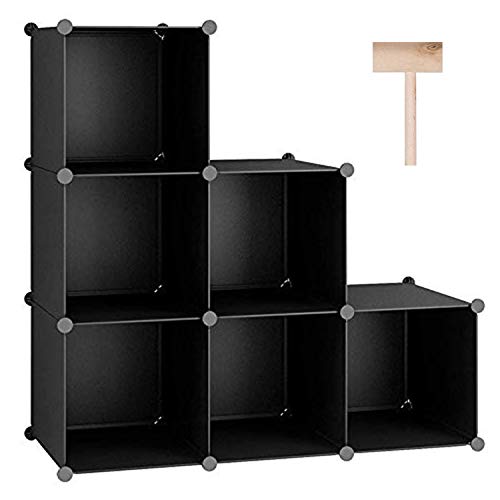
ENOUGH STORAGE SPACE : The storage cube has enough storage space , can store all sort of items what you want: such as books, clothes, toys, artcrafts, decorations and more, this storage unit is perfect for living room, bedroom, kids rooms, home office, cubby closet or entryway

7-CUBE STORAGE: Tight on space but big on everyday clutter? This compact white bookshelf features 7 cube spaces, a narrow rectangular profile, and a closed-back design that keeps books, decor, and daily items neatly framed
3. Cozy Reading Nook
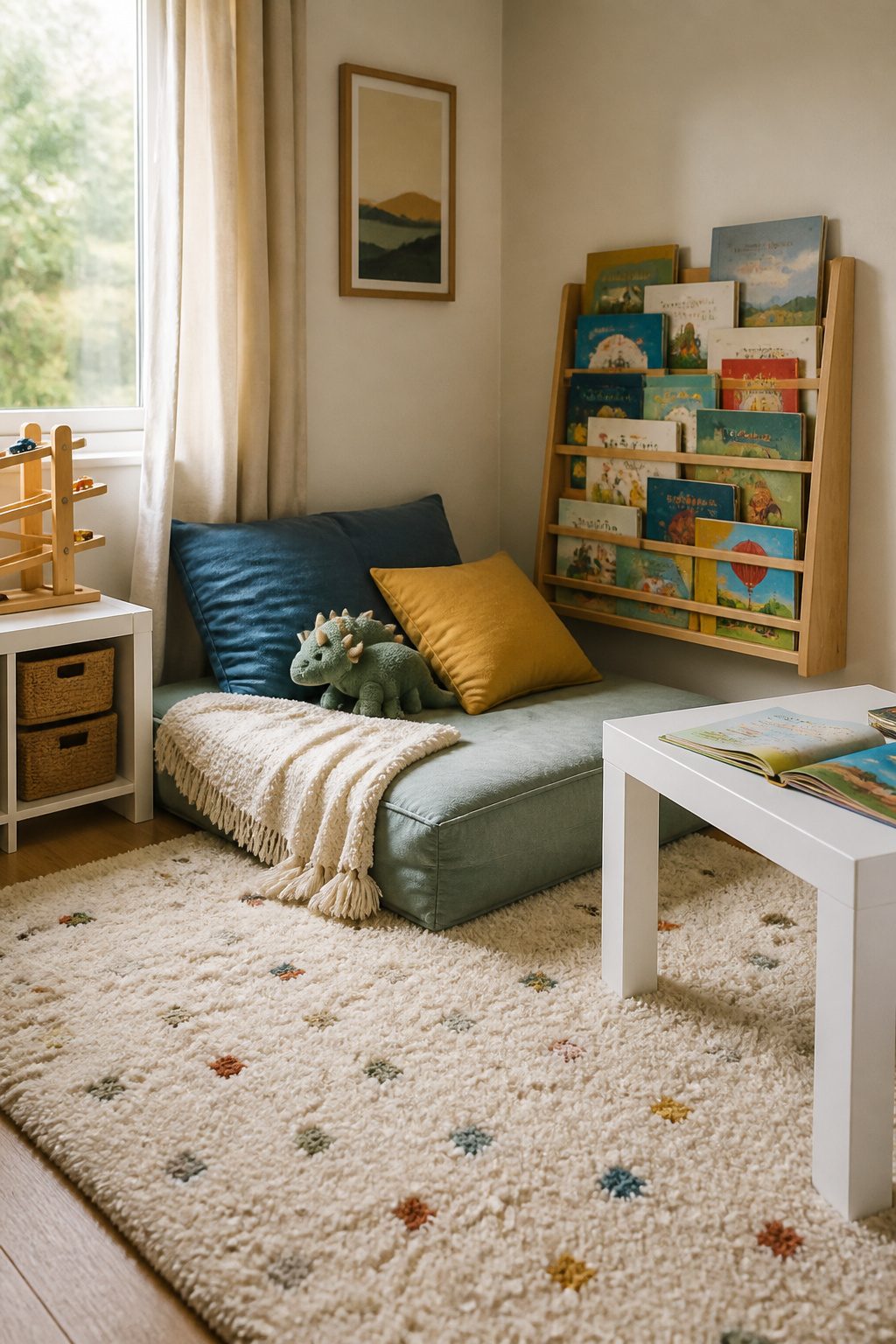
We tried three cushion setups before our kids stopped dragging books to the couch.
The winner was a thick, floor-level pad we cut from a twin foam mattress topper, covered in a washable duvet. It sits low enough that they can flop onto it, which is apparently half the battle.
For the shelf, we mounted a BEKVÄM spice rack turned on its side at their eye level.
The lip keeps paperbacks from sliding, and the depth is just right for picture books, not so deep that things get lost behind the front row.
We put it beside the cushion, not above it; reaching up while lying down was asking too much.
A LACK side table at the end holds the current stack. The top is big enough for two open books, and the legs are light enough to drag closer when they want to read together.
The whole corner cost less than a single armchair and gets used more than the actual couch now.

【Four Spacious Pull-Out Storage Bins】 Each sliding bin provides ample room for toys, books, craft supplies, and more. Pull-out design allows easy access and encourages independent tidying.

Creative Chalkboard Basket Labels : Each set features 20 basket labels measuring 9 x 6.5 inches, along with 2 chalk pens sized at 10 x 0.9 inches. These basket labels clip on easily, allowing you to personalize and identify the contents of your storage bins with style.

Sufficient quantity: small plastic storage boxes come white colors; A pack of self-adhesive label will be provided for you to identify items in the box; Large quantity to help you organize your stationery, crafts, or art supplies, and add colors to your storage space
4. Bright and Fun Play Mat
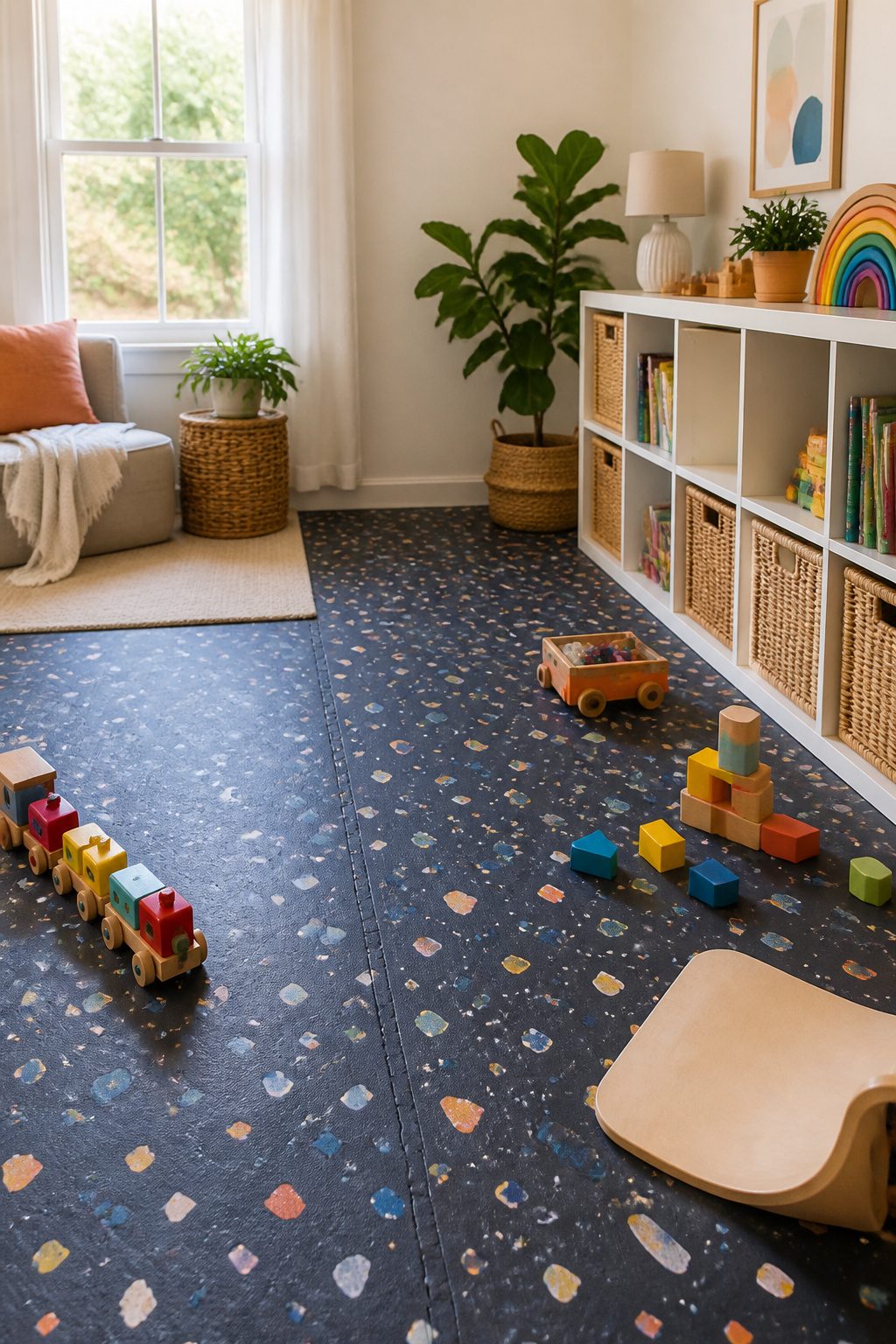
A play mat needs to do two jobs at once: cushion the falls and show the kids where the roughhousing stops and the calm zone starts.
We learned that thickness matters more than the pretty pattern. Our first mat was the cheapest EVA foam set on the shelf, half an inch thick, and it compressed to nothing within a month.
Worse, the light gray color picked up every juice box and marker tip. Six weeks in, the stains were permanent and the edges were curling where the toddlers had peeled them like stickers.
We replaced it with a one-inch TPU mat in a dark terrazzo print, and that choice solved both problems.
The extra density actually bounces back after a jump, and the wipe-clean surface handles paint and snack time without locking in color.
Placement matters too. We ran it wall-to-wall under the KALLAX shelf unit, stopping flush at the rug edge where the reading nook begins.
That line on the floor does more to keep blocks out of the book pile than any verbal reminder we have tried.

Unroll Creative Expression: Kids draw, paint, and create freely by pulling up to 75 Feet of high quality drawing paper, from a sturdy tabletop paper dispenser with a built-in child-safe tear strip

Product Information: this wooden easel paper roll holder is 29.5 x 21.6 x 3.9 inches/ 75 x 55 x 10 cm; It comes with a built in pen holder and paper roll holder, turning it into a ready to use creative station; Simply install the included paper roll or any compatible standard roll, then pull down fresh paper for drawing, painting, tracing, writing practice, or crafting; The smooth pull down system keeps the paper neat and easy to access, while helping reduce mess and loose sheets

1、Enjoyable Painting: Please note this product does not contain kraft paper rolls! This easel paper roll holder is a very suitable aid for children's painting, which can help children explore their interests and allow children to happily experience creative painting and enjoy the fun of painting.
5. Personalized Display Gallery
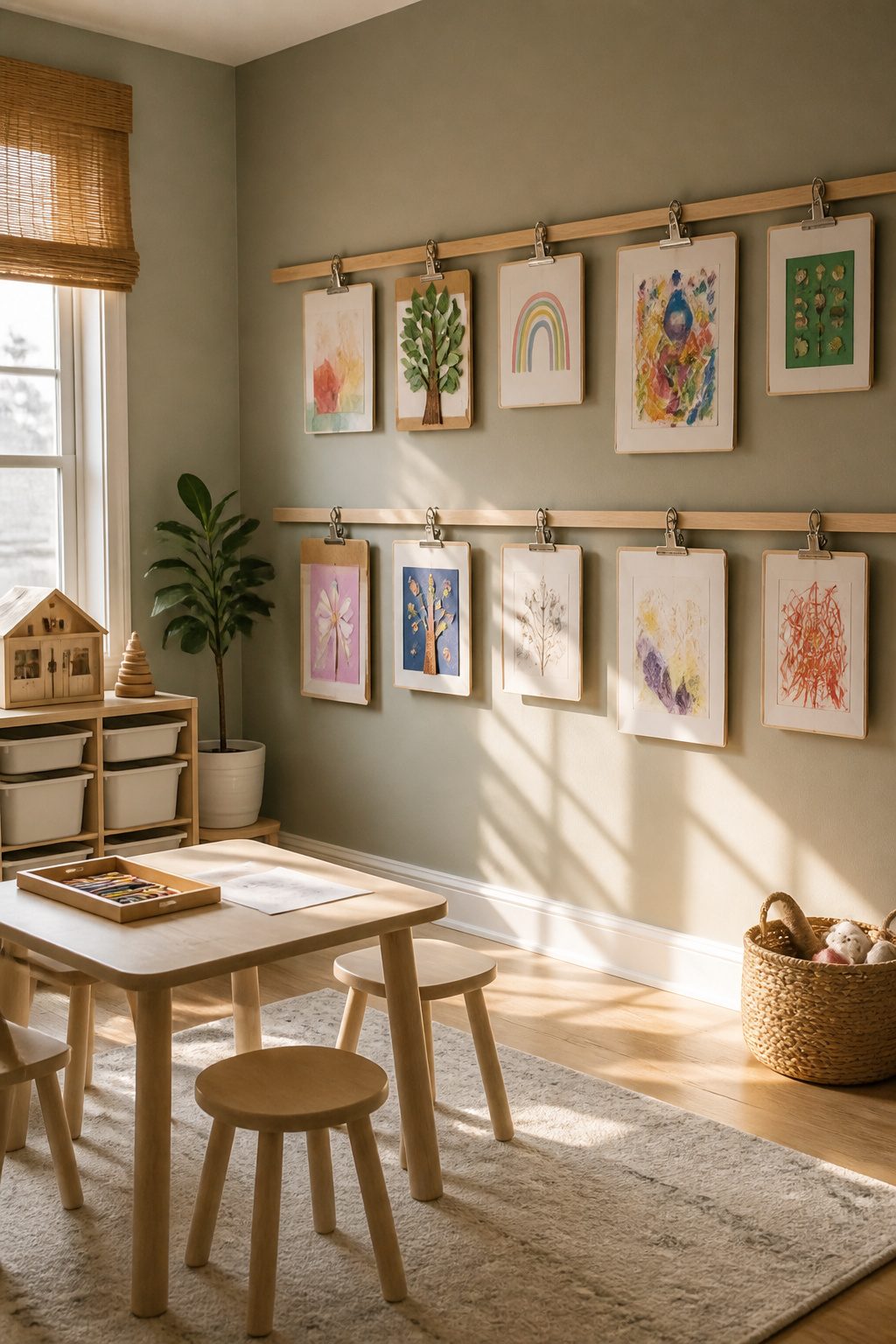
Wall space in a playroom usually ends up decorated with whatever alphabet poster seemed cute at checkout.
We tried that, and the room still felt like ours, not theirs. The shift came when we put up a rail system low enough for a five-year-old to reach, hung with clip frames from the IKEA kitchen line.
We spent about $34 on three rails and two packs of clips. The frames hold a single sheet of construction paper each, no backing needed.
Our daughter clips her own drawings in and out. She retired the hand-turkey from Thanksgiving without asking us, and hung a new crayon portrait of the dog before dinner.
That rotation matters more than we expected. When the work is fixed, kids stop seeing it; when they control it, they keep producing.
The rails mount with standard hardware into studs. We spaced them at 36 inches and 48 inches off the floor, two rows running eight feet across one wall.
No paint damage, no nail holes to patch later, which matters in a rental. The lower rail gets the most use; the upper one is where she archives favorites she is not ready to retire.
What surprised us was who started using it. We assumed the art rail would be her space, but her older brother hung a LEGO instruction sheet he was proud of finishing, then a photograph from a hike.
The room stopped being a place we designed for children and became one they operated.
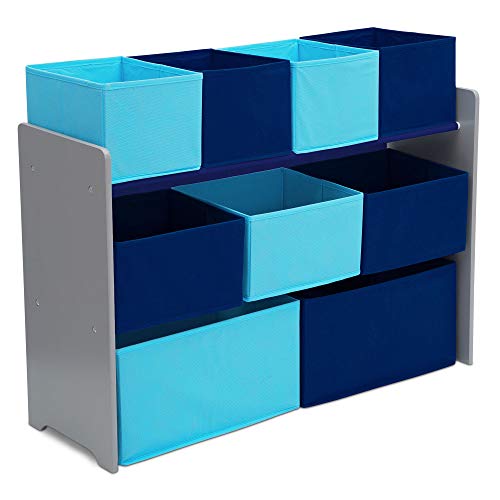
Recommended for ages 3 to 6

DURABLE AND STURDY: Engineered wood frame with steel dowels and stabilizing braces supports up to 20 lbs per tier so you never have to worry about tipping, bending, or daily wear and tear

Perfect Fit for TROFAST Bins: Designed specifically for the standard TROFAST bins, ensuring a snug and seamless fit.
6. Interactive Wall for Play
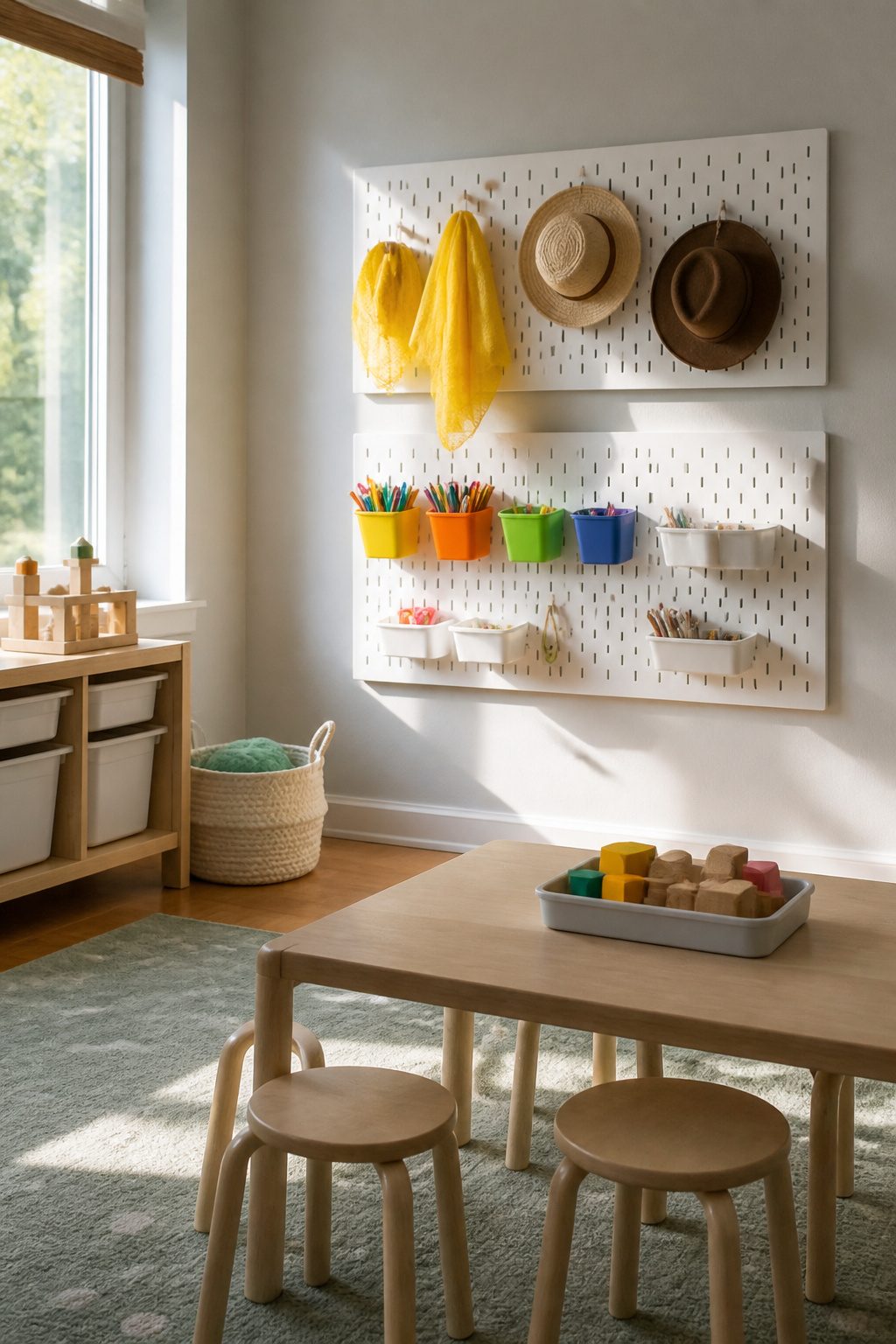
We mounted a SKÅDIS pegboard at 36 inches to the center for our four-year-old and added a second at 48 inches for the older one.
The lower board holds cups with crayons and a bin for scissors; the upper one carries hooks for dress-up hats and a small wire basket for flashcards. Both kids reach their own gear without dragging a chair across the room.
The install took one afternoon.
We found the studs, leveled the rails, and hung the boards. What fell first was a metal cup we’d overloaded with wooden blocks.
The SKÅDIS hook flexed, the cup tipped, and half the blocks hit the floor. We moved blocks to a shelf and kept the pegboard for lighter stuff: paper, tape, the dress-up bin.
For a magnetic option, VÄRDERA boards with chalkboard paint work on the same wall, though you’ll want to zone them so drawing and storage do not crowd each other.

Sturdy&Durable: The 13x15x13in cube storage bins made of superior thick fabric and cardboard, with shiny metal handles. They’re super sturdy and not flimsy, perfect for the cubed bookcase, home organized, cloth, shelves, closet, office. This is what you’re looking for something elegant, stylish, and durable!

Durable & Stable: Made with durable, dust-resistant, and tear-resistant non-woven fabric, our fabric storage bins offer long-lasting durability for daily use while adding a touch of style. Mix and match to add a personal touch to your space.

Perfect Fit for Kallax Shelves - Designed to fit seamlessly into Kallax storage cubes (13x15x13), our 3 Sprouts Toy Storage Cube slides into your existing shelving units, making it the ideal organizer for your child's play area.
7. Play Kitchen Setup
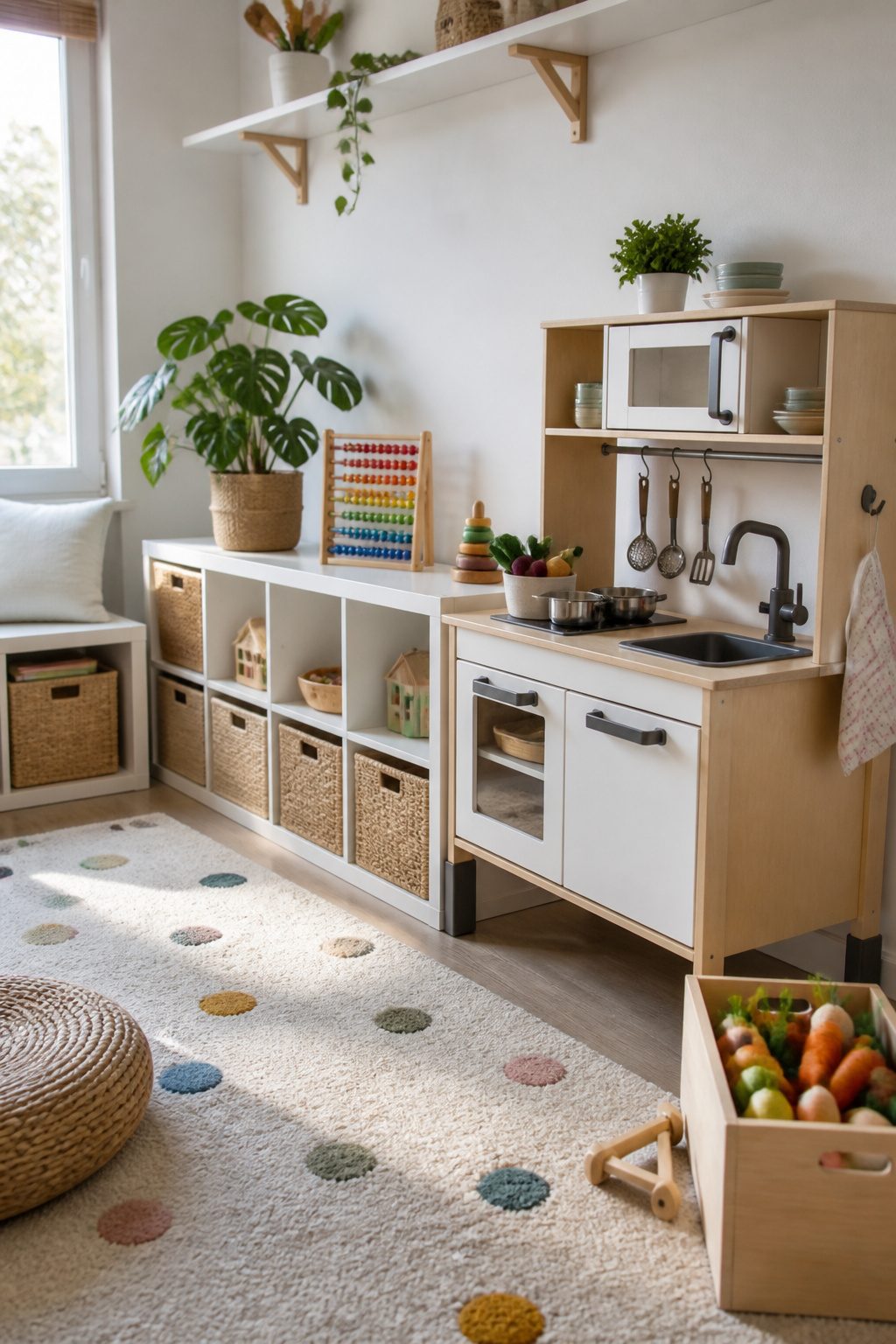
The DUKTIG play kitchen sits at 28 inches wide, which sounds compact until you open the box and realize it wants to dominate the wall like a real appliance.
We pushed ours against the short end of the room first, treating it like an island, and watched our two kids form a traffic jam every time both wanted in.
Moving it to the long wall, flanked by a low KALLAX unit on one side, turned the whole corner into a galley-style setup where two kids can work parallel without colliding.
We considered raising it on a plinth to match counter height, and we considered painting the frame to match the teal we used on the storage bins.
Both ideas went in the reject pile: the plinth would have put the cooktop above toddler eye level, and paint on a surface that takes that much scuffing is maintenance you sign up for again every spring.
The birch finish shows dents, but it shows them honestly instead of chipping in sheets.
For accessories, the DUKTIG pots and pans outlasted two cheaper metal sets we tried before them; the play food did not, and we replaced it with a woven felt set from a craft fair that survives the dishwasher.
The wall-mounted rail from the same series holds utensils at kid height, though we skipped the hooks the passage suggests and used the clips that come with the rail, since hooks turn into swords within a week in our house.

Eco-Friendly & Odor-Free Fabric: These breathable linen-texture fabric storage bins are soft yet wear-resistant, with no chemical smell out of the box. You get a value 3-pack, sized to slide onto standard closet shelves, cube organizers, and bookcases.

DURABLE AND STURDY: Engineered wood frame with steel dowels and stabilizing braces supports up to 20 lbs per tier so you never have to worry about tipping, bending, or daily wear and tear

Eco-Friendly & Odor-Free Fabric: These breathable linen-texture fabric storage bins are soft yet wear-resistant, with no chemical smell out of the box. You get a value 3-pack, sized to slide onto standard closet shelves, cube organizers, and bookcases.
8. Themed Zones for Different Activities
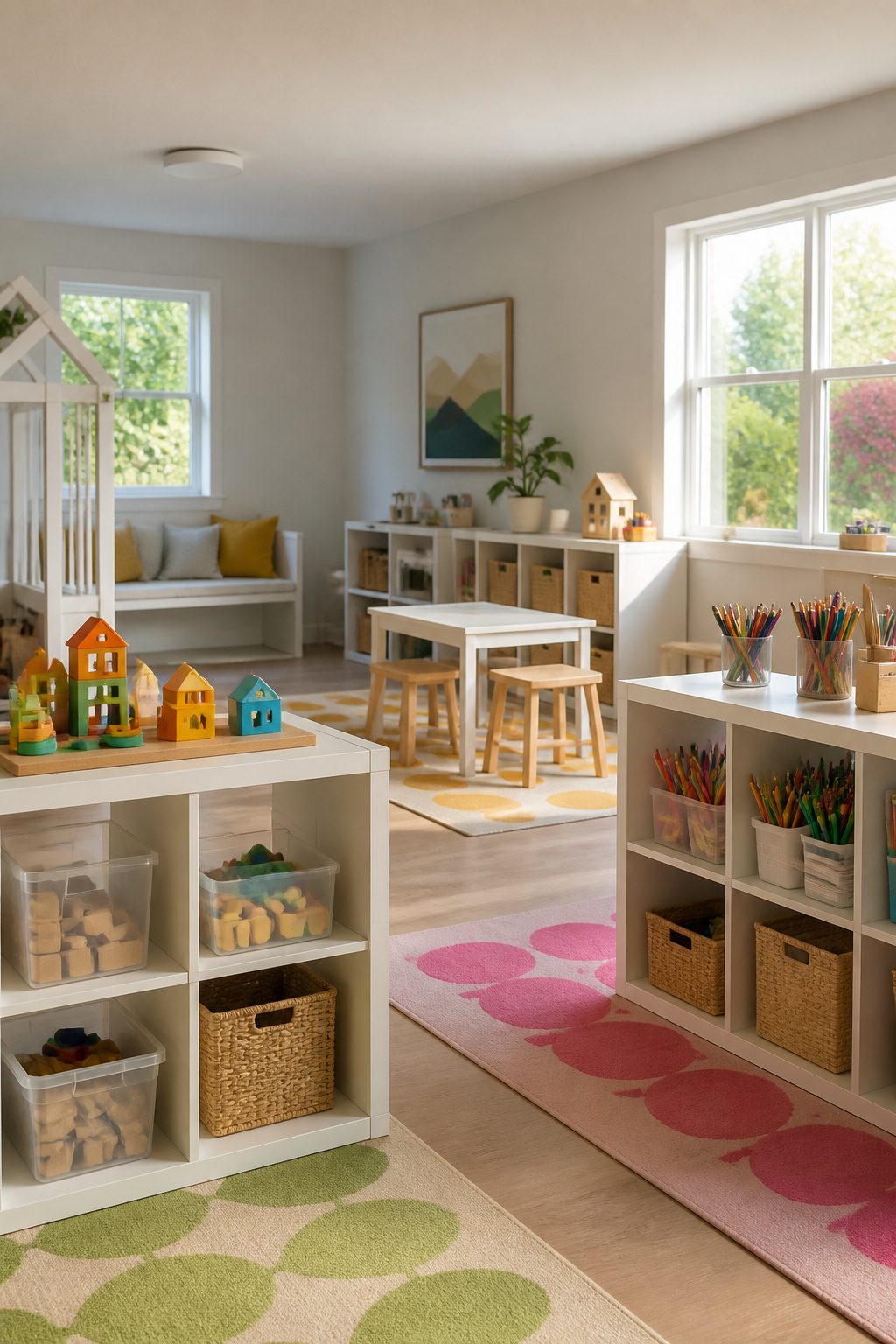
Low shelves work better than walls for splitting a playroom into zones.
We used a KALLAX unit on its side to separate the art corner from the building area, and the kids still see the whole room, which keeps the space from feeling boxed in.
Keep dividers under 30 inches tall so a kindergartner can look over them; anything taller and the zones stop feeling connected.
Curtains on a ceiling-mounted wire gave us a reading nook we could pull shut or leave open. The fabric signals "quiet space" without a door, though in our experience the curtain stayed open about ninety percent of the time.
Kids that age do not self-segregate neatly. What the markers actually did was give us a place to return toys to, so cleanup had addresses instead of one big bin.
Rugs helped more than we expected. A bright mat under the LEGO table and a softer one by the cushion pile let the kids carry the zone idea in their heads even when the physical edges were invisible.
The SKÅDIS pegboard on the art-side wall reinforced it further, tools hanging where they get used rather than marching back to a central closet.
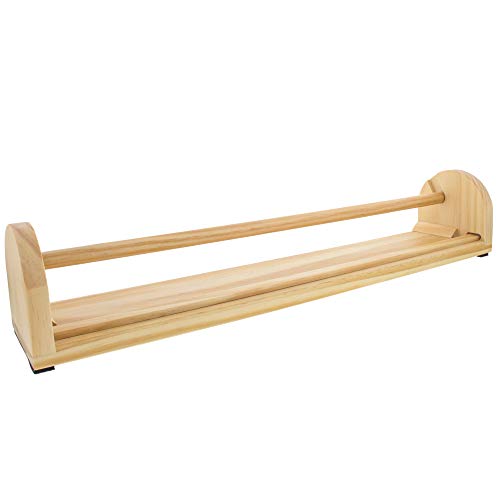
Paper Compatibility: Paper roll dispenser accommodates standard 12-inch wide paper rolls. Suitable for use with various types of paper.

HIGH QUALITY - Our 80gsm white industrial-grade craft paper is made from recycled and recyclable materials. It is thick, durable, and tear-resistant.

THOUGHTFUL SET: 1 x paper roll dispenser for kids + 1 x art paper roll (11.4 inch x 98.43 ft ) + 4 x pencil holder cups + 24 x watercolor pens. The paper roll holder measures 13.7 x 6.7 x 4.3 inch and fits paper roll width less than 12 inch. NO assembly required. Just take it out and load the paper to paint immediately
9. Fun DIY Toy Storage
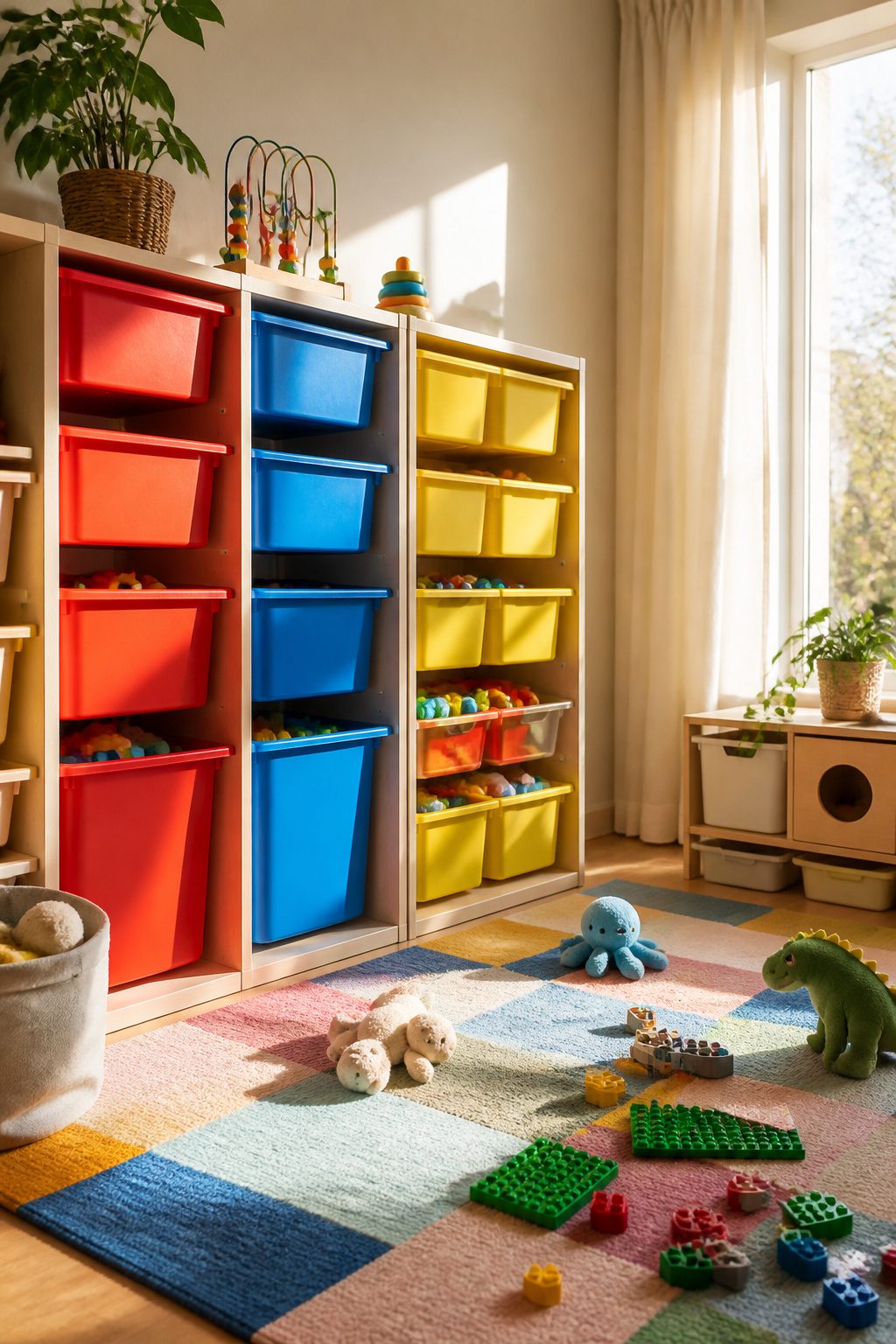
We stacked three TROFAST frames in a column against the playroom wall and bolted them together with L-brackets, then added wall anchors at the top.
The bins sit in tracks so the kids can pull them out like drawers, and we color-coded them: red for LEGO, blue for stuffed animals, yellow for art supplies.
Labels with simple icons came later, after we realized our four-year-old could not read the word "puzzles."
What we bought: three TROFAST frames, nine bins in mixed sizes, two packs of wall brackets, and a box of drywall anchors. Tools were a drill, a level, and a stud finder we borrowed from a neighbor.
The first version stood on the floor without anchors. We figured the weight of the toys would hold it down.
It tipped forward the first time our kid climbed up to reach a bin on the second row. The frames are light pine; empty, the whole stack weighs less than a toddler.
After that we drilled into studs at the top frame and added a second bracket mid-column. Now it does not move even when leaned on.
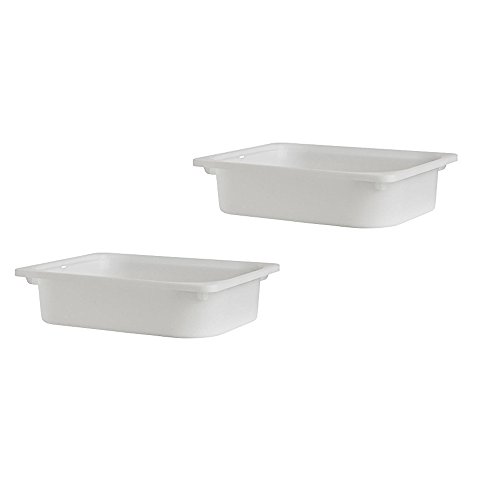
Includes: Set of 2 Ikea TROFAST Storage box

【MULTI-PURPOSE】 Our 6 pcs closet storage bins are home essentials to save storage space and keep everything organized. Large enough baskets for organizing clothes, kid’s toys, nursery room items, extra linens, laundry, towels, sheets, pantry and more.

✅Washable High-Quality Toy Chest - Our toy cube storage organizer bins are made with the finest materials to ensure durability and longevity. This kids storage cubes is made with canvas using dust-free, water-treatment skin polyester with an inner filling of 2.6 mm harder PP plater that can be washed without deforming your bin.
10. Practical and Stylish Seating
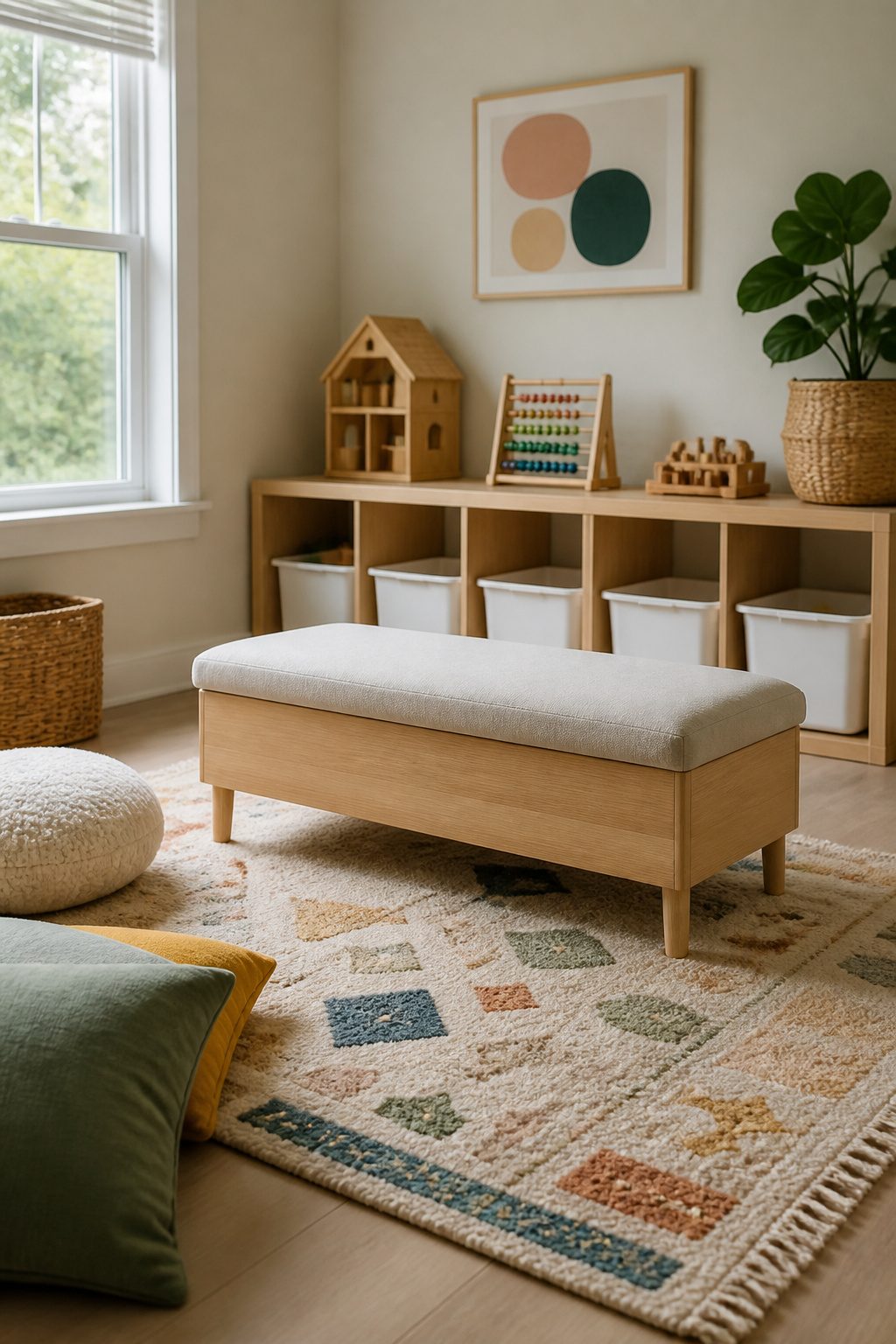
For the first six months we sat on the floor. A folded blanket was our cushion, and by month three our backs were telling us this was not a long-term plan.
We needed something low enough that a two-year-old could climb on and off alone, but firm enough that an adult could get up without using the coffee table as a crutch.
We tried a pouf first. It looked right in the photos, but sinking into it made supervising at floor level feel like work.
Getting out required a hand on the rug and a small prayer. We moved it to the bedroom inside a week.
What lasted was a bench-height wooden seat with a flat, upholstered top.
The height let us drop straight down and push straight up, no leverage needed. The flat top meant board books and sippy cups sat where we put them.
After two years the fabric has taken marker, juice, and one incident with glitter glue; it wipes clean with a damp rag and has not torn. The pouf, meanwhile, still holds our laundry.

Durable & Stable: Made with durable, dust-resistant, and tear-resistant non-woven fabric, our fabric storage bins offers long-lasting durability for daily use while adding a touch of style. Mix and match to add a personal touch to your space.
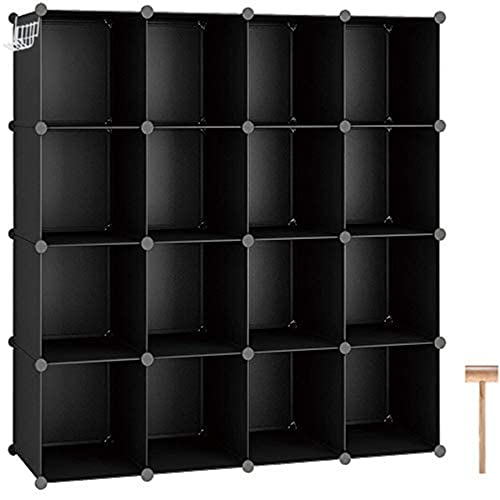
ELEGANT DISPLAY SHELF: Well-organized home makes you being at home more enjoyable. The modern fashionable plastic cube organizer by displaying multiple items, such as books, photos, toys, bags, potted plants, CDs make your house organized and neat
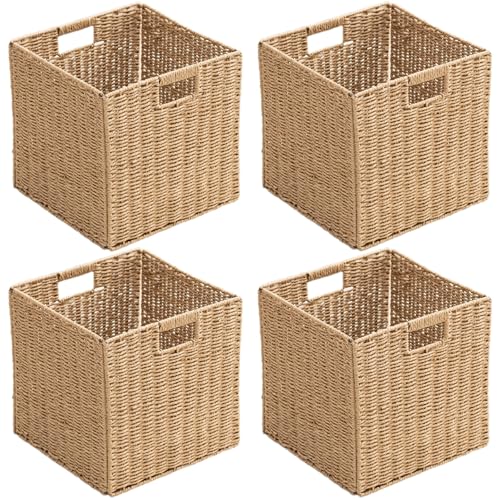
HIGH QUALITY MATERIAL: Made of high quality paper rope, wrapped around a metal frame and woven, each woven basket shows the exquisite craftsmanship of the artisan. The woven texture is tight and even, showing a unique texture. It is not only a practical storage tool, but also a decorative piece that can add a natural artistic atmosphere to your home.
11. Wall-Mounted Toy Storage
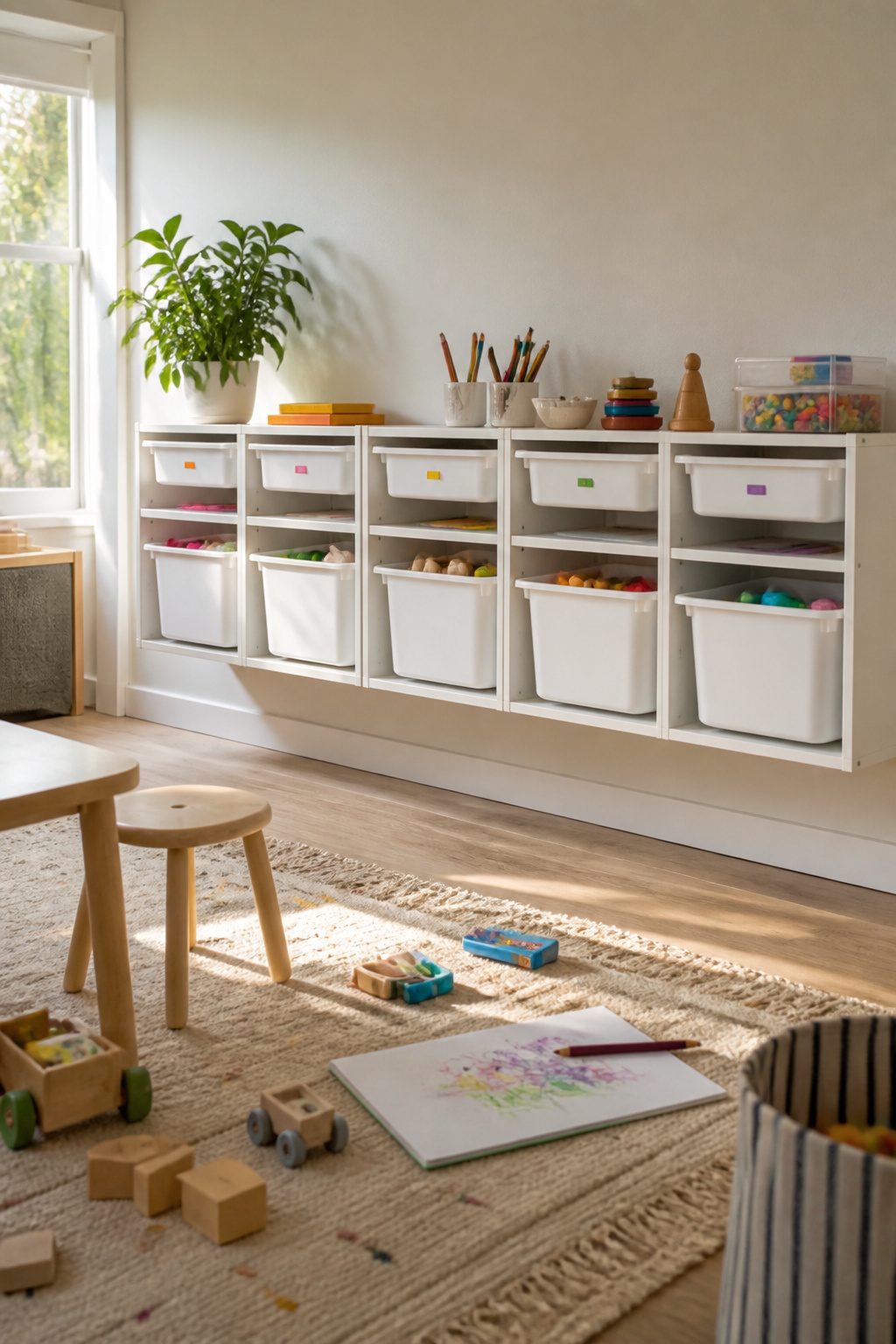
We mounted TROFAST frames on the wall in a row, three across, about six inches off the floor so the bins still slide out without dragging carpet.
The first unit went into studs; the second and third needed toggle anchors because the wall framing did not line up with where we wanted them. We used the brackets that come in the TROFAST hardware pack, nothing extra.
The mistake came with height.
We filled the top row with stuffed animals the kids could not reach, thinking they would ask when they wanted them. They did not ask.
They climbed. After two weeks we moved the plushies down to the second row and put puzzle boxes and art supplies we rotate on top.
Keep the top bins for toy rotation, not daily toys, unless you want to find a four-year-old standing on a bin that is not built for that.
Labels help, but we skipped words and used colored tape: blue for blocks, red for vehicles. The kids sort faster than they read, and the tape peels off clean when the system changes.
12. Easy to Clean Surfaces
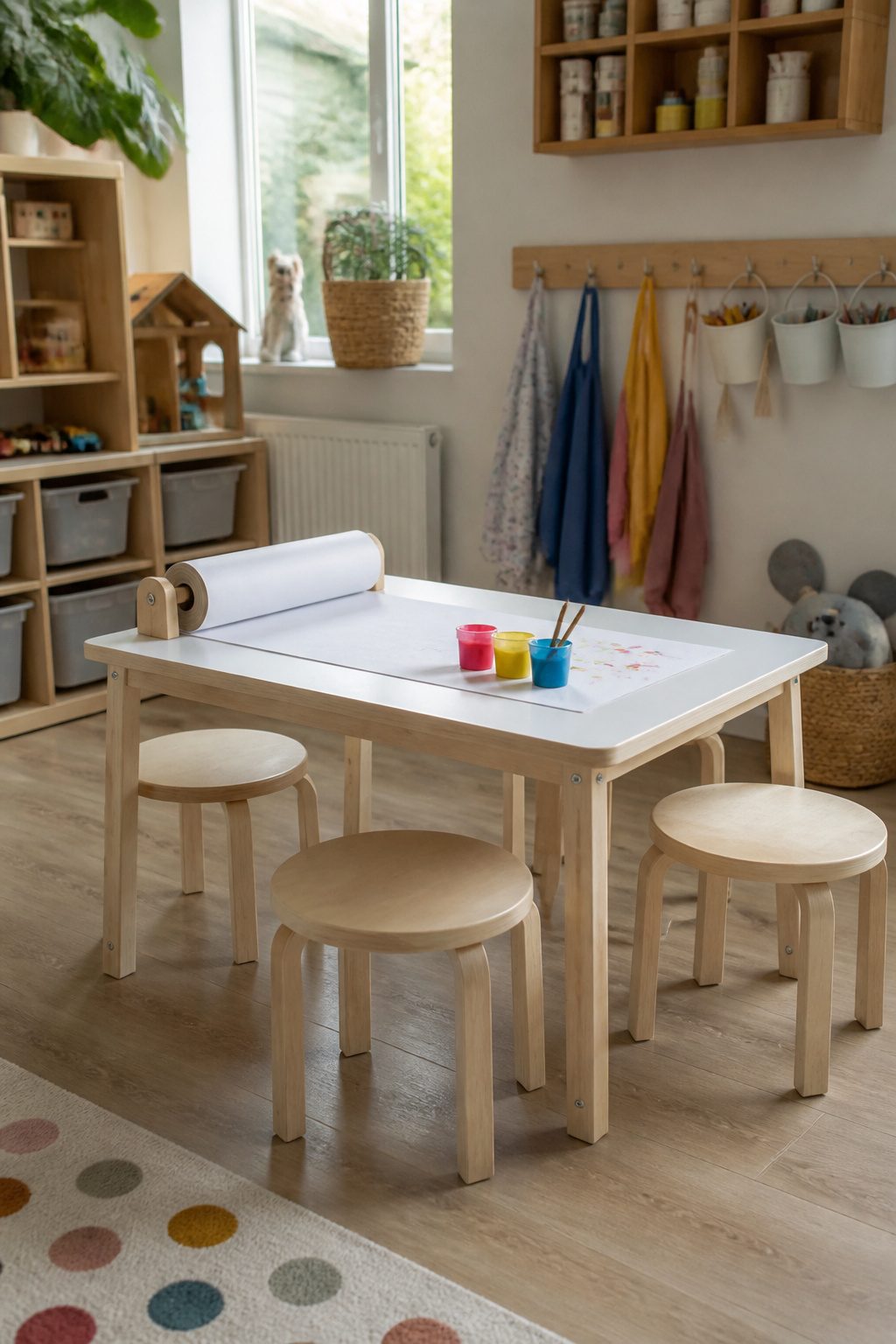
We learned fast that laminate and vinyl are the only table finishes worth considering if you want to spend Saturday playing instead of scrubbing.
IKEA builds most of its play tables and storage in these materials, and the difference shows the first time a marker cap comes off without the cap on.
Warm water and a rag handle most of it; dried glue needs a plastic scraper and patience.
The FLISAT table sits in the center of our setup, and we keep a roll of paper loaded in the holder to buy us time when paint comes out.
For the floor, we went with vinyl plank. Juice cups tip.
That is not a question, it is a law of physics. Vinyl lets us lift the stain with a damp mop instead of living with it.
What still fails: red tempera paint left overnight, and the oil from certain sticker adhesives.
Those leave ghosts. We tried the wipeable mat trick over the FLISAT surface, and it helps, but the mat itself gets dinged up and needs replacing every few months.
Removable cushion covers are the other move we actually use; the TROFAST bins underneath catch the supplies before they roll onto the floor.
13. Creative Use of Color
We learned the hard way that a bright yellow accent wall looks cheerful for about twelve weeks, then starts to feel like a scream you cannot turn off.
Our first playroom color lasted three months before we painted over it on a Saturday we had planned to spend assembling a KALLAX unit.
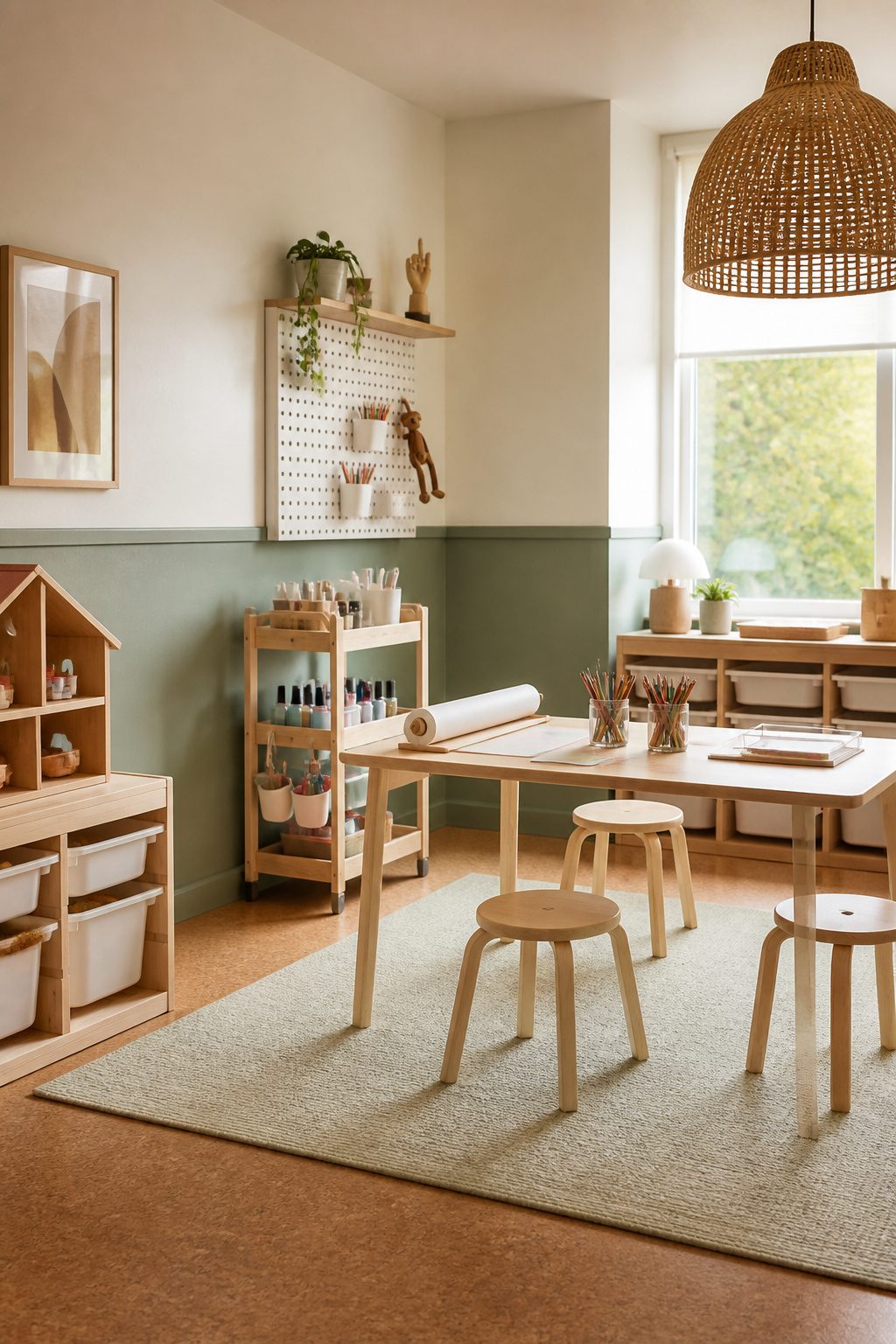
Now we start with a base that can carry a kid from preschool to early elementary without embarrassment: a warm off-white that reads clean under both daylight and the warm bulbs we use after dinner.
Color does the zoning so furniture does not have to. We ran a single band of muted sage at chair-rail height around the art corner, then stopped it dead at the corner where the building zone begins.
No border, no transition strip, just the end of the paint line and the start of a floor that shifts from cork to a low-pile rug.
The kids figured out the system faster than the adults did. Keep the bold color below eye level and let the walls above stay quiet; it survives longer and costs nothing extra in paint.
14. Incorporating Nature
We tried three plants in our first playroom before we understood what "bright indirect light" actually meant in a north-facing basement. The spider plant went first, then a pothos we overwatered into root rot.
The succulent survived only because we forgot it on a high shelf for six weeks, which taught us the real lesson: plants that tolerate neglect survive kids better than plants that tolerate low light.
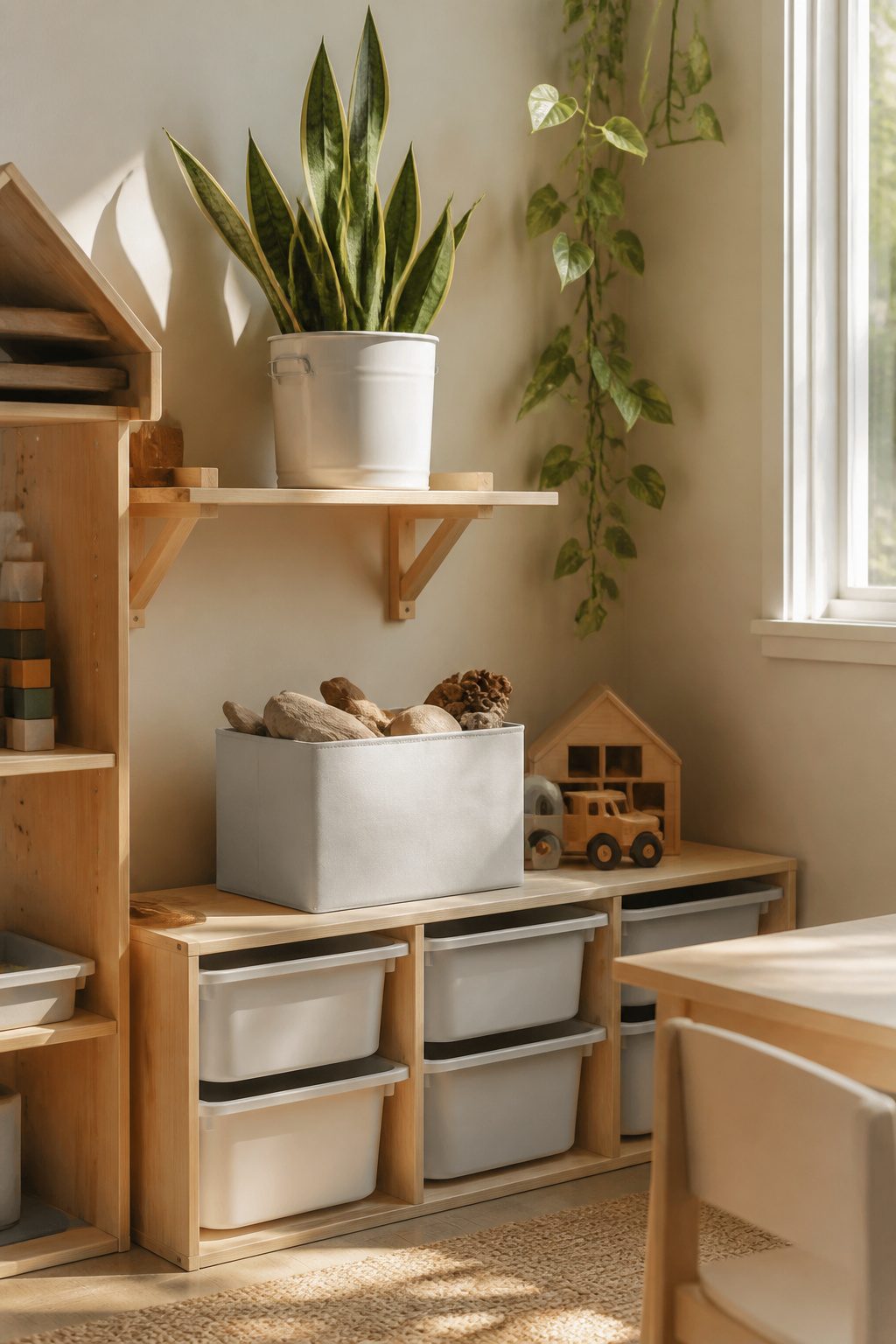
We keep the DRONA box labeled "nature exploration items" on the lowest KALLAX shelf now, but the living plants stay up high.
A single snake plant in an IKEA FINTORP bucket, hung on the rail, has outlasted two years of dry air and occasional basketballs.
The kids water it with a spray bottle on Saturdays. When they forget, the plant does not die; when they drown it, the bucket drains.
That failure with the pothos turned out to be useful. They saw the leaves yellow and understood why, which is a different kind of nature lesson than keeping a perfect windowsill garden.
15. IKEA Hacks for Customization
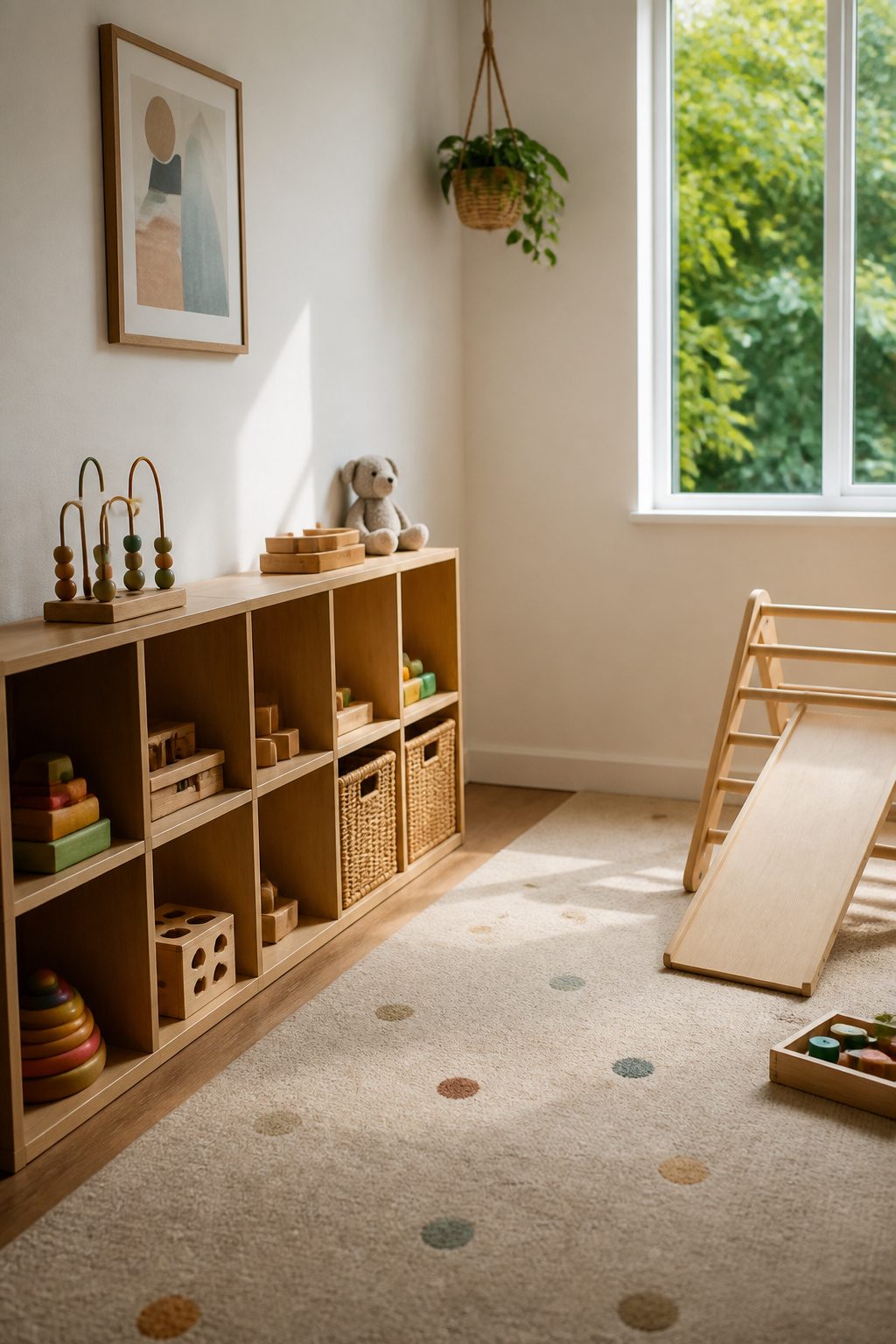
Standard KALLAX shelving runs about 15 inches deep, which swallows floor space in a narrow room. We trimmed ours down to 11 inches with a circular saw, then faced the raw edge with 1×3 poplar from the hardware store.
The cut edge is what you see first, so we sanded to 220 grit and stained it to match the existing frame rather than trying to hide it. Materials ran roughly $25; the work took an evening, counting the reassembly.
We abandoned the same trick on a TROFAST frame. The side panels are hollow particleboard with a thin skin, and cutting them without crumbling the edge meant building a jig we did not own.
After two hours of test cuts on scrap, we put the saw away and used the unit as-is against a wall where the extra depth did not matter.
That is the call we would make again: modify where the piece is solid pine or you have the tools already, and live with the stock dimensions where the construction is thinner.
16. Sensory Play Stations
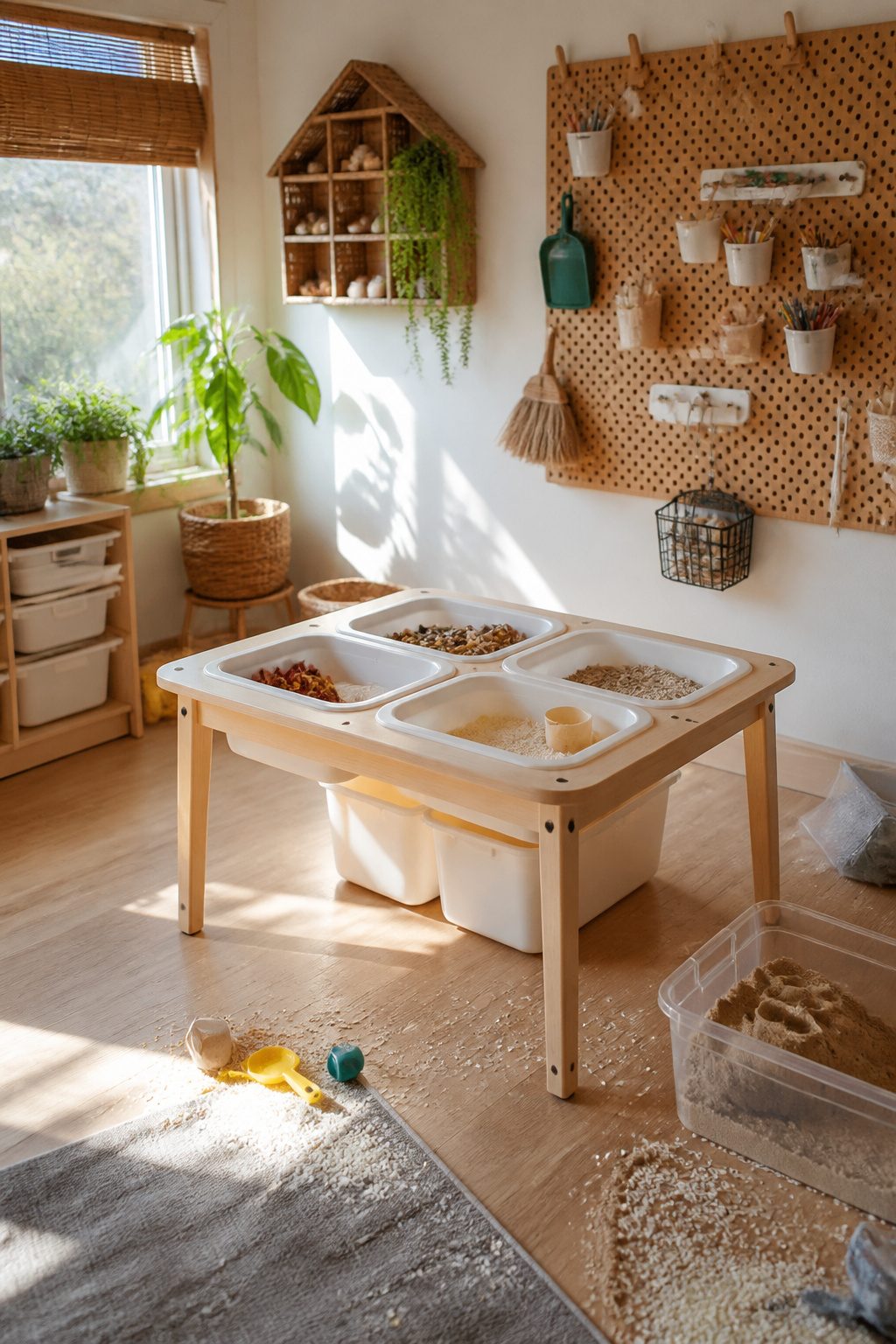
We started with a LACK table because the flat top looked easy to modify, and it was. We cut out the center to fit two removable plastic bins for sand and rice, which kept the mess contained until it didn’t.
The bins sat flush when the table was still, but a three-year-old leaning on the edge tipped one every time.
We switched to the FLISAT table after that, since the bins are inset and the lid goes back on for regular use. It cost more, but we gained back the vacuuming time.
For tools, we hung a SKÅDIS pegboard nearby with scoops and cups. That part worked.
What we failed to contain was the water bead phase. They bounce, they roll under baseboards, and you will find them for months.
Skip the water beads if your playroom has hard floors. We also tried chalkboard paint on the LACK table before we cut it up.
It scuffed within a week. Stick with the plastic trays or accept that the surface is temporary.
What We Bought and What It Cost
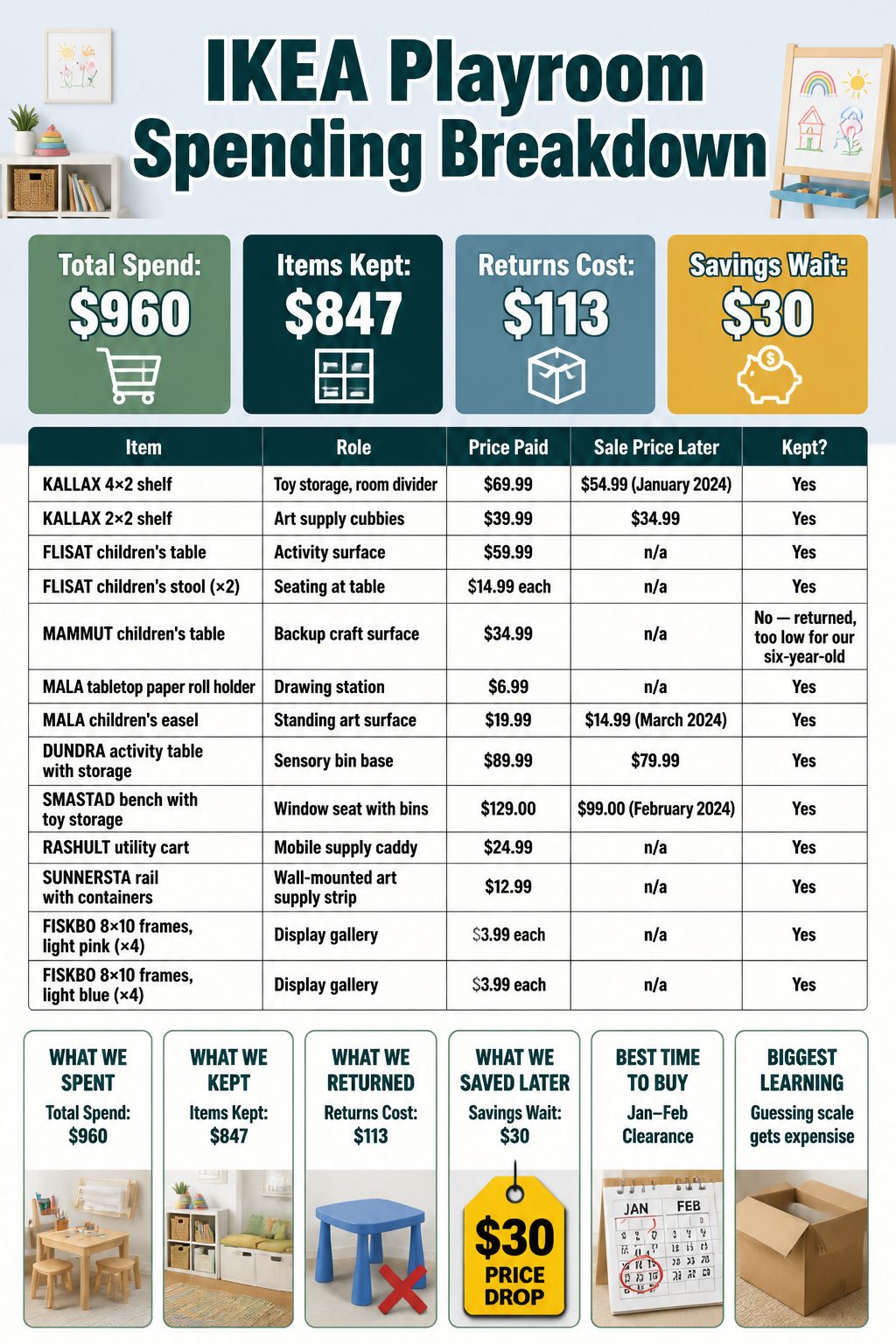
We spent $847 on IKEA items that stayed in the room, and another $113 on pieces we boxed back up. The returns were not flaws in the product; they were guesses about scale that looked wrong once the boxes were open.
The table below is our actual receipt, split by what the item does rather than where it sits. Prices are what we paid in 2023 and early 2024, with notes on what dropped later.
| Item | Role | Price Paid | Sale Price Later | Kept? |
|---|---|---|---|---|
| KALLAX 4×2 shelf | Toy storage, room divider | $69.99 | $54.99 (January 2024) | Yes |
| KALLAX 2×2 shelf | Art supply cubbies | $39.99 | $34.99 | Yes |
| FLISAT children’s table | Activity surface | $59.99 | n/a | Yes |
| FLISAT children’s stool (×2) | Seating at table | $14.99 each | n/a | Yes |
| MAMMUT children’s table | Backup craft surface | $34.99 | n/a | No — returned, too low for our six-year-old |
| MALA tabletop paper roll holder | Drawing station | $6.99 | n/a | Yes |
| MALA children’s easel | Standing art surface | $19.99 | $14.99 (March 2024) | Yes |
| DUNDRA activity table with storage | Sensory bin base | $89.99 | $79.99 | Yes |
| SMASTAD bench with toy storage | Window seat with bins | $129.00 | $99.00 (February 2024) | Yes |
| RASHULT utility cart | Mobile supply caddy | $24.99 | n/a | Yes |
| SUNNERSTA rail with containers | Wall-mounted art supply strip | $12.99 | n/a | Yes |
| FISKBO 8×10 frames, light pink (×4) | Display gallery | $3.99 each | n/a | Yes |
| FISKBO 8×10 frames, light blue (×4) | Display gallery | $3.99 each | n/a | Yes |
The SMASTAD bench dropped thirty dollars six weeks after we bought it, which still stings. If your timeline is flexible, January and February clearances on the storage pieces are real and worth waiting for.
Tools We Kept Reaching For
We did not own a power drill with a stud finder at the start and bought one mid-project after borrowing a neighbor’s corded model twice.
The cord never reached where we needed it, and we spent more time hunting outlets than drilling holes.
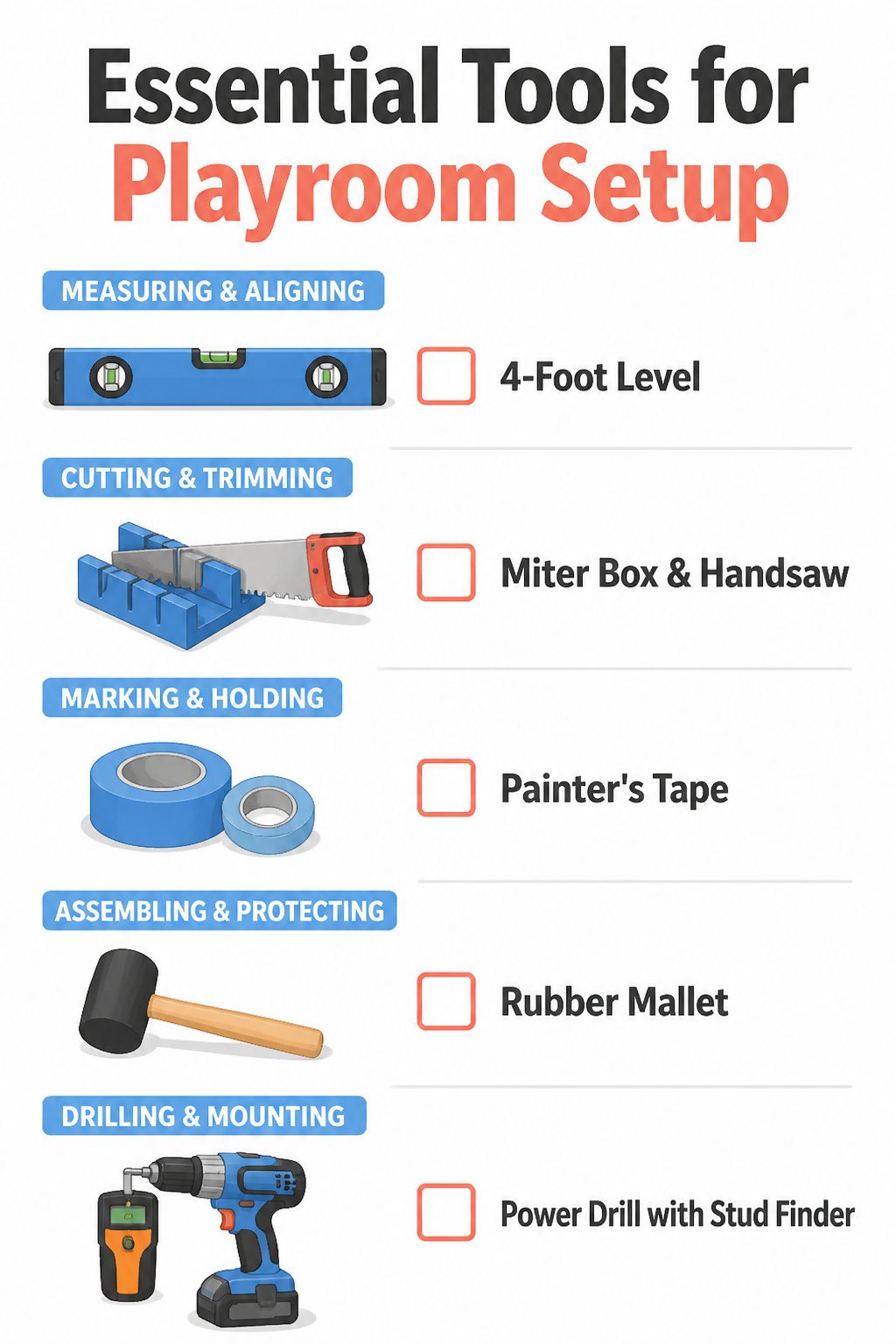
Here is what came out for more than half of the builds above:
- A 4-foot level. The KALLAX units sit flat, but the wall-mounted SKÅDIS pegboard and any Trofast frames you hang need to read level from three feet away or the whole wall looks off.
- A miter box with a handsaw. Faster than setting up the power miter for the short trim pieces we added to the KALLAX edges, and it kept sawdust out of a room already full of toys.
- Painter’s tape in two widths. The wide tape marked stud locations through two coats of paint; the half-inch tape held brackets in place while we pre-drilled, same as the mirror frame trick we learned in the bathroom years back.
- A rubber mallet. The Trofast frames lock tight with it, and it does not mar the plastic the way a hammer would. We cracked one bin early on using the wrong tool; the mallet paid for itself in that single save.
- The power drill with a stud finder. We spent about $60 on a cordless kit, which sits in the middle of the $50–$100 tool range these projects typically need.
Mistakes That Cost Us a Weekend
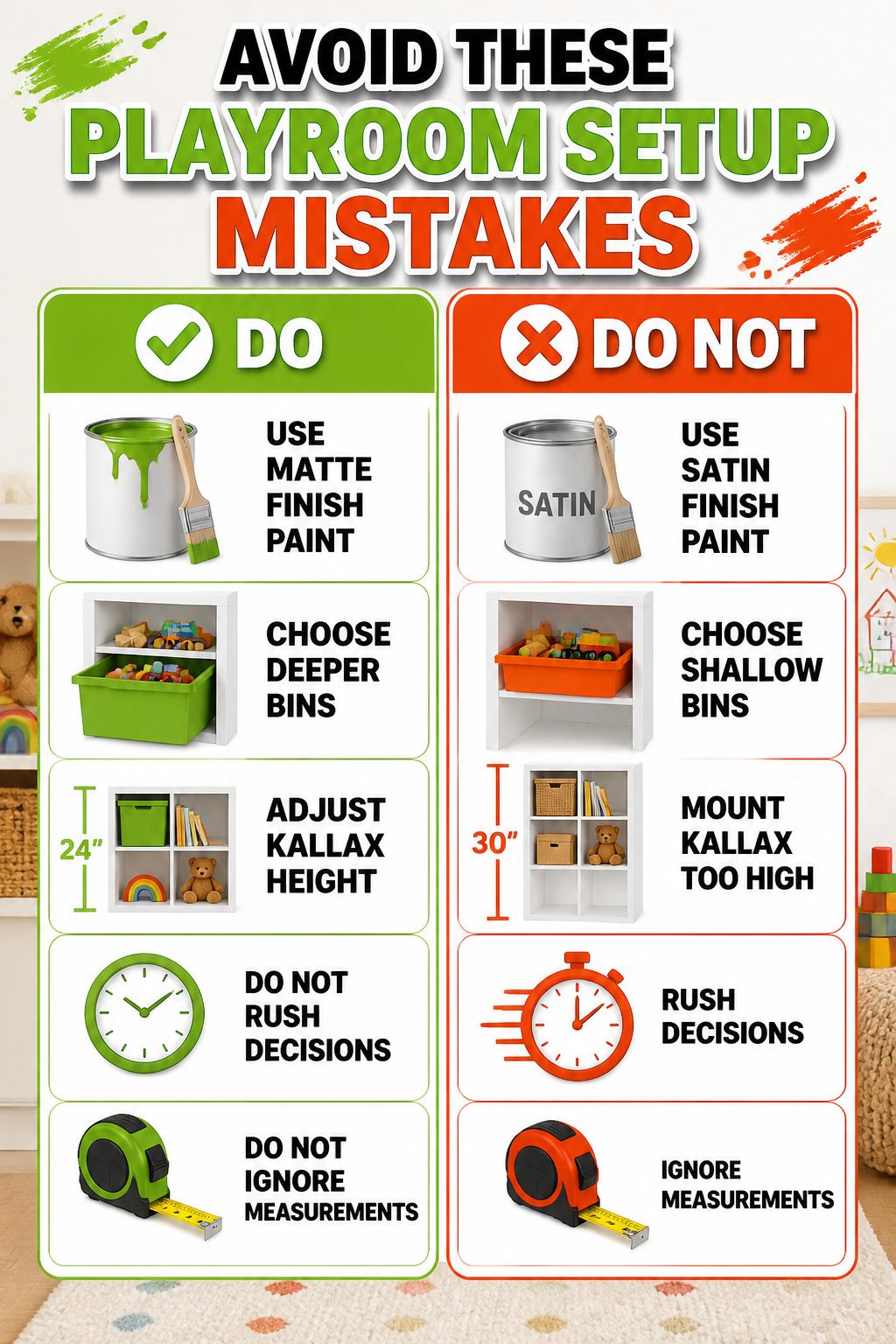
We picked a satin finish for the first paint job because it wiped clean in the kitchen.
In a playroom it showed every scuff within a week, and we spent the next Saturday sanding it back to matte. The second room got eggshell from the start, and three years later it still looks the same.
The TROFAST bins we grabbed were the shallow ones, the ones that look generous on the shelf. Blocks and train sets spilled out the top by Tuesday.
We drove back for the deeper bins, swapped the runners, and lost another Saturday to disassembly. Measure the tallest toy your kid actually owns before you buy; we did not.
We mounted the first KALLAX unit at standard desk height, thirty inches off the floor, because it felt right standing up.
Our four-year-old could not reach the second row without climbing. We dropped it to twenty-four, patched the old holes, and that was the third lost weekend.
Standard height is for adults. Sit on the floor before you drill.
Frequently Asked Questions
What are some IKEA playroom ideas?
The best setups combine KALLAX or TROFAST storage with defined activity zones. A horizontal KALLAX works as bench seating with cubbies underneath; TROFAST bins with picture labels let kids clean up independently.
Add a MALA easel with wall-mounted paper holders, a floor-level cushion with a BEKVÄM spice rack for books, and a SKÅDIS pegboard at two heights so each child reaches their own supplies.
The article’s full build ran $847 for pieces that stayed in the room.
How can I organize toys in a playroom?
TROFAST frames with solid-color bins outperform clear plastic, which scratches and fogs within two months. Color-code by toy type, red for LEGO and yellow for plushies, but add picture labels so a three-year-old knows where blocks go without asking.
Wall-mounted TROFAST units need anchors and brackets, not just the included frame hardware; keep daily-use bins low and reserve top rows for toy rotation. This cut one family’s evening cleanup time by about 40 percent.
What is the best way to create a reading nook?
A thick pad cut from a twin foam mattress topper, covered in a washable duvet, sits low enough that kids can flop onto it.
Mount a BEKVÄM spice rack turned on its side at their eye level beside the cushion, not above it; the lip keeps paperbacks from sliding.
Add a LACK side table at the end for the current stack. The whole corner costs less than a single armchair and, in one home, gets used more than the actual couch.