

Reparenting yourself works because the brain’s attachment circuits stay malleable into adulthood. But it only works if you stop treating self-kindness as a reward you still have to earn. The 2025 meta-analysis by Zhang and Chen found that secure attachment correlates with notably higher self-compassion, while anxious and avoidant styles correlate with lower self-compassion. That gap is where the work starts.
[link-whisper-related-posts]1. Acknowledge Your Inner Child

The inner child is not a metaphor we use lightly. It names the younger parts of ourselves, the memories and experiences that still shape how we react as adults. Attachment theory gives this shape: as children, we learned to grow the parts of us that brought caregivers closer and shrink the parts that created distance. A child depends on literal attachment for survival, so these patterns run deep.
Those same patterns now surface in adult relationships, in what we express or suppress, in how we handle conflict, in what we fear. You will notice your inner child is active when a reaction feels wildly out of proportion to what just happened. A minor criticism lands like abandonment. A small change of plans spikes anxiety. Someone sets a boundary and you feel guilty, or you find yourself people-pleading, rebelling, hoarding, or driving to overachieve. These are not character flaws. They are signs that a younger self is still trying to stay safe using the only strategies it had.
The reparenting you need depends on which gaps your childhood left. Anxious, avoidant, and disorganized attachment styles each create different patterns, and the work shifts accordingly. The styles are not fixed categories. They shift with intentional practice and safe relationships. Recognizing your pattern simply tells you where to start.


2. Identify Unmet Needs

We spent years watching customers pick up dolls and put them down again, and the ones who lingered usually had a story about whose attention they were trying to give or get. That is the work of this step: figuring out what you needed and who was not there to provide it.
The three gaps that show up most often are validation, safety, and unconditional love. When a child’s feelings are met with silence or punishment, they learn to doubt their own read on situations. That self-doubt does not stay in childhood. It becomes the adult who over-apologizes, who reads a neutral email as angry, who picks partners who keep them guessing.
Parentification is one specific pattern worth naming. Some children, often eldest daughters in households where parents were overwhelmed or absent, ended up managing siblings, bills, or emotional caretaking. The child becomes competent early and trusts no one to return the favor. As adults they can assemble furniture alone, but they also retreat when someone gets too close, or they choose partners who are emotionally unavailable because that distance feels familiar.
If this sounds like your pattern, write directly to the child you were. Acknowledge what she carried, tell her it was not her job, and name the need that went unmet. The act of naming it is what lets you stop proving you never needed it in the first place.


✅Structured Framework for Self-Discovery: Follow a user-friendly guide filled with introspective exercises, questions, and reflections to explore and understand your shadow side.

3. Practice Self-Compassion

Self-compassion is where reparenting yourself shifts from idea to daily practice. Research ties it to lower anxiety and depression alongside higher overall well-being, and the techniques are simpler than we expected them to be.
The one that changed how we talk to ourselves: speak as you would to a friend. When you make a mistake, the voice in your head probably repeats whatever criticism you absorbed early. We started catching that and replacing it with what we’d actually say to someone we care about. "Nobody is perfect. Let’s figure out what to do next." It sounds small until you realize how rarely you gave yourself that room before.
Place a hand on your heart during hard moments. This came from watching how we’d soothe a distressed child. The physical contact signals safety to your nervous system in a way words alone don’t. We were skeptical until we tried it during a rough afternoon and noticed the shift in our breathing.
Writing a letter to yourself from a compassionate perspective works best when you’re stuck in self-criticism you can’t talk your way out of. Address yourself by name, acknowledge what happened without judgment, and write what a kind witness would see. The paper holds the kindness when your own voice can’t yet.


4. Set Healthy Boundaries

We used to say yes to every invitation, every favor, every late-night call, then wonder why we felt hollow by Tuesday. Learning to say no is the boundary work that lets the other three pillars of reparenting actually stick. Emotional regulation, self-compassion, building trust with yourself, none of it holds if you keep handing your time away the moment someone asks.
Start with the small stuff. A friend texts about dinner and you are already drained; you say you will check your calendar, then you buy yourself a night in. A coworker dumps a project on your desk; you ask when they actually need it and whether your manager assigned it to you both. The pause before the yes is where reparenting lives, because a parent who values a child teaches them to check in with their own body first.
Some people will keep pushing. They show up unannounced, they joke about how you "used to be fun," they treat your stated limit as the opening of a negotiation. Limiting contact with them is not cruelty; it is maintenance. You are not rebuilding your boundaries to perform maturity for someone else. You are building them so your own needs stop coming last.


COMPLETE SELF-CARE SYSTEM: Discover your path to well-being with 91 days of thoughtfully curated prompts and bonus video content. Our guided self care journal for women combines structured exercises, daily reflection practices, and mindfulness activities for personal growth and emotional balance

5. Reframe Negative Self-Talk

The voice that shows up when you make a mistake, the one that calls you a failure before you’ve even finished processing what happened, usually isn’t yours. It belongs to whoever taught you that love came with conditions: good grades, quiet behavior, a clean room. When emotional expression gets discouraged at home, you learn to police yourself instead, and that internal critic keeps the job long after childhood ends.
Reparenting yourself means catching that voice in the moment and asking where it came from. Would you say this to a child you love? If the answer is no, deliberately offer the response a good parent would give. Instead of "I’m such a failure," try "I’m learning, and it’s okay to make mistakes." The reframe feels wooden at first. That is normal. The critic had years to install itself; the kind voice needs repetition to take root.
Write down the replacement if saying it aloud feels too strange. Imperfections are part of being human, and growth comes from learning, not from punishment. The discomfort of doing things badly, on purpose even, is where the rewiring happens. Leave the dishes, send the typo, skip the makeup. Notice the anxiety without fixing it. You are not a performance.


6. Create Joyful Rituals

Joy is the pillar of reparenting that most of us skip first, because if you learned early that play was frivolous or rest had to be earned, sitting down to color feels like a trap. We have been there. The discomfort is the signal: it points to what was unsafe or unavailable in your childhood, and moving through it is the work.
Start with what you actually wanted at eight. Building with blocks, dancing to the music you loved then, buying the snack you were denied and eating it without apology. Joy is not a reward for good behavior; it is a basic need. The sources keep the activity list open on purpose, because the specific thing matters less than the permission. Doodle badly, watch the silly movie, lie in grass and watch clouds. No product, no outcome, no post about it.
If play feels hollow at first, that is normal. The inner child does not trust you yet. Keep the time short, keep the phone in another room, and treat the resistance as data, not failure. The nervous system learns from repetition, not from one perfect afternoon.


7. Seek Professional Support

At some point in reparenting work, the solo effort hits a wall. Earned secure attachment is what researchers call the shift that happens when adults who grew up with insecure, neglectful, or frightening caregiving develop the coherent emotional narratives and flexibility characteristic of secure attachment later in life. This reorganization typically happens through sustained relationships, reflection, and often therapy. A 2025 meta-analysis by Zhang and Chen found that secure attachment correlates with notably higher self-compassion, while anxious and avoidant styles correlate with lower self-compassion. The capacity to be gentle with yourself in the process is itself a learnable skill.
Neuroplasticity makes this possible. The brain’s neural circuits for emotional regulation and attachment stay malleable into adulthood. Repeated emotional experiences can build new neural pathways governing safety and self-regulation alongside the old ones. The flinch you feel when your phone buzzes late with your boss’s name is a well-worn trail, not a permanent sentence.
Signs it is time to seek professional support: feeling stuck after months of self-directed work, memories surfacing that you cannot process alone, or relationship patterns repeating despite genuine effort. Therapy does not mean the personal work failed. It means the work is ready for a depth that benefits from trained guidance.


Signs You Need Reparenting
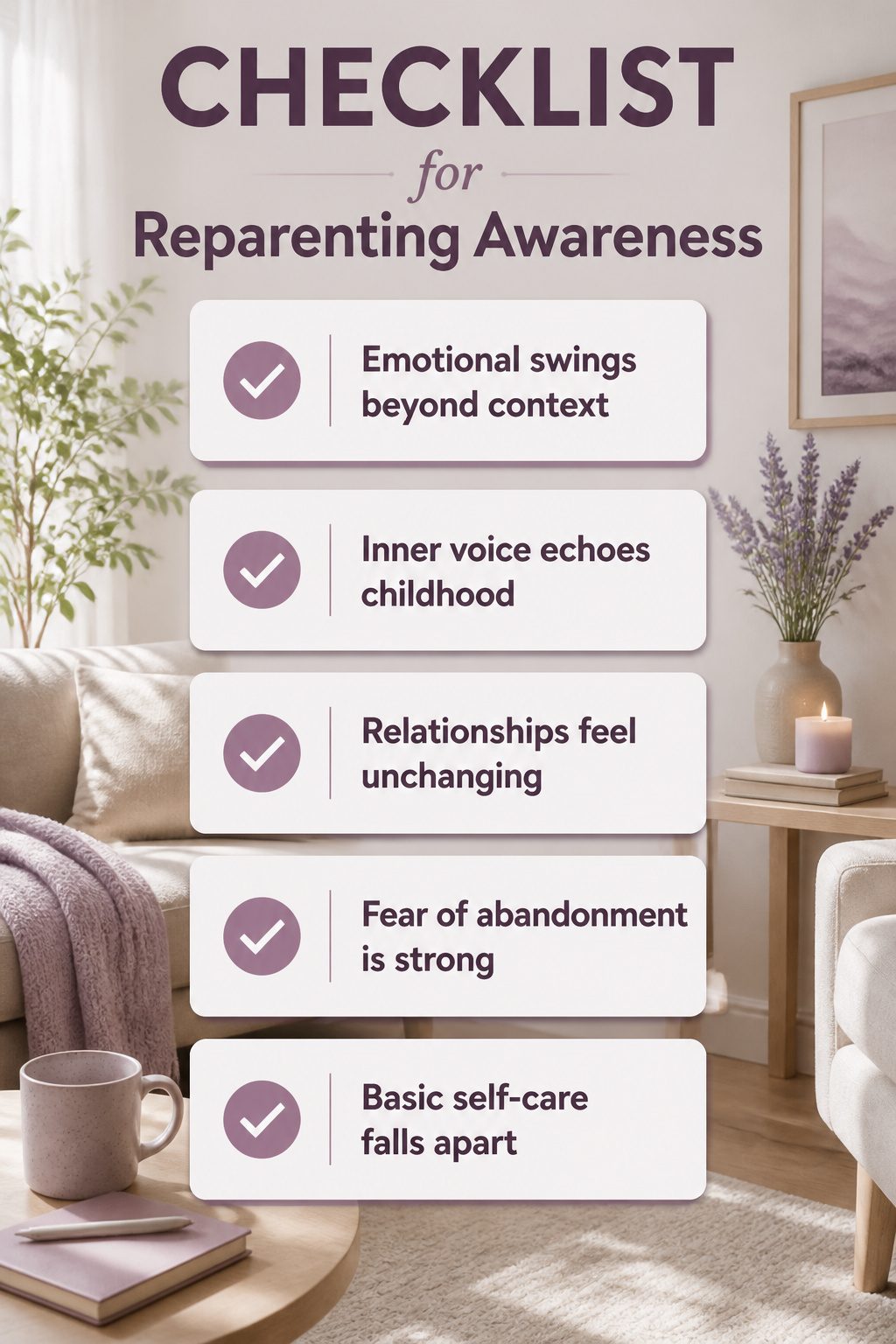
Some patterns show up long before you name them. If you recognize yourself in more than a couple of these, reparenting yourself is probably worth your time.
- Your emotions swing past what the moment calls for. Minor inconveniences leave you crying or furious, and you cannot dial it back in the moment.
- Your inner voice repeats what you heard as a kid. The same tone, the same disappointed sighs, the same "not good enough."
- Relationships feel like reruns. You chase unavailable partners, avoid conflict like it is dangerous, or feel guilty for setting boundaries and over-explain them.
- Fear of abandonment runs the show. You need constant reassurance, cannot trust people will stay, or freeze when someone asks if you are upset because you genuinely do not know.
- Basic self-care collapses under stress. You skip meals, lose sleep, or let hygiene slide because no one taught you that caring for yourself was non-negotiable.
- You check with others before small decisions. Should I take this job? Is it okay to be upset? You never learned to trust your own judgment.
None of these mean you are broken. They mean you are running on rules you did not write.



Emotional Regulation Skills
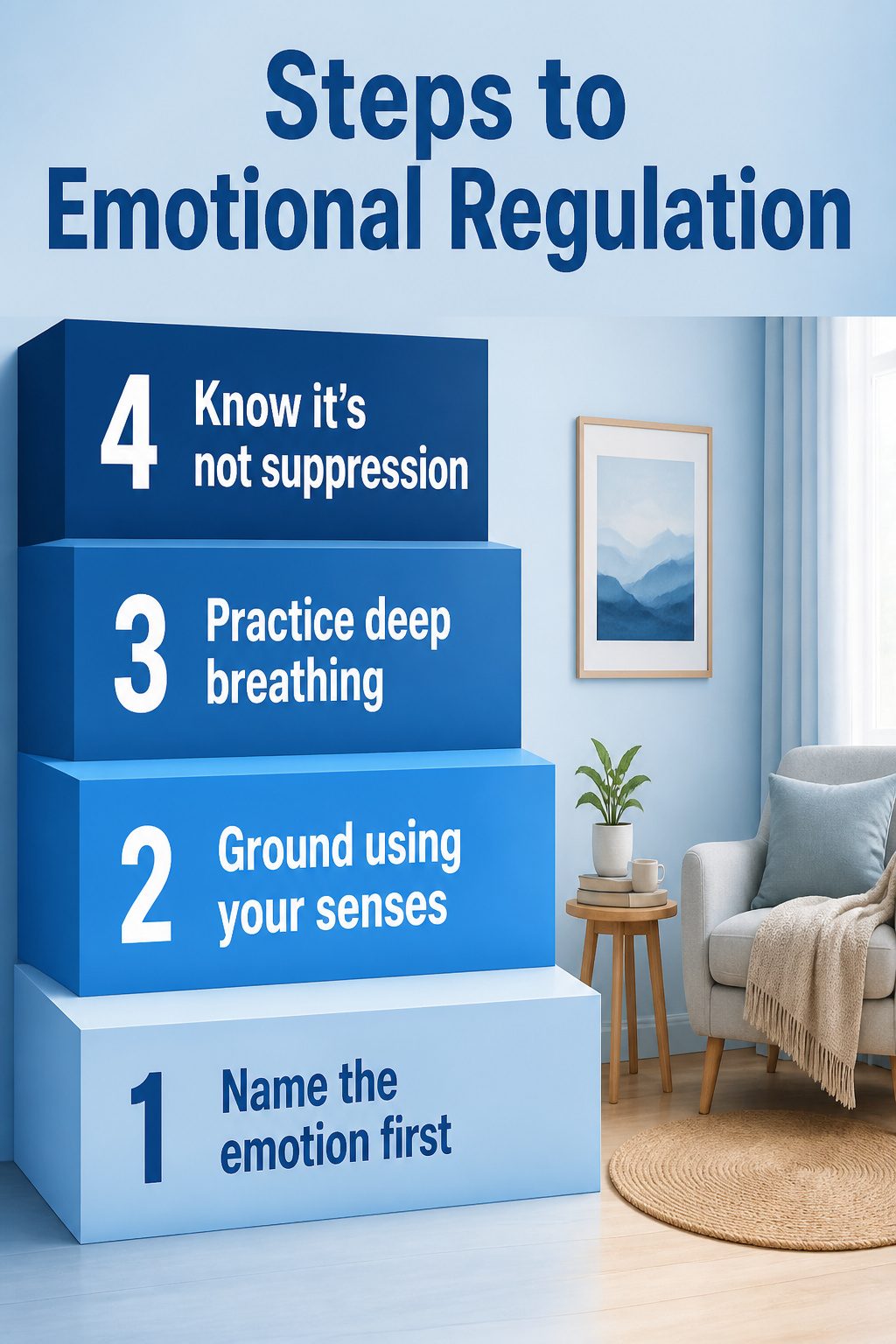
Emotional regulation is the ability to recognize, manage, and respond to your emotions in a healthy and constructive way, and it sits at the center of reparenting yourself. When you reparent yourself, you learn to co-regulate with yourself the way a calm, attuned parent would soothe a distressed child. That means sitting with uncomfortable feelings without immediately numbing, distracting, or exploding.
The first move is naming the emotion before you react. Developing a more specific emotional vocabulary helps reduce the intensity of what you are feeling. Getting past the surface resentment and frustration to the emotion underneath gives you space to respond thoughtfully rather than reactively.
Grounding through your five senses works when naming is not enough. Place a hand on your chest during anxiety, talk yourself through a disappointment with kindness, or step away from a situation to reset. Deep breathing or grounding techniques calm the nervous system directly.
This is not suppression. Suppression is shutting the feeling down or pushing through it. Regulation is understanding the feeling, controlling impulsive reactions, and adapting without becoming overwhelmed or shutting down. A trauma-informed approach recognizes that this skill develops over time, especially if early caregivers were unable to model it.


Inner Child Dialogue

Inner child dialogue works best when you put it on paper rather than running it in your head. We start by writing in the voice of the child, letting whatever comes up land without editing. The feelings might not make logical sense, and that is the point. Then we switch hats and answer as the nurturing adult we are learning to be.
The journal format matters because it slows the loop down enough to catch what is actually being felt. When you write as the child, you are processing the emotion instead of reacting from it. When you respond as the adult, you are validating the feeling rather than dismissing it or spiraling into it.
A brief exchange might look like this. The child writes: "Everyone left me out again. I must be impossible to love." The adult answers: "You are not impossible to love. You were left out, and that hurts. I am here with you." The adult voice does not argue with the child’s logic; it meets the feeling first. That distinction is what separates this from positive self-talk that bounces off because it sounds like a correction.



Discipline and Structure

Discipline in reparenting is the structure that lets you function, not the voice that berates you when you don’t. We learned this the hard way after trying to white-knuckle our way through a 5:30 a.m. wake-up for three weeks straight. The alarm went off, we dragged ourselves up, and by day ten we were so exhausted that we skipped three mornings in a row and spent the weekend hating ourselves for it. That is not discipline. That is punishment wearing a schedule as a disguise.
Keeping a promise to yourself means choosing one you can actually keep. For us, that shifted to a 7:00 a.m. wake-up, one home-cooked meal a day, and a hard stop on screen time at 10:00 p.m. The difference was not the rigor of the routine but the tone we brought to it. When we missed the bedtime, we noted it without the lecture, then started again the next evening. The research on this is consistent: self-compassion paired with follow-through outperforms harsh self-criticism for habit formation.
Boundaries work the same way. Saying no to plans when you are already depleted is not selfishness; it is the equivalent of a parent recognizing a child is overtired and calling the evening early. We schedule one completely unplanned evening per week. Nothing goes on the calendar for it. That buffer protects the energy we need to show up for the commitments we do make.
The line between care and rigidity is worth watching. If your routine leaves no room for a sick day, a grief day, or a plain bad day, it is not supporting you. It is performing wellness for an imaginary audience. We dropped the two-liter daily water goal when we noticed we were chugging it resentfully at 10:00 p.m. to hit the number. A smaller, sustainable target won out.
Frequently Asked Questions
What is reparenting?
Reparenting is the deliberate process of giving yourself the emotional nurturing, structure, and validation that were missing or inconsistent in childhood. You become both the caregiver and the recipient, offering yourself what you needed then and still need now. It is not about blaming your parents; it is about building an internal voice that can respond to your present-day emotional needs.
How do I reparent myself?
Start by acknowledging your inner child and identifying which needs went unmet, whether validation, safety, or unconditional love. Then practice self-compassion, set healthy boundaries, reframe negative self-talk, create joyful rituals, and seek professional support when the solo effort hits a wall. Each step builds the internal patterns of care that were missing earlier.
What are the signs that I need to reparent myself?
Signs include emotions that swing past what the moment calls for, an inner voice that repeats childhood criticism, relationships that feel like reruns of the same painful pattern, fear of abandonment running your decisions, basic self-care collapsing under stress, and checking with others before small decisions. None of these mean you are broken; they mean you are operating on rules you did not write.
Why is self-compassion important in reparenting?
Self-compassion is where reparenting shifts from idea to daily practice. Research ties it to lower anxiety and depression alongside higher overall well-being. Speaking to yourself as you would to a friend, placing a hand on your heart during hard moments, and writing letters from a compassionate perspective each help replace the harsh internal voice that formed when early caregivers were unable to model kindness.